Utah Transfer on Death Deed (Single Owner, Primary and Alternate Beneficiaries)
County Specific Legal Forms Validated as recently as November 23, 2026 by our Forms Development Team
About the Utah Transfer on Death Deed (Single Owner, Primary and Alternate Beneficiaries)
How to Use This Form
- Select your county from the list
- Download the county-specific form
- Fill in the required information
- Have the document notarized if required
- Record with your county recorder's office
What Others Like You Are Saying
"This is fast and easy."
"Documents are helpful and much appreciated. Grateful for this service when an attorney is not requir…"
"Service as needed. A bit expensive."
"Very easy process!"
"I was extremely pleased with how easy this process was, and how quickly my document was recorded. I …"
4.8/5 from 4,867 reviews. Read all
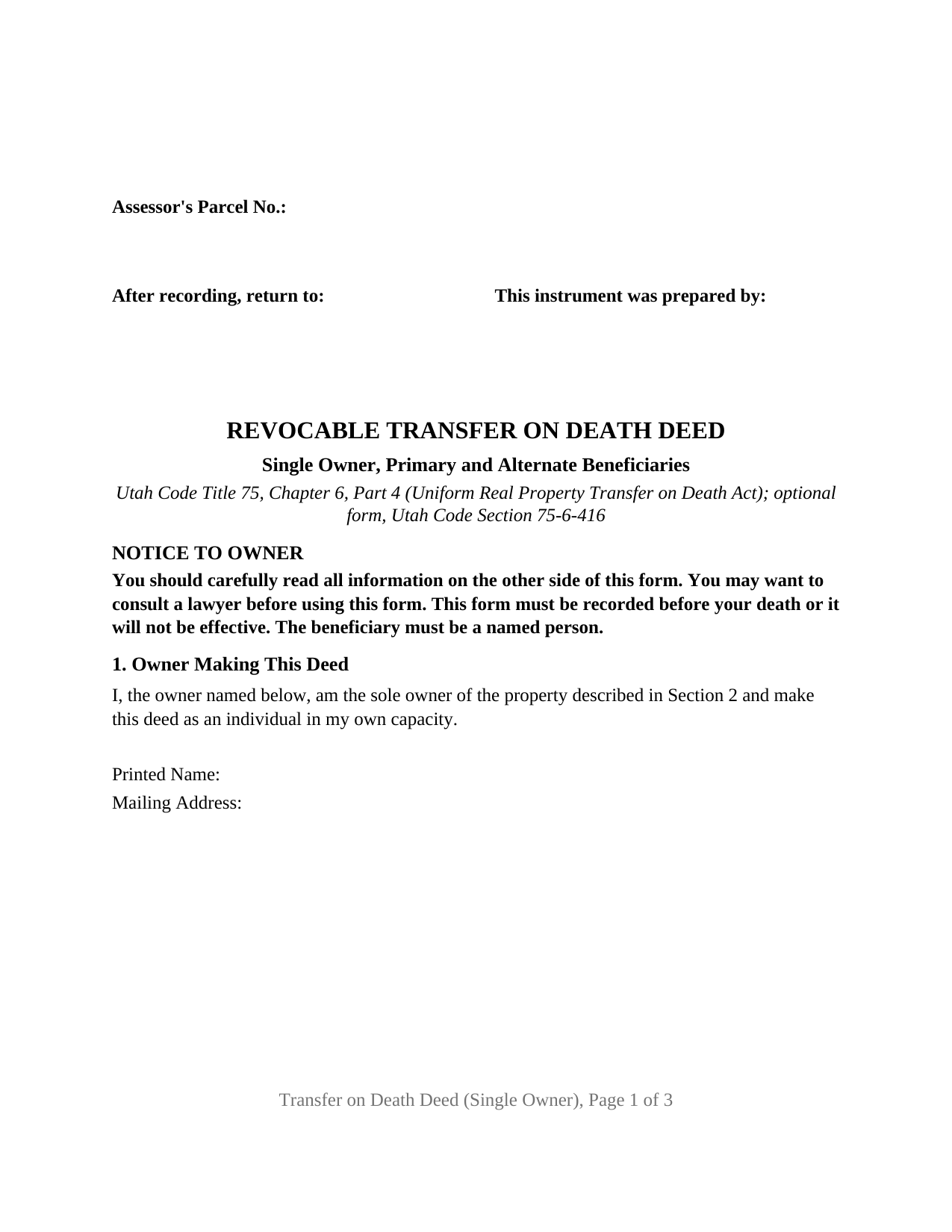
One Utah owner who holds real property alone can name, in a single recorded deed, the person who takes that property at the owner's death and a second person who takes only if the first does not survive. This Utah transfer on death deed is built for exactly that configuration: one owner, one primary beneficiary designation, and one alternate beneficiary designation, under the Uniform Real Property Transfer on Death Act, Utah Code Title 75, Chapter 6, Part 4.
One owner, one signature, one certificate
The form recites exactly one owner. Section 1 opens with a fixed sentence in which the signer states that the signer is the sole owner of the described property and makes the deed as an individual, followed by the owner's printed name and mailing address. The signature section carries one block captioned OWNER, and the deed closes with one acknowledgment certificate worded as the affidavit of acknowledgment in Utah Code Section 46-1-6.5(3), the certificate the statutory form directs the owner to attach. Nothing on the form asks about marital status, and no second owner block exists anywhere on the instrument.
Several ownership patterns appear in the record under this deed: an unmarried owner who bought alone, a married owner whose vesting deed names only that spouse, and a surviving joint tenant whose co-owner has died and whose termination affidavit under Section 57-1-5.1 is already of record. Two or more current record owners present a different pattern; under Section 75-6-413(3) the act applies its own rule to a joint owner's deed, and this form is not set up as a deed by co-owners, by an entity or a trustee, or by an attorney-in-fact.
A named alternate who takes only if the primary does not survive
The two beneficiary sections carry the statutory form's own sentences. The primary designation reads, I designate the following beneficiary if the beneficiary survives me; the alternate designation reads, If my primary beneficiary does not survive me, I designate the following alternate beneficiary if that beneficiary survives me. The act makes every designated beneficiary's interest contingent on surviving the owner (Section 75-6-413(1)(b)), and Section 75-2-702 measures survival by 120 hours unless the governing instrument says otherwise, so the alternate's role is defined by the deed's condition and the statute's survival rule together. Each box takes a printed name and a mailing address; a beneficiary may be an individual, a trust, or an entity, and the act does not allow a class gift such as a designation of the owner's children without naming them (Section 75-6-405(2)). Where a box names more than one beneficiary, Section 75-6-413(1)(c) supplies equal and undivided shares with no right of survivorship unless the deed specifies otherwise, and the form prints no selection among share arrangements.
What the owner keeps until death
A transfer on death deed, also searched as a TOD deed or beneficiary deed, changes nothing while the owner lives. Section 75-6-412 provides that during the transferor's life the deed does not affect the owner's interest or rights, the rights of the owner's creditors, or the owner's eligibility for public assistance, and that the beneficiary acquires no interest. The deed is revocable even if it says otherwise (Section 75-6-406), and the form's Section 5 states both halves of that bargain in the statutory form's words: the transfer of the owner's interest at death, and the owner's right to revoke before death. Revocation is by a later recorded instrument that satisfies Section 75-6-411, acknowledged after this deed and recorded before the owner's death; a note written on the deed, or a will, revokes nothing. At death the beneficiary takes the owner's interest subject to the mortgages, liens, and other interests then affecting the property, without covenant or warranty of title (Section 75-6-413).
Recorded before death, or not at all
Section 75-6-409 makes recording an effectiveness requirement: the deed is recorded before the owner's death in the office of the county recorder of the county where the property is located, and an unrecorded deed transfers nothing. The statewide recording fee under Section 17-71-407 is $40 for a document with up to ten legal descriptions, plus $5 in counties of the second through sixth class, and Utah collects no transfer tax and requires no transfer declaration with a deed. The deed's pages are built to the standards a Utah county may require under Section 17-71-402(4), with the upper right of page one left open for the recorder's stamp, one inch margins at the sides and bottom, and 12 point type throughout, and the county tax identification number sits on a line in the recording margin, where Section 17-71-402(5) permits it. After the owner's death, the act calls for an affidavit in the form of Section 57-1-5.1, with the death certificate attached, to be recorded against the property; that affidavit is prepared separately after the death and is not included in this package.
The package contains the fillable deed with its instructions cover page, a completed example of the same deed filled in for a fictional owner of a platted lot in Utah County naming one primary and one alternate beneficiary, and a seven page guide that walks through each section, the signing and notarization rules, and recording. This description and the guide describe the form and the governing Utah statutes in general terms; they are not legal advice and do not apply the law to any particular situation.
Important: County-Specific Forms
Our transfer on death deed (single owner, primary and alternate beneficiaries) forms are specifically formatted for each of the 29 counties in Utah.
After selecting your county, you'll receive forms that meet all local recording requirements, ensuring your documents will be accepted without delays or rejection fees.