Utah Transfer on Death Deed (Single Owner, One Beneficiary)
County Specific Legal Forms Validated as recently as November 23, 2026 by our Forms Development Team
About the Utah Transfer on Death Deed (Single Owner, One Beneficiary)
How to Use This Form
- Select your county from the list
- Download the county-specific form
- Fill in the required information
- Have the document notarized if required
- Record with your county recorder's office
What Others Like You Are Saying
"Quick, easy and the most resonably priced!"
"It was fast, secure, and reliable, and for the cost it saved me time, and driving four hours to the …"
"I ordered the wrong forms at first because I'm an idiot and didn't do my research. When I told the c…"
"Great forms! No issues at all at the recorder office. Will be back for sure if needed."
"The forms were easy to download and fill."
4.8/5 from 4,867 reviews. Read all
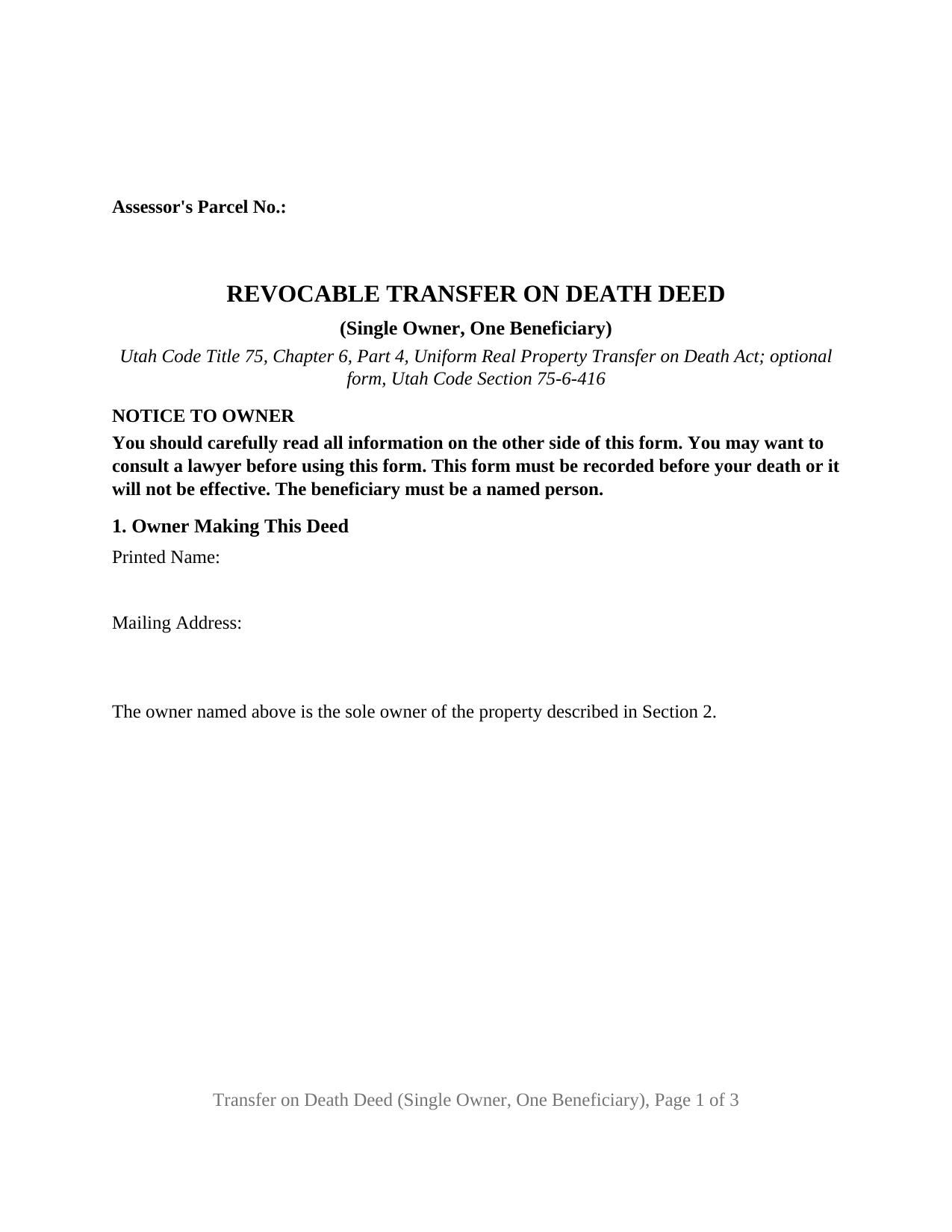
This Utah transfer on death deed is built around the simplest designation the Uniform Real Property Transfer on Death Act allows: one owner, the sole owner of the property, names one beneficiary to receive the property at the owner's death. The form prints no second owner block and no alternate beneficiary; it carries one owner signature line, one acknowledgment certificate, and one beneficiary name and mailing address.
One owner, one named beneficiary
The deed recites that the owner named in its first section is the sole owner of the described property, and the owner signs in an individual capacity. The beneficiary section opens with the statutory form's own sentence, I designate the following beneficiary if the beneficiary survives me, followed by a single printed name and mailing address. Under Utah Code Section 75-6-402(7) the one beneficiary may be an individual, a trust, or an entity, and under Section 75-6-405(2) the beneficiary is named individually rather than described as a class such as the owner's children.
A parent leaving a home to one adult child, a widowed owner naming a sibling, and an owner naming the trustee of a living trust all present the one-to-one pattern this deed recites. The form is not set up as a deed by two owners, by a trustee or an entity, or by an attorney-in-fact, and it is not set up to name several beneficiaries, shares, or an alternate; a co-owner's designation follows the act's joint owner rules in Section 75-6-413(3), under which a deed by a joint owner with right of survivorship takes effect only at the death of the last surviving joint owner.
What happens if the one beneficiary does not survive
Naming a single beneficiary with no alternate has one consequence the act spells out. Section 75-6-413(1)(b) makes the beneficiary's interest contingent on surviving the owner, and an interest that fails to survive lapses, a rule the subsection states notwithstanding Section 75-2-706. Survival is measured under Section 75-2-702's 120 hour rule unless the deed specifies a different period, which this form does not. If the one beneficiary dies first, the deed transfers nothing and the property remains in the owner's estate at death. Because the deed is revocable for the owner's whole life, an owner in that situation may record a new transfer on death deed naming someone else, which revokes the earlier deed to the extent of the inconsistency under Section 75-6-411.
The statute's own words on the page
Utah prints an optional transfer on death deed form in Section 75-6-416, repealed and re-enacted in 2024 with an effective date of May 1, 2024. The form is permissive, so this deed arranges its entries in numbered sections while carrying the statutory form's sentences wherever the form speaks: the Notice to Owner under the title, the beneficiary designation sentence, and the operative sentences, At my death, I transfer my interest in the described property to the beneficiaries as designated above, and, Before my death, I have the right to revoke this deed. Subsection 75-6-416(2) provides that the other sections of the act govern the effect of the form or any other instrument, so the deed's lifetime neutrality under Section 75-6-412, its revocability under Section 75-6-406, and its effect at death under Section 75-6-413 come from the statute rather than from anything the owner writes in.
The acknowledgment certificate is the affidavit of acknowledgment printed in Section 46-1-6.5(3), the certificate the statutory deed form directs an owner to attach, with the venue fixed as the State of Utah because it is a Utah notary's affidavit. The guide describes the path for an owner who signs in another state, where the officer's own certificate or the short form in Section 57-2a-7 is attached instead.
Recorded now, effective at death
A Utah TOD deed is effective only if it is recorded before the owner's death in the office of the county recorder of the county where the property is located; Section 75-6-409 makes that a requirement of the deed itself, and the Notice to Owner on the form repeats it. Nothing else is required to give the deed life: no notice to the beneficiary, no delivery, no acceptance, and no consideration. The parcel number line in the recording space at the top of the first page carries the county's tax identification number, which Section 17-71-402(5) allows in the margin of a recorded document, and the form is laid out to the format menu a Utah county may adopt under Section 17-71-402(4), with letter size pages, a 2.5 inch recording space, and 1 inch margins. The statewide recording fee under Section 17-71-407 is $40 for a document with up to ten legal descriptions, with an additional $5 collected in counties of the second through sixth class unless the county's restricted account is above its statutory threshold, and Utah imposes no transfer tax on a deed.
After the owner's death
The beneficiary takes the property subject to the mortgages, liens, and other interests affecting it at the owner's death, and without covenant or warranty of title. The transfer is completed of record by an affidavit in substantially the form in Section 57-1-5.1, with a copy of the death certificate attached and the entry number of the recorded deed cited, which is prepared and recorded separately after the owner's death and is not included in this package. Section 75-6-415 lets the estate, and only the estate, reach the transferred property where the probate estate cannot satisfy allowed claims or the statutory allowances to a surviving spouse or child, in a proceeding commenced within 12 months after the death.
The download contains the fillable deed with its instructions cover page, a completed example of the same deed by a fictional Utah County owner naming her son, and a seven-page guide to the form, the governing statutes, signing, and recording. The description above and the guide explain the form and Utah law in general terms; they are not legal advice and do not apply the law to any particular situation.
Important: County-Specific Forms
Our transfer on death deed (single owner, one beneficiary) forms are specifically formatted for each of the 29 counties in Utah.
After selecting your county, you'll receive forms that meet all local recording requirements, ensuring your documents will be accepted without delays or rejection fees.