Utah Transfer on Death Deed (Two Joint Owners, Last Survivor)
County Specific Legal Forms Validated as recently as November 23, 2026 by our Forms Development Team
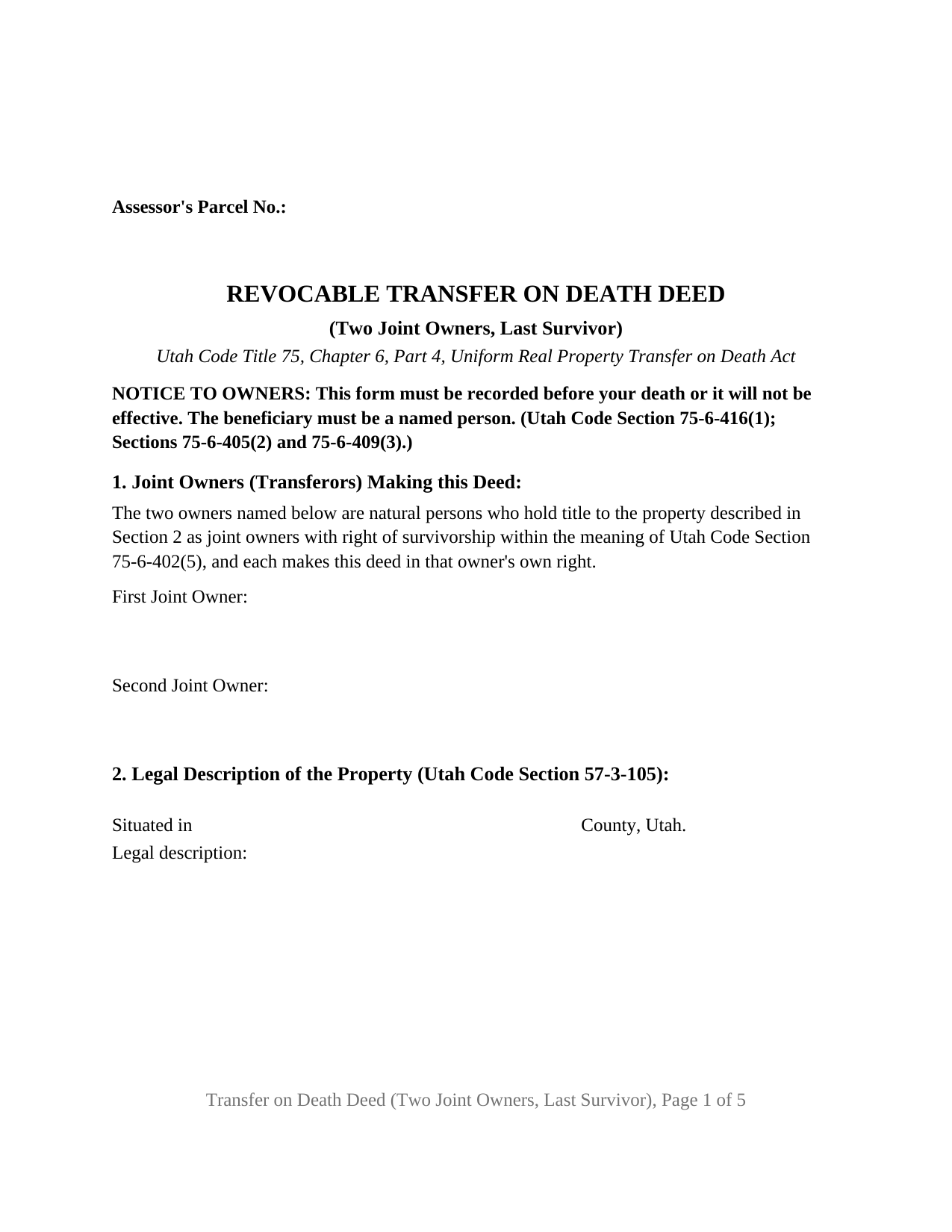
About the Utah Transfer on Death Deed (Two Joint Owners, Last Survivor)
How to Use This Form
- Select your county from the list
- Download the county-specific form
- Fill in the required information
- Have the document notarized if required
- Record with your county recorder's office
What Others Like You Are Saying
"The website was easy to navigate but only needed one form. The guide was helpful also. Cost want hig…"
"Website is very easy to navigate."
"Fast and friendly service. I will use Deeds.com again."
"Very good so far -- downloading all the forms. So many forms -- I had no idea ...."
"AMazing service. Fast and affordable."
4.8/5 from 4,867 reviews. Read all
A transfer on death deed signed by two joint owners in Utah does not operate at the first death. The survivorship already in the title carries the property to the surviving joint owner, and the deed waits for the second death to pass the property to the named beneficiaries. This Utah transfer on death deed is built for exactly that configuration: two joint owners with right of survivorship, both signing one instrument, with the transfer fixed at the death of the last surviving joint owner.
A deed that waits for the second death
While either joint owner lives, the survivorship in the title does the work. At the first death the property belongs to the surviving joint owner with right of survivorship, and the deed transfers nothing at that point. Utah Code Section 75-6-413(3) writes that sequence into the Uniform Real Property Transfer on Death Act: where a transferor is a joint owner survived by another joint owner, the property belongs to the survivor, and where the transferor is the last surviving joint owner, the deed is effective. The form states the same sequence as fixed deed text, so the recorded instrument says on its face which death it waits for, and a beneficiary's survival is measured from the last surviving joint owner.
Who the deed recites as owners
The form recites two natural persons who hold title as joint owners with right of survivorship within the meaning of Section 75-6-402(5) and who each make the deed in their own right. In Utah real property that is the joint tenancy with rights of survivorship of Section 57-1-5, the estate Utah presumes for an interest granted to two or more persons in their own right on or after May 1, 2024, and the estate into which Utah folds the tenancy by the entirety and community property labels. Spouses who hold as joint tenants and co-owners who are not married to each other present the same recited pattern; the form recites nothing about marital status, and a spouse who is not a joint owner has no signature line. The form is not set up for a tenant in common, whose undivided interest passes to that owner's own beneficiaries at that owner's death rather than to a surviving co-owner, for a sole owner, for three or more owners on one instrument, or for a trustee, an entity, or an owner acting through an attorney-in-fact.
Two signatures, two certificates, one revocation rule
Both owners sign, and the deed carries a separate acknowledgment certificate for each, worded as the affidavit of acknowledgment in Utah Code Section 46-1-6.5(3) that the act's optional form names, so the two owners can acknowledge on different dates, before different notaries, or in different counties. Revocation follows the act's joint owner rule: under Section 75-6-411(2) a transfer on death deed of joint owners is revoked only if it is revoked by all of the living joint owners, through an instrument acknowledged after the deed and recorded before death, and once the deed is recorded a revocatory act on the deed itself is ineffective. After the first death the surviving owner is the only living joint owner.
What the form carries from the statute
The deed prints the operative sentences of the optional statutory form in Section 75-6-416, re-enacted effective May 1, 2024: at my death, I transfer my interest in the described property to the beneficiaries as designated above, and before my death, I have the right to revoke this deed, each owner stating them in that owner's own right. It carries the form's notice that the deed must be recorded before death or it will not be effective and that the beneficiary must be a named person, the joint owner recital and last survivor statement that fix this configuration, primary and optional alternate beneficiary sections that take named individuals, trusts, or entities by name and mailing address, and a statement that the deed transfers the property without covenant or warranty of title, the rule of Section 75-6-413(4). Where two or more beneficiaries are named, the act transfers concurrent interests in equal and undivided shares with no right of survivorship and passes a lapsed share to the other beneficiaries; the form prints no selection among share or survivorship arrangements.
Recording in Utah
Recording before death in the office of the county recorder of the county where the property is located is an effectiveness requirement under Section 75-6-409(3), and the form keeps that notice on its first page. The statewide recording fee under Section 17-71-407, as amended in 2026, is $40 for a document with up to 10 legal descriptions, with an added $5 in counties of the second through sixth class; no transfer tax, consideration declaration, or cover sheet accompanies a Utah deed. The form is laid out to the format menu a Utah county may adopt under Section 17-71-402(4): letter-size pages, a 2.5 inch recording space across the top of the first page with the parcel number line at its left, 1 inch side and bottom margins, and 12 point type. The guide notes the published county differences, including Davis County's 3 inch first-page top margin.
The guide and the completed example
The seven-page guide walks the form in printed order with the completed example's entries beside each blank, and covers the statutory framework, how a vesting deed shows a joint tenancy, signing and remote notarization, the recording conditions of Sections 17-71-402 and 57-3-105, what the deed does not do, and the affidavit Section 75-6-413(5) calls for after the last owner's death, which is prepared separately and is not included. The completed example fills the form for two fictional joint owners of a Utah County lot, with the two acknowledgments taken on different dates in different counties before different notaries.
The package includes the fillable deed with its non-recorded instructions page, the completed example, and the guide. This description and the guide describe the form and the governing Utah statutes in general terms; they are not legal advice and do not apply the law to any particular situation.
Important: County-Specific Forms
Our transfer on death deed (two joint owners, last survivor) forms are specifically formatted for each of the 29 counties in Utah.
After selecting your county, you'll receive forms that meet all local recording requirements, ensuring your documents will be accepted without delays or rejection fees.