Wisconsin Grant Deed
County Specific Legal Forms Validated as recently as November 19, 2026 by our Forms Development Team
About the Wisconsin Grant Deed
How to Use This Form
- Select your county from the list
- Download the county-specific form
- Fill in the required information
- Have the document notarized if required
- Record with your county recorder's office
What Others Like You Are Saying
"Deeds.com is a wonderful resource providing helpful information, forms, examples, and instructions. …"
"Phenomenal service! If only every request and transaction with other companies could be this seamles…"
"Good, but make your PDFs convertible to Word or RTF."
"Well, we are 10 days from leaving the country for months and needed to notarize and record deed chan…"
"The whole experience was amazing. Your site was easy to work with and the staff was supper responsiv…"
4.8/5 from 4,861 reviews. Read all
The Wisconsin Grant Deed is a conveyance of real property under Chapter 706 of the Wisconsin Statutes. In its own operative words the grantor "grants and conveys" the described property and makes two express covenants, and the deed states that no other warranty or covenant is made. This download delivers one statewide version of the deed together with a guide and a completed example; there are no county-specific versions.
What the download includes
- Grant Deed Form: a four-page fillable PDF instrument, preceded by a one-page instructions cover sheet that is not part of the recorded deed.
- Grant Deed Guide: a section-by-section explanation of the deed, the signing and notarization steps, the real estate transfer return, and the recording process.
- Completed Example of the Grant Deed: the same deed filled in with sample entries, shown in blue italic type so each completed field can be compared with the blank form and the guide.
What the deed conveys and covenants
Wisconsin implies no warranty or covenant in any conveyance (Wis. Stat. 706.10(6)), so a Wisconsin deed carries only the covenants written on its face. This deed states two: that the grantor has not conveyed the same estate, or any interest in it, to anyone other than the grantee, and that the property is free from encumbrances made or suffered by the grantor, except as the deed itself states. The deed does not use the word "warrant", so the covenants of seisin, right to convey, freedom from all encumbrances, and defense of title that 706.10(5) reads into a deed that warrants the land are not part of it. The guide explains that the two stated covenants bind the grantor as written and describes the result as a deed positioned between a quitclaim deed and a full warranty deed.
The guide is equally direct about the deed's limits. It does not covenant that the grantor is seized of the land, has good right to convey, that the land is free from encumbrances created by others, or that the grantor will defend the title. Under 706.10(3) the deed passes whatever estate or interest the grantor holds, which may be less than the whole, and it does not clear existing liens or encumbrances; those remain on the property after the conveyance.
Parties the form is built for
The grantor and grantee blocks are open: nothing about marital status, vesting, or capacity is preprinted, and the names, any marital status recital, and any designation of how the grantees will hold title are entered in those fields. The form carries two grantor signature blocks, each followed by its own acknowledgment certificate in the Wisconsin short form for an individual capacity (Wis. Stat. 140.16(1)), and the guide describes it as serving one or two grantors signing in their own right as natural persons, conveying to one or two grantees.
The form is not set up as a conveyance by a corporation, limited liability company, partnership, or other entity; by a trustee; by a personal representative or other fiduciary; by an agent under a power of attorney; or by three or more grantors or to three or more grantees. The guide states that those configurations carry different recitals, signature capacities, and in some cases different acknowledgment forms, and are outside this form.
What the guide explains
Because the grantee designation is left open, the guide describes the Wisconsin forms of title that designation may name, such as tenancy in common, joint tenancy, marital property, survivorship marital property, individual property, and a life estate with remainder, with the words that create each and its effect. A related passage explains how Wisconsin's marital property system and the homestead signature rule of Wis. Stat. 706.02(1)(f) bear on which spouses sign, and how the second grantor block accommodates a spouse signing under those rules.
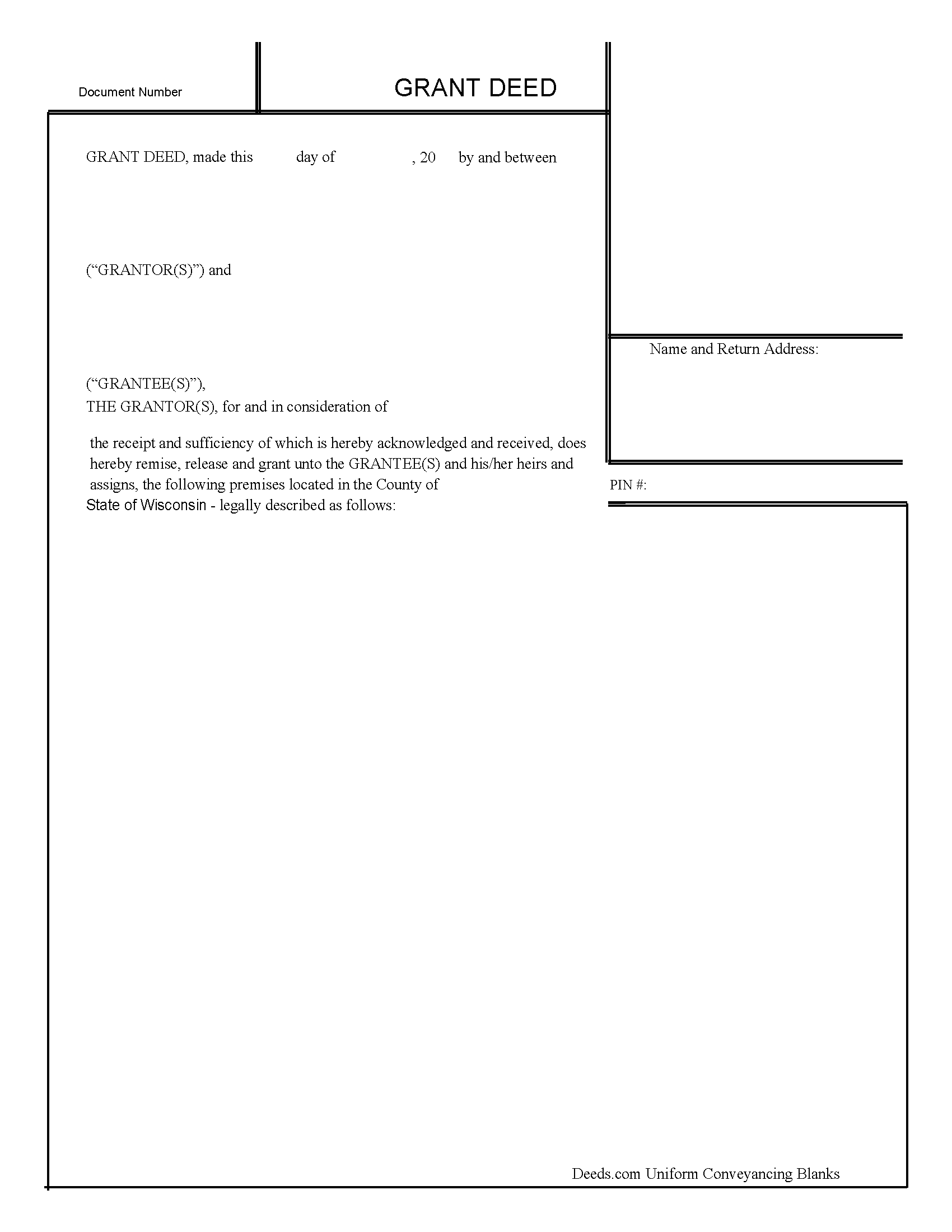
The guide's recording section covers recording with the register of deeds of the county where the property lies, the $30 recording fee for a document under Wis. Stat. 59.43(2), the standard document format of 59.43(2m), and the real estate transfer return and transfer fee that 77.22 makes prerequisites to recording. The deed carries a line for stating a 77.25 exemption on its face, and the guide explains that an exempt conveyance still files the electronic return. The deed's first page leaves its upper area blank for the register's recording information and carries the return-address and drafter blocks above the title; the guide describes this layout against the standard document format. The guide also describes the fillable PDF fields and printing the deed at actual size.
What the completed example shows
The example demonstrates the fullest pattern the form carries: two married grantors conveying a platted lot to two grantees designated as survivorship marital property in a sale, with every field completed, including the source-of-title recital, the encumbrances entry, a "Not exempt" entry on the transfer-fee line, and both acknowledgment certificates. The guide cross-references these entries section by section. The names, addresses, and recording data in the example are fictional.
Boundaries of this deed
The deed is a present conveyance. It is not a transfer on death beneficiary designation under Wis. Stat. 705.15, and it is not the real estate transfer return, which is filed separately with the Department of Revenue. Recording the deed does not by itself change the parcel's property tax classification, lottery and gaming credit, or assessment, and the deed does not release a spouse's homestead rights unless that spouse signs it.
This description and the included guide provide general information about the Wisconsin Grant Deed and are not legal advice.
Important: County-Specific Forms
Our grant deed forms are specifically formatted for each of the 72 counties in Wisconsin.
After selecting your county, you'll receive forms that meet all local recording requirements, ensuring your documents will be accepted without delays or rejection fees.