Cochise County Deed of Partial Release and Partial Reconveyance Form
Last validated September 4, 2026 by our Forms Development TeamFormatted for recording in Cochise County, for property anywhere in the county: rural and unincorporated areas as well as Benson, Bisbee, Bowie, Cochise, Douglas, Dragoon, Elfrida, Fort Huachuca and 12 more.
- 3 documents included
- Immediate PDF download
- Formatting guarantee
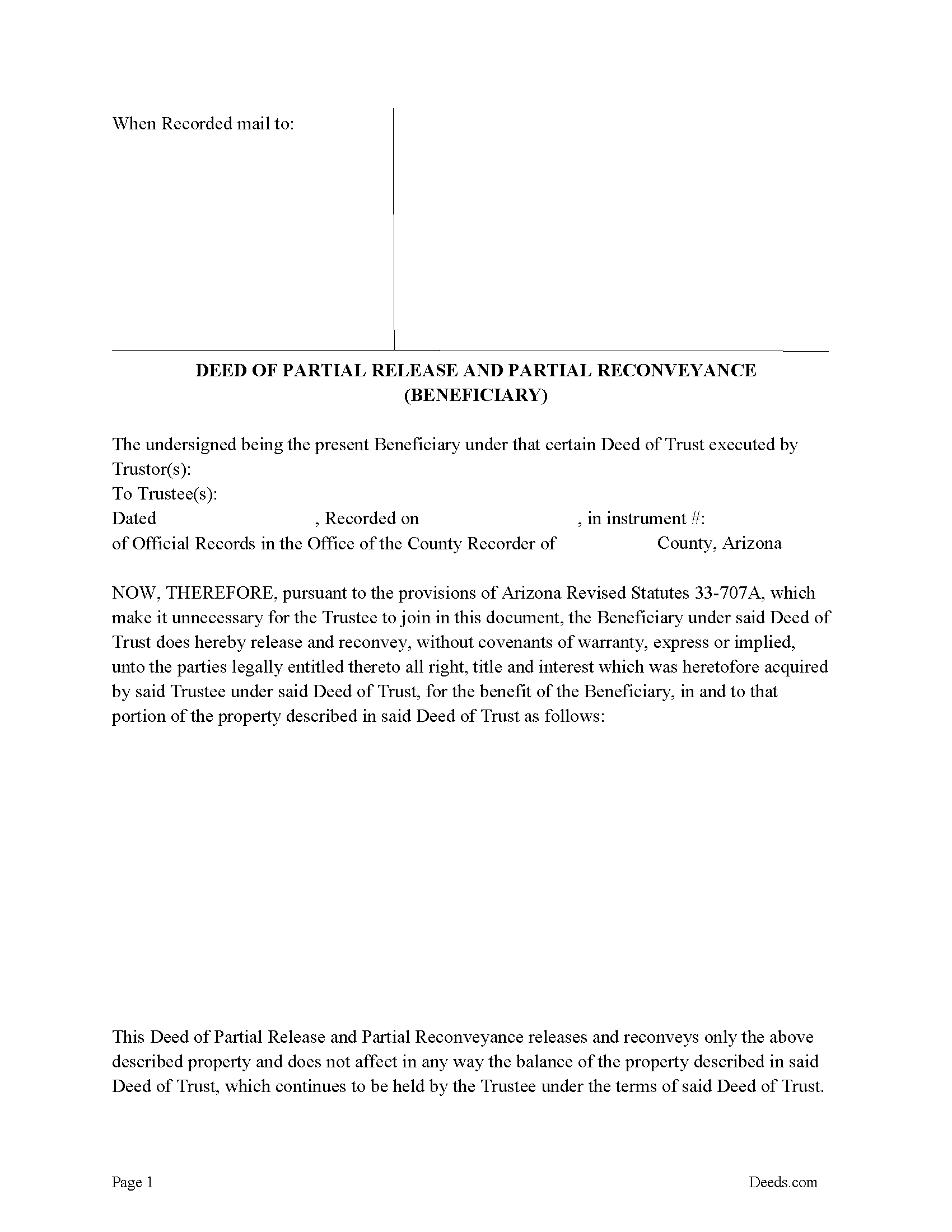
Cochise County Deed of Partial Release and Partial Reconveyance Form
Fill in the blank form formatted to comply with all recording and content requirements.
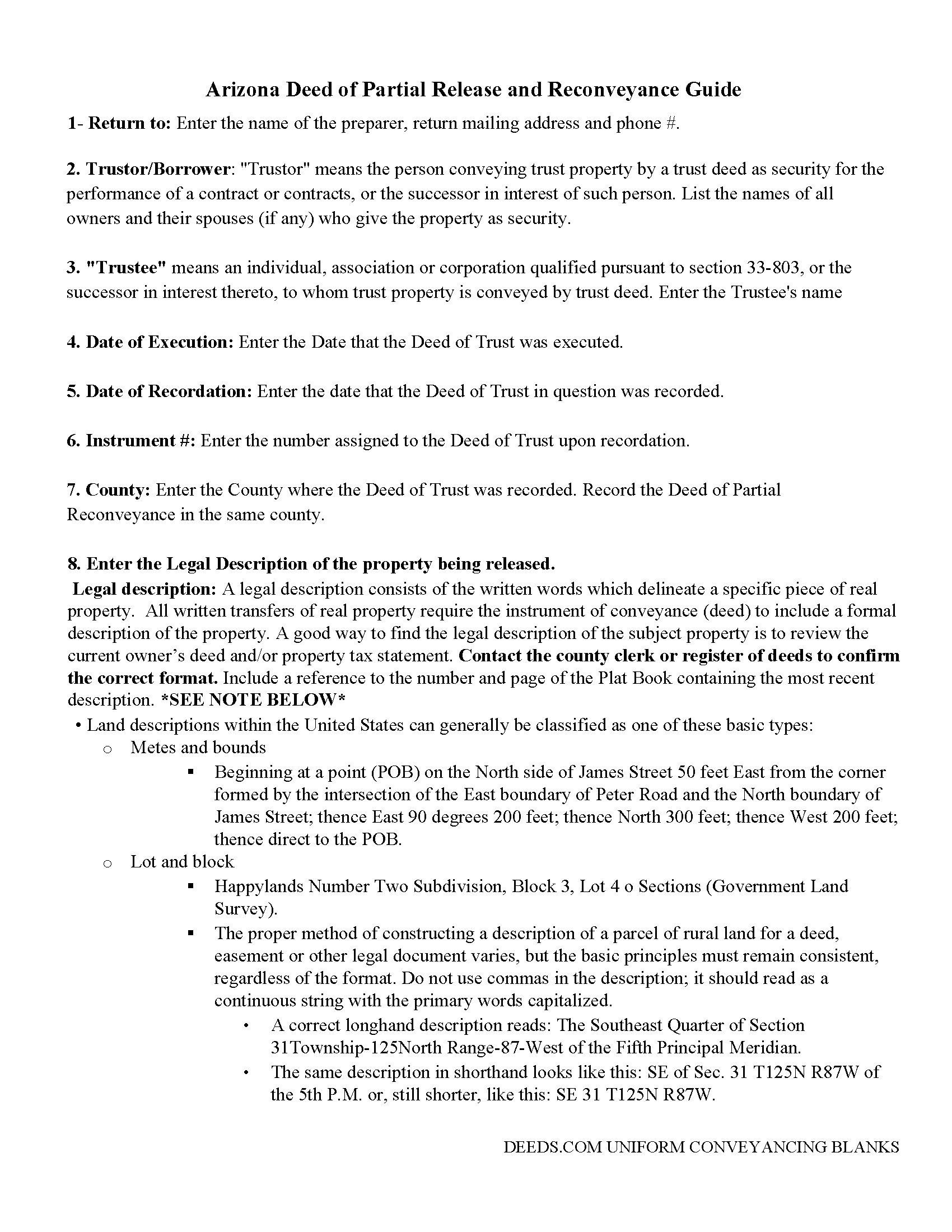
Cochise County Guidelines for Deed of Partial Release and Partial Reconveyance
Line by line guide explaining every blank on the form.
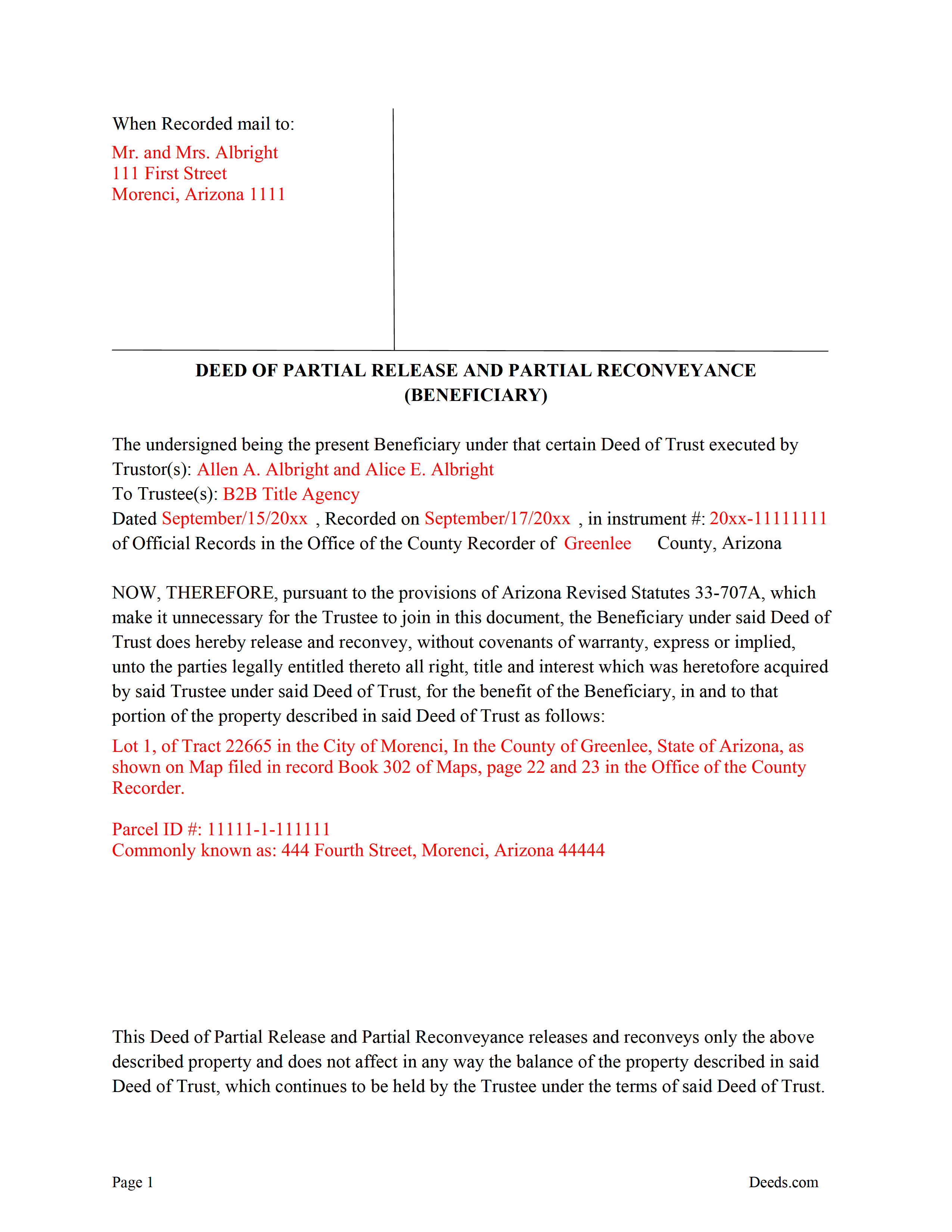
Cochise County Completed Example of the Deed of Partial Release and Partial Reconveyance Document
Example of a properly completed form for reference.
All 3 documents above included • One-time purchase • No recurring fees
Immediate Download • Secure Checkout
Additional Arizona and Cochise County documents included at no extra charge:
Where to Record Your Documents
Recorder's Office
Bisbee, Arizona 85603
Hours: 8:00am - 5:00pm Monday - Friday
Phone: 520-432-8350
Recording Tips for Cochise County:
- Bring your driver's license or state-issued photo ID
- Ensure all signatures are in blue or black ink
- Ask if they accept credit cards - many offices are cash/check only
- Check that your notary's commission hasn't expired
- Documents must be on 8.5 x 11 inch white paper
Cities and Jurisdictions in Cochise County
Properties in any of these areas use Cochise County forms:
- Benson
- Bisbee
- Bowie
- Cochise
- Douglas
- Dragoon
- Elfrida
- Fort Huachuca
- Hereford
- Huachuca City
- Mc Neal
- Naco
- Pearce
- Pirtleville
- Pomerene
- Saint David
- San Simon
- Sierra Vista
- Tombstone
- Willcox
Hours, fees, requirements, and more for Cochise County
How do I get my forms?
Forms are available for immediate download after payment. The Cochise County forms will be in your account ready to download to your computer. An account is created for you during checkout if you don't have one. Forms are NOT emailed.
Are these forms guaranteed to be recordable in Cochise County?
Yes. Our form blanks are guaranteed to meet or exceed the applicable formatting requirements used for recording in Cochise County, including margin requirements, font requirements, and other layout standards. This guarantee applies to formatting, not to the legal sufficiency of information entered by the user or the suitability of a form for a particular transaction.
Can I reuse these forms?
Yes. You can reuse the forms for your personal use. For example, if you have multiple properties in Cochise County you only need to order once.
What do I need to use these forms?
The forms are PDFs that you fill out on your computer. The free Adobe Acrobat Reader is recommended, and most PDF apps also work. You do NOT enter your property information online - you download the blank forms and complete them privately on your own computer.
Are there any recurring fees?
No. This is a one-time purchase. Nothing to cancel, no memberships, no recurring fees.
How much does it cost to record in Cochise County?
Recording fees in Cochise County vary. Contact the recorder's office at 520-432-8350 for current fees.
Questions answered? Let's get started!
The Arizona Deed of Partial Release and Partial Reconveyance is the recorded instrument used to release a specified portion of a property from the lien of a deed of trust while leaving the deed of trust in effect as to the remaining property. Arizona law at ARS 33-707 lets the beneficiary execute this release without the trustee's joinder — an efficiency that matters in practice because the named trustee on an older deed of trust may be difficult to locate or no longer in active practice. The instrument's working feature is precision of scope: it releases only the described portion, and it expressly preserves the deed of trust's continuing force against the balance. That precise scoping is what distinguishes a partial release from a full release, and it is the point where drafting mistakes can inadvertently convert a partial release into something much broader than the parties intended.
When the Arizona Deed of Partial Release and Partial Reconveyance Is Used
Partial releases come up whenever a deed of trust encumbers more property than needs to remain encumbered at a particular moment. Typical scenarios include a subdivision developer selling individual lots from a tract covered by a blanket construction loan, where each lot must be released as it sells; a landowner selling one parcel out of a larger ranch that is collateral for a single loan, with the sale proceeds either paying down the loan or going to the seller subject to the lender's consent; a commercial borrower spinning off a portion of a campus or facility to a new owner while keeping the balance under the same financing; a subdivider releasing common areas or HOA parcels from the original development financing so they can be conveyed to the homeowners' association; lot-line-adjustment and easement transactions where a sliver of property is being reconfigured and needs to come out from under the existing security; and seller-financed transactions where the seller has agreed to release specific parcels on payment milestones rather than waiting for the full loan to be satisfied.
Why Partial Releases Are Common in Arizona Development Practice
Arizona's development patterns — master-planned communities, large subdivisions, commercial parks, ranches divided for estate sale — produce frequent situations where a blanket loan covers a large tract and the borrower needs to convey pieces of it over time. Construction lenders typically address this by building release provisions directly into the loan documents: the deed of trust provides that upon payment of a specified release price per lot (or per acre, or per square foot), the beneficiary will execute a partial release for the specified parcel. The partial release form then implements that obligation when each trigger occurs. Without a working release mechanism, the developer's business model breaks — every sale would require refinancing the entire loan or obtaining ad hoc lender consent, which would be economically impossible at subdivision scale. The partial release is therefore not a specialty instrument but a routine working document in Arizona real estate and construction finance.
ARS 33-707 — Beneficiary Signs Without the Trustee
ARS 33-707 authorizes the beneficiary to execute and record a partial release and partial reconveyance without the trustee joining in the execution or acknowledgment. The recorded instrument is effective to release the described property from the deed of trust, and like a full release under the same statute, it carries conclusive-evidence status in favor of subsequent purchasers and encumbrancers for value without actual notice. The policy behind the rule is practical: the beneficiary is the party whose security is being partially released, and the trustee's role is a neutral one that does not add meaningful protection against improper releases (the trustee would only release on the beneficiary's instruction anyway). Eliminating the trustee's joinder requirement speeds the process and avoids the recurring problem of trustee unavailability on older deeds of trust where the named trustee has retired, changed firms, or died.
The form should expressly recite its reliance on ARS 33-707 and the consequent non-participation of the trustee. That recital protects the release against later challenges on the ground that the trustee did not join — a challenge that might otherwise come from someone unfamiliar with Arizona's specific statutory permission.
Describing What Is Released and What Remains
The drafting core of a partial release is the precise identification of the portion being released and the precise preservation of everything that is not being released. The released portion is described by its own full legal description — the lot and block of the specific lot within a recorded subdivision, or the metes-and-bounds description of the specific parcel being carved out, or the reference to a recorded survey of the released area. The release then recites that the remaining property described in the original deed of trust continues to be subject to the deed of trust, unaltered. Both descriptions need to be correct; both need to match the structure of the original deed of trust; and neither should be drafted so loosely that the effective scope of the release becomes ambiguous.
Common drafting errors in this area are expensive. A partial release that inadvertently describes all the property rather than just the released portion functions as a full release, discharging the beneficiary's entire security — a catastrophic outcome if the beneficiary intended to keep the deed of trust in place against the balance. A partial release that describes the released parcel by address or approximate description rather than by legal description may create ambiguity about exactly what comes out, and title companies insuring the buyer of the released parcel will not accept ambiguity. A partial release that describes the released portion correctly but fails to preserve the continuing lien against the balance may raise questions about the beneficiary's intent — generally resolved in favor of the balance continuing to be encumbered, but with more friction than careful drafting would have created.
Release Prices and Lender Conditions
Most partial releases are conditional — the beneficiary agrees to release specific property only on payment of a release price, reduction of the principal balance of the loan, or other agreed consideration. The mechanics of how the release price is paid and credited should be coordinated between the loan documents and the release instrument. In development financing, a typical arrangement is that a percentage of the sale proceeds for each lot goes to the lender as a release price (often 110 or 115 percent of the pro-rata loan balance attributable to that lot, to ensure the lender's overall coverage ratio remains acceptable), with the lender executing the release on receipt. For seller-financed transactions releasing parcels on milestones, the release conditions are negotiated at closing and memorialized in the deed of trust's partial release provisions. The partial release instrument itself typically does not spell out the release conditions — those are in the underlying loan documents — but the execution of the release is the beneficiary's confirmation that the conditions have been satisfied.
Effect on Continuing Security and Priority
After recording, the partial release removes the specified property from the deed of trust's lien but does not otherwise affect the deed of trust's priority, terms, or enforceability against the balance. The remaining property continues to secure the remaining loan balance on the same terms. The beneficiary's priority against the remaining property continues as of the original recording date of the deed of trust, not as of the date of the partial release — the partial release does not create a new lien or reset priority. This continuity matters particularly in transactions where junior liens have been recorded against the remaining property in the interval: those junior liens remain junior to the deed of trust's original priority, and the partial release does not disturb that relationship.
Coordination with the Underlying Transaction
A partial release is almost always executed in coordination with an underlying transaction — a sale, a refinance of the released portion, a transfer to an affiliate. The timing and mechanics of recording matter. The buyer of the released parcel typically wants the partial release recorded before (or simultaneously with) the deed into the buyer, so that the buyer takes title free of the deed of trust lien. Title insurance is almost always involved, and the insurer coordinates the release, the deed, and any new security instrument being recorded into a single ordered closing. A partial release that is recorded after the deed into the buyer leaves a brief period in the chain where the buyer appears to have taken title subject to the deed of trust — a technical issue that can usually be resolved but is avoided by recording in the correct order.
Execution and Acknowledgment
Under ARS 33-401 and 33-707, the partial release must be in writing, subscribed by the beneficiary, and acknowledged before a notary public or other officer authorized to take acknowledgments. Arizona does not require subscribing witnesses. Acknowledgments taken outside Arizona must comply with ARS 33-501. Institutional lenders typically execute partial releases from their out-of-state servicing offices, and the acknowledgment must satisfy Arizona's foreign-acknowledgment rules to be recordable.
Affidavit of Property Value Exemption
Arizona requires an Affidavit of Property Value to accompany most instruments affecting interests in real property (ARS 11-1133), but a partial release of a deed of trust is exempt under ARS 11-1134 because no property is being transferred — the instrument is releasing a security interest as to a described portion, not conveying the fee. The exemption should be claimed on the face of the release with a statement that the transfer is exempt and a citation to the specific exemption subsection, placed below the legal description of the released portion. Partial releases that omit the exemption recital are routinely rejected at the recorder's window even though the transaction plainly qualifies.
Formatting and Recording
ARS 11-480 sets the formatting requirements for every recordable instrument: legible type of at least ten points, white paper no larger than 8.5 by 14 inches, a caption identifying the document (for example, "Deed of Partial Release and Partial Reconveyance"), a top margin of at least two inches on the first page reserved for the recorder's stamp, and minimum half-inch margins elsewhere. Record the partial release in the county where the original deed of trust was recorded. When the deed of trust was recorded in more than one county, the partial release should be recorded in each county where the released portion is situated — a blanket deed of trust covering property in multiple counties may require coordinated recordings. Confirm current recording fees and accepted forms of payment with the county recorder's office in advance, and verify that the release has actually been indexed rather than relying on a drop-off or mailing receipt.
What's Included in the Download Package
The Arizona Deed of Partial Release and Partial Reconveyance package includes the release form drafted around ARS 33-707 with the statutory authority for the beneficiary to execute without trustee joinder and language preserving the continuing force of the deed of trust against the balance of the property, detailed guidelines covering the Arizona-specific drafting and recording requirements, and a completed example showing how the form should look for a typical partial release. All files are available for instant download after purchase.
Important: Your property must be located in Cochise County to use these forms. Documents should be recorded at the county recording office listed above.
This Deed of Partial Release and Partial Reconveyance meets all recording requirements specific to Cochise County.
Our Promise
The documents you receive here are guaranteed to meet or exceed the applicable Cochise County recording format requirements. If there is a rejection caused by our formatting, we will correct the issue or refund your payment. This guarantee applies to document formatting only and does not extend to information entered by the user, the selection of the form, or the legal effect of the completed document.
Save Time and Money
Get your Cochise County Deed of Partial Release and Partial Reconveyance form done right the first time with Deeds.com Uniform Conveyancing Blanks. At Deeds.com, we understand that your time and money are valuable resources, and we don't want you to face a penalty fee or rejection imposed by a county recorder for submitting nonstandard documents. We constantly review and update our forms to meet rapidly changing state and county recording requirements for roughly 3,500 counties and local jurisdictions.
4.8 out of 5 - ( 4,824 Reviews )
Janna V. 4 out of 5 stars
Very easy process!
Thank you!
Linda H. 5 out of 5 stars
This was so easy to download, open the files and then complete the document on the computer then printing out. I waited to review this until we took it to Courthouse for the Recorder of Deeds and the legal task is now done. An attorney would probably have charge $300. This is a real deal packet!
Thanks for sharing your experience, Linda. It’s great to hear the documents were easy to complete and accepted by the recorder with no issues.
Katherine W. 5 out of 5 stars
I was impressed by the completeness of the package of forms PLUS instructions. Particularly helpful is the filled in sample, which enables you to see what a correct, completed deed ought to look like.
We appreciate your business and value your feedback. Thank you. Have a wonderful day!
richard E. 5 out of 5 stars
First time I used service. It was simple to use. The response time was excellent. I look forward to using them in the future.
That's awesome Richard, glad we could help!
Diana B. 5 out of 5 stars
Really can't say enough good things about these deed forms and the related material. Just having the formatting done saves possibly hours of work. County seems to love these forms also (they referred me to Deeds.com). All around great great great!
Thank you!
ALI T. 5 out of 5 stars
It is very easy to use Deeds.Com to perform eRecording. The case staff are very professional and punctual. My eRecording package was completed within a day where it usually takes months. Thank You
We appreciate your business and value your feedback. Thank you. Have a wonderful day!
Darrell G. 5 out of 5 stars
Very easy to work with.
Thank you!
Russell B. 5 out of 5 stars
complete package as promised at a very reasonable cost. Easy forms to complete. Thank you. Definitely 5 stars!!!
Thank you for your feedback. We really appreciate it. Have a great day!
Ben F. 5 out of 5 stars
My initial review during download and before reading the guide and forms looks promising.
Thank you!
Thomas W. 5 out of 5 stars
A great way to access form knowledge
Thank you!
David K. 3 out of 5 stars
Price seemed high (~$28) for just some forms (especially because we may not actually use the forms), but it beats navigating the Hawaii state and Honolulu county websites for forms. It would be better if a single button push would download all 7 or 8 forms.
Thank you for your feedback. We really appreciate it. Have a great day!
Pouya N. 5 out of 5 stars
THEY ARE AWSOME. MAKE IT REALLY EASY AND EFFICIENT TO WORK. THANK YOU
We appreciate your business and value your feedback. Thank you. Have a wonderful day!
William C. 5 out of 5 stars
Excellent, easy to use. Technically accurate in all information offered.
Thank you!
leila m. 5 out of 5 stars
Very good service, friendly customer service I absolutely will use the service again
Thank you!
Allen P. 5 out of 5 stars
Information very useful and helpful. It would be helpful to inform purchasers that legal size paper is needed to print documents. We had to run to the store and purchase some.
Thank you for your feedback. We really appreciate it. Have a great day!