California Revocable Transfer on Death Deed (Entity Beneficiary)
County Specific Legal Forms Validated as recently as September 16, 2026 by our Forms Development Team
About the California Revocable Transfer on Death Deed (Entity Beneficiary)
How to Use This Form
- Select your county from the list
- Download the county-specific form
- Fill in the required information
- Have the document notarized if required
- Record with your county recorder's office
What Others Like You Are Saying
"Excellent Service Terrific Follow Up and Follow Throught"
"No review provided."
"Quit Claim deed for North Carolina did not include all of the information I needed (two separate not…"
"I was skeptical when I first came upon this website. Not sure why I had such a negative feeling, but…"
"Good service, great price, the website is a bit hard to maneuver in places."
4.8/5 from 4,818 reviews. Read all
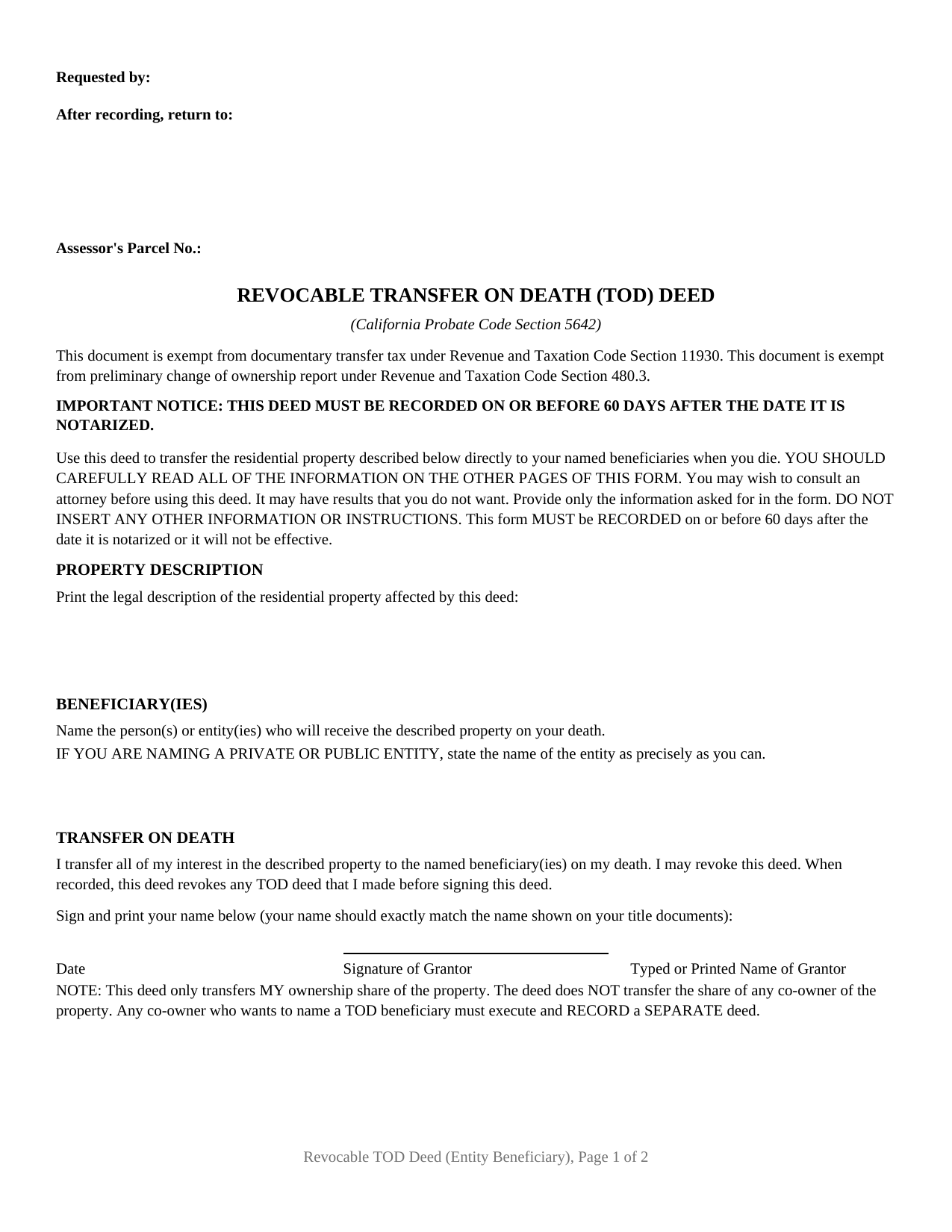
A land conservancy, a parish, a college foundation: any can be the taker under a California transfer on death deed, and the deed identifies the one it names by a single thing, its own name. This package prepares the Probate Code Section 5642 statutory form in that configuration: one owner signing, one private or public entity in the beneficiary entry. Californians look for the instrument as a TOD deed or a beneficiary deed.
Precision in the name is the whole designation
Probate Code Section 5608 settles who may take: a natural person, trust, or legal entity may be named as a beneficiary. For an entity the form asks one thing: that the entity be named as precisely as the person completing the deed can name it. The entry takes the legal name in the organizing documents or the Secretary of State's records, corporate suffix and all, not a program name or a fundraising alias. The form's opening instruction bars other information: no address line, no officer line, no conditions to write in. Where a name still proves imprecise, Section 5659 leaves an ambiguity in designating a beneficiary open to judicial construction where a court can determine the transferor's intention.
An institution can outlive an owner, or not
Section 5652(a)(2) conditions a beneficiary's interest on surviving the transferor, and institutions fail it in their own ways, by dissolving or merging into something larger. The form prints no alternate taker and forbids adding one, so the remedy sits in the chapter. Section 5658 permits the court administering the transferor's estate, on a petition or on its own motion, to apply the doctrine of cy pres to reform a deed made for a charitable purpose, in either of two circumstances the section lists, one of them a beneficiary that is a legal entity dissolved or merged into another entity before the death. A noncharitable entity designation has no comparable statutory repair.
One owner, one row, one certificate
A single transferor executes this instrument. Section 5642(a) prints the signing area as one captioned row, date beside signature beside printed name, and the note under it holds the deed to the signer's ownership share, sending a co-owner who wants a beneficiary to a separate deed. The form is built to that shape: one row, two witness columns, one acknowledgment certificate, no second owner block. An owner leaving a house to a neighborhood nonprofit, and an owner naming a public agency or a religious corporation, present the single-entity designation this deed recites. A natural person or trust taker follows another of the statute's conventions.
Witnesses, a notary, and sixty days
Section 5624 puts two witnesses in the room at once, each signing after watching the transferor sign or hearing the transferor own that signature; nothing they sign is notarized. From the date of the transferor's acknowledgment Section 5626 counts sixty days, and recording inside that window is a condition of the deed operating at all. Section 5656 keeps the filing clear of documentary transfer tax and of a preliminary change of ownership report; the two recitals near the top of the form say so.
What the entity would receive
Whatever the owner holds at death, as title then stands. Section 5652 passes the property with no covenant or warranty and subject to each limitation of record at that death, so a deed of trust or an easement rides along. Section 5664 can wipe the designation out: title held at death in joint tenancy or as community property with right of survivorship voids the deed, and survivorship carries the interest. Section 5672 then makes a beneficiary personally liable for the transferor's unsecured debts, capped by Section 5674(b) at the death value net of liens and removed by Section 5674(a) where administration of the transferor's estate is commenced and the beneficiary complies with Section 5677 or Section 5678.
Recording goes to the recorder of the county holding the parcel, on a first page laid out to Government Code Section 27361.6, the title placed for indexing under Section 27324; fees vary by county. After the death the taker records evidence of death, notifies the heirs, and files a change in ownership statement, each handled separately, none of it in this package.
The package holds the blank fillable deed, a completed example built on a Mendocino County fact pattern naming one nonprofit public benefit corporation, and the guide covering the form part by part. Both describe the form and the governing California statutes in general terms; neither is legal advice.
Important: County-Specific Forms
Our revocable transfer on death deed (entity beneficiary) forms are specifically formatted for each of the 58 counties in California.
After selecting your county, you'll receive forms that meet all local recording requirements, ensuring your documents will be accepted without delays or rejection fees.