California Revocable Transfer on Death Deed (Multiple Individual Beneficiaries)
County Specific Legal Forms Validated as recently as September 16, 2026 by our Forms Development Team
About the California Revocable Transfer on Death Deed (Multiple Individual Beneficiaries)
How to Use This Form
- Select your county from the list
- Download the county-specific form
- Fill in the required information
- Have the document notarized if required
- Record with your county recorder's office
What Others Like You Are Saying
"Seems fairly simple with forms and instructions"
"I love how quick the turnaround is, my only request would be for an email notification be sent once …"
"I was very pleased with the service and the product. All the extras were a nice addition to my order…"
"Very quick and simple process! Will be using this service much more."
"A little difficult in the beginning but with the messaging back and forth it was very simple and fas…"
4.8/5 from 4,815 reviews. Read all
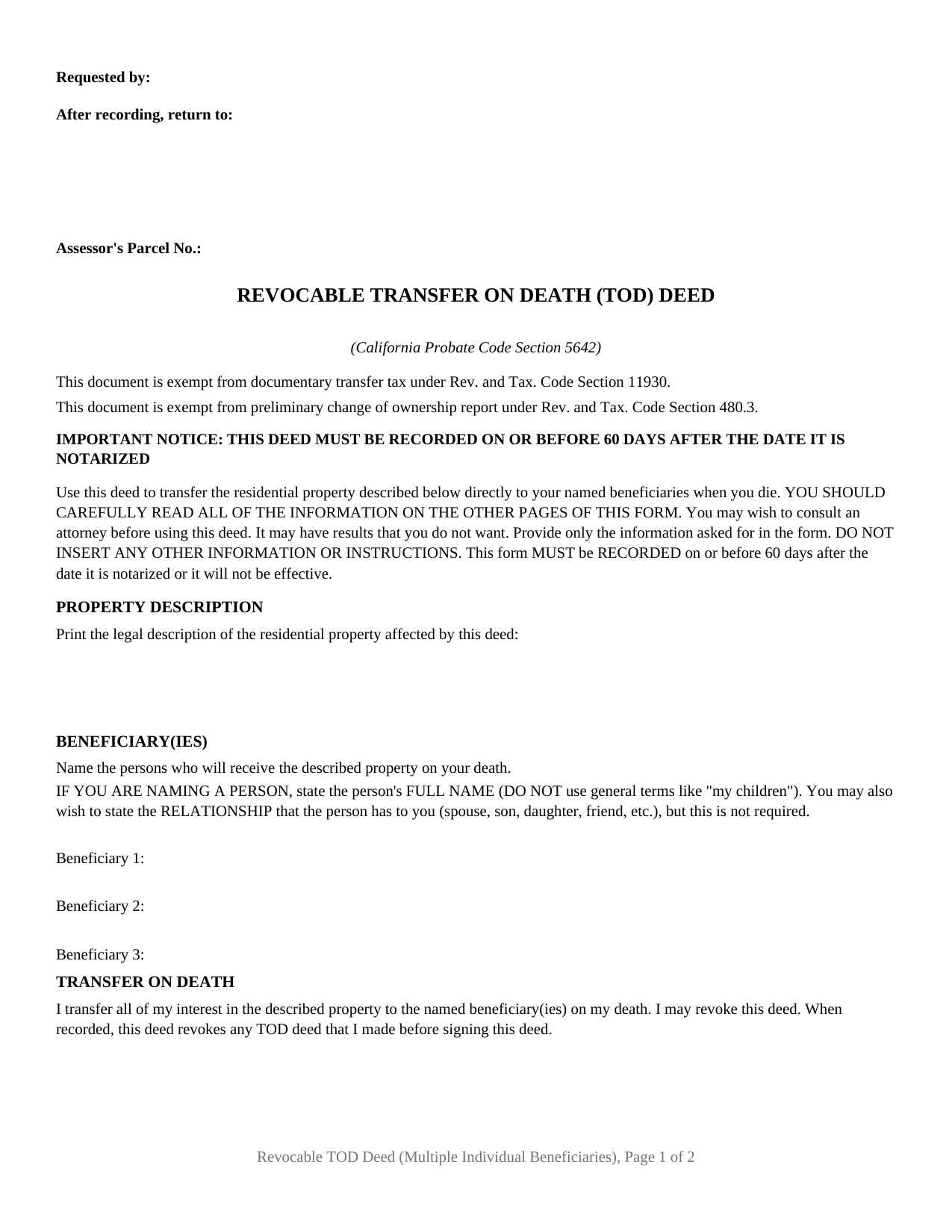
Three names on one page, and the California Probate Code settles the rest. This California revocable transfer on death deed is the Probate Code Section 5642 statutory form in its multiple individual beneficiary configuration: one record owner, a beneficiary section of three entry lines, one named individual to a line, and nothing to fill in about shares, alternates, or conditions. The instrument is also searched as a California TOD deed or a beneficiary deed.
Three lines, three names, one signature
The beneficiary section is where this deed parts company with the rest of its family. It prints three individual entry lines under the statute's own naming instruction for a person: full name, no general term such as a reference to children, and the relationship to the owner stated or left out. Two names fill the section as readily as three, and an unused line simply stays empty. On the signing side there is exactly one of everything. Section 5642 prints its signature block as a captioned row, Date and Signature of Grantor and Typed or Printed Name of Grantor, and one acknowledgment certificate follows it. A parent dividing a residence among adult children, and an owner naming two siblings, present the pattern this deed recites. A designation naming a trust or an entity is outside what this form carries, and a co-owner's share travels on its own deed, as the note under the signature row says.
Equal shares, fixed by the chapter rather than by the deed
Because the form states no fractions, Probate Code Section 5652 supplies them: two or more beneficiaries take as tenants in common in equal shares. Three named individuals become three co-owners of undivided thirds at the owner's death, each share then passing under its own owner's estate plan, with no survivorship running among them. Nothing on the form sets a different split, and the statutory common questions say plainly that the form produces no other result.
What the chapter does when a beneficiary dies first
The same section answers the question that naming several people raises. Each interest is contingent on surviving the transferor. A share that lapses is divided equally among the beneficiaries who do survive, which is why the deed carries no alternate line: with two or three names on the instrument, the substitution the statute writes already runs among them. Where none of the named individuals outlives the owner, the deed has no effect.
Formalities the names do not change
Two signing requirements ride with this instrument whatever the beneficiary count. Under Probate Code Section 5624 two witnesses, together at one time, sign after watching the owner sign or hearing the owner acknowledge that signature, and no notary touches their signatures. Under Probate Code Section 5626 the deed takes effect only on recording within 60 days measured from the notarial acknowledgment. The two tax recitals the form prints rest on Probate Code Section 5656: recording this deed is no change in ownership, so no transfer tax declaration and no preliminary change of ownership report accompany it.
Limits every taker inherits
Each named individual takes the title as it stands. Section 5652 passes the property without covenant or warranty and subject to recorded liens, encumbrances, easements, and leases, so a mortgage rides along and is shared among the takers. Section 5664 voids the deed where title is held in joint tenancy or as community property with right of survivorship at the owner's death, and survivorship controls in its place. Section 5610 keeps the chapter to residential property of one to four dwelling units, or a residential unit in a common interest development, and shuts out agricultural parcels over 40 acres. Section 5672 reaches the takers for the transferor's unsecured debts, capped by Section 5674 at the value of what each received less the liens then on the property, and lifted under Section 5674(a) where estate administration is opened and the beneficiary satisfies Section 5677 or Section 5678.
Recording happens with the recorder of the county where the property sits, on a first page built to the reserve Government Code Section 27361.6 sets aside, the statutory title printed below it for indexing under Section 27324. Fees vary by county. The package holds the fillable form, a completed example worked through a Placer County fact pattern with three named individuals, and the guide that covers the form part by part. This description and that guide describe the form and the governing California statutes in general terms; they are not legal advice.
Important: County-Specific Forms
Our revocable transfer on death deed (multiple individual beneficiaries) forms are specifically formatted for each of the 58 counties in California.
After selecting your county, you'll receive forms that meet all local recording requirements, ensuring your documents will be accepted without delays or rejection fees.