California Revocable Transfer on Death Deed
County Specific Legal Forms Validated as recently as September 15, 2026 by our Forms Development Team
About the California Revocable Transfer on Death Deed
How to Use This Form
- Select your county from the list
- Download the county-specific form
- Fill in the required information
- Have the document notarized if required
- Record with your county recorder's office
What Others Like You Are Saying
"Very fast and smooth process, thank you for your quick answers and follow up."
"Great service and all seems to be what I was looking for"
"Ordered and received the quitclaim form. Exactly what I expected, perfect."
"The forms were easy to download and use. I'm satisfied with it. The sample and the instructions were…"
"Easy instructions and a example on how to fill out the form."
4.8/5 from 4,817 reviews. Read all
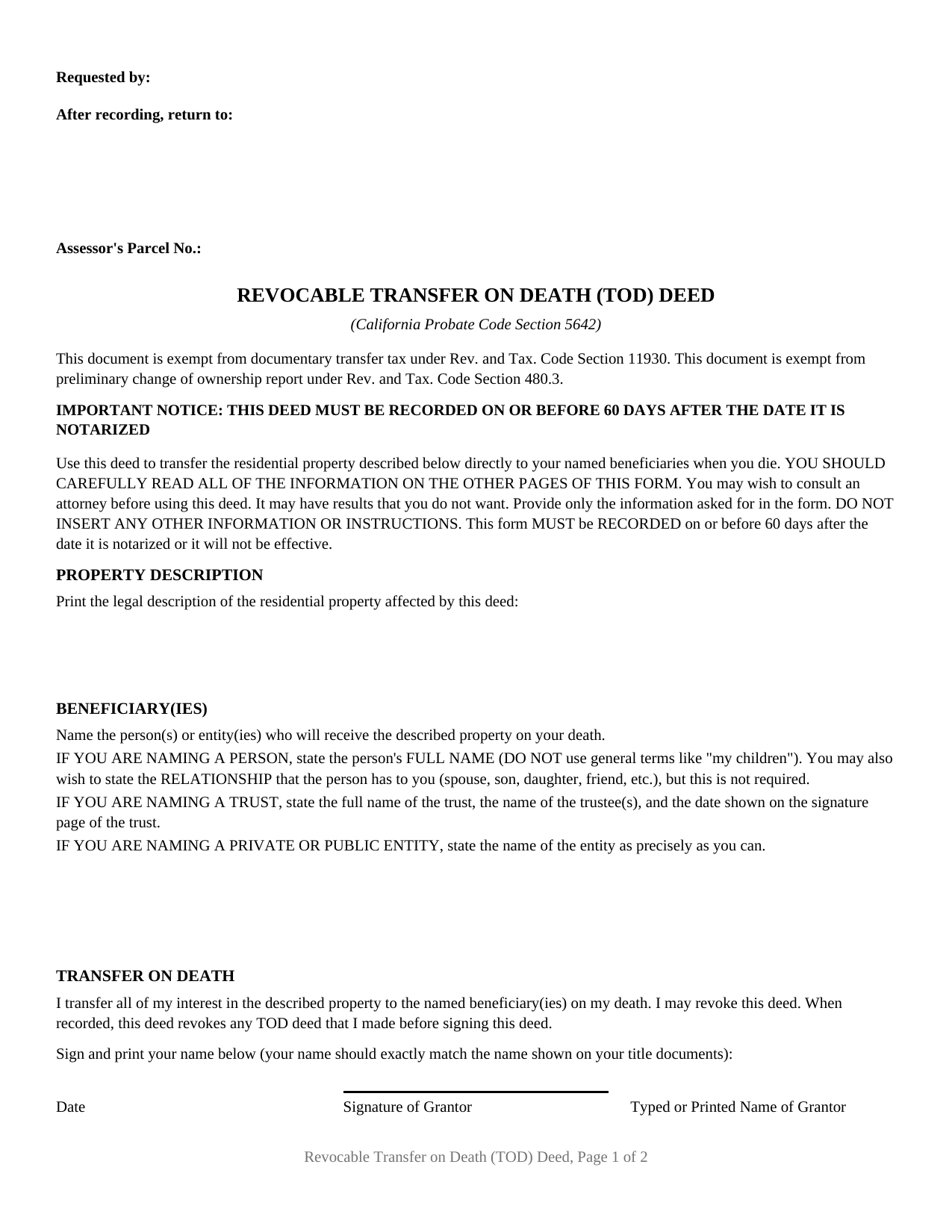
California is one of the few states that writes its transfer on death deed out in the statute itself: Probate Code Section 5642 sets the form word for word and says a revocable transfer on death deed shall be substantially in that form. This package prepares it. A California revocable transfer on death deed, also searched as a California TOD deed or a beneficiary deed, lets one owner of residential California real property name who receives it at death, without probate administration.
A statute that supplies the words
Most deed forms are drafted around a statute. This one is the statute. Section 5642 prints the title and citation line, the tax exemption recitals, the capitalized 60 day recording warning, the introductory paragraph, the beneficiary naming instructions, the operative transfer sentence, the co-owner note, and the witness sentence. The operative language is fixed rather than drafted: the deed reads that the owner transfers all of that owner's interest in the described property to the named beneficiaries on death, may revoke the deed, and, on recording, revokes any earlier TOD deed. The form's own introduction directs that only the information it asks for be provided, which is why this deed carries no provisions box and no condition to write in.
One owner, one signature, one certificate
Section 5642 is executed by a single transferor. It prints one signature line, and the note under it states that the deed transfers only that owner's ownership share, not the share of any co-owner, and that a co-owner who wants a TOD beneficiary executes and records a separate deed. The form matches that architecture: one owner block, one signature block, one acknowledgment certificate, and no second owner block anywhere. Two record owners of one parcel present the pattern of two separate deeds, each on its own recording clock.
Three classes of beneficiary, named the statute's way
The beneficiary block takes more than one beneficiary, and the form recognizes three classes with a naming convention for each: a person by full name, with a general term such as a reference to children ruled out; a trust by its full name, its trustee or trustees, and the date on its signature page; and an entity by its own name. The completed example fills the block with one of each. What happens among them belongs to the chapter, not the deed: Probate Code Section 5652 makes each interest contingent on survival, gives multiple beneficiaries equal shares as tenants in common, and passes a lapsed share to the others. The deed states no share and names no alternate.
The sixty day clock and the two witnesses
California put two formalities on this instrument that its ordinary deeds do not carry. Probate Code Section 5624 requires two witnesses, both present at the same time, who witness either the signing or the owner's acknowledgment of the signature, and those witness signatures need no notarization. Probate Code Section 5626 then makes recording an effectiveness condition and starts the clock at the notarial acknowledgment rather than at signing: a deed recorded after the sixtieth day does not take effect. Hence the capitalized warning on the first page.
Where the deed stops
Probate Code Section 5610 limits this part to a parcel improved with one to four residential dwelling units, or a residential separate interest in a common interest development, and excludes agricultural land over 40 acres. Section 5652 transfers the property without covenant or warranty of title, subject to the liens of record. Section 5664 makes the deed void where title stands in joint tenancy or as community property with right of survivorship at the owner's death, so survivorship governs instead. Section 5672 leaves a beneficiary personally liable for the owner's unsecured debts, capped by Section 5674 at the property's value at death less the liens then on it. After the death, Sections 5681 and 5682 add a notice to heirs and a recorded affidavit, each prepared separately and not included here.
The deed records with the recorder for the county where the property sits, on a page built to the Government Code Section 27361.6 format, with the title below the reserved recording space where Government Code Section 27324 puts it for indexing. Fees vary by county.
The package contains the fillable form, a completed example filled in for a Sonoma County fact pattern, and the guide that walks through every section. This description and the guide describe the form and the governing California statutes in general terms; they are not legal advice.
Important: County-Specific Forms
Our revocable transfer on death deed forms are specifically formatted for each of the 58 counties in California.
After selecting your county, you'll receive forms that meet all local recording requirements, ensuring your documents will be accepted without delays or rejection fees.