Pitkin County Beneficiary Deed (Two Joint Tenants, Last Surviving Owner) Form
Last validated November 8, 2026 by our Forms Development TeamFormatted for recording in Pitkin County, for property anywhere in the county: rural and unincorporated areas as well as Aspen, Meredith, Snowmass, Snowmass Village, Woody Creek.
- 3 documents included
- Immediate PDF download
- Formatting guarantee
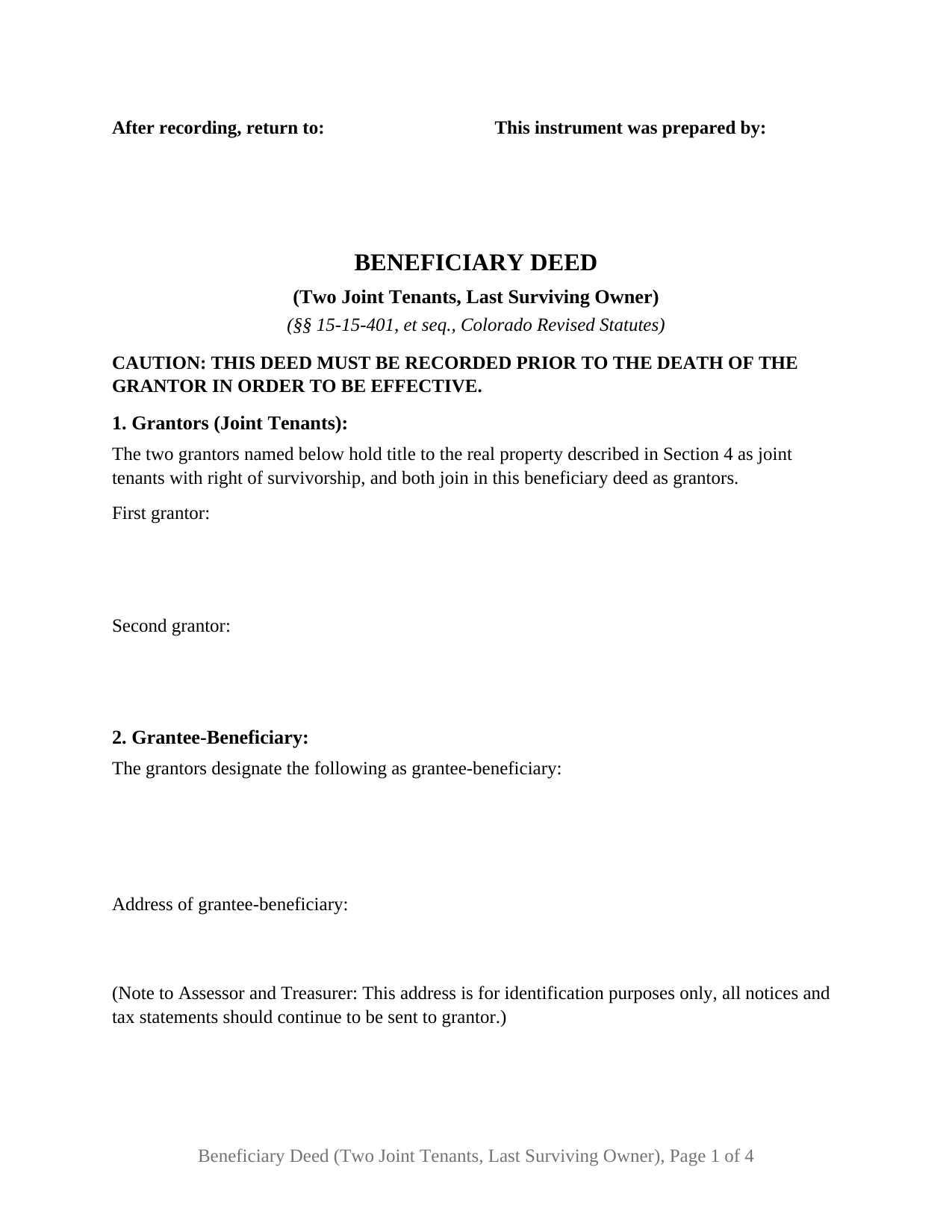
Pitkin County Beneficiary Deed (Two Joint Tenants, Last Surviving Owner) Form
Fill in the blank Beneficiary Deed (Two Joint Tenants, Last Surviving Owner) form formatted to comply with all Colorado recording and content requirements.
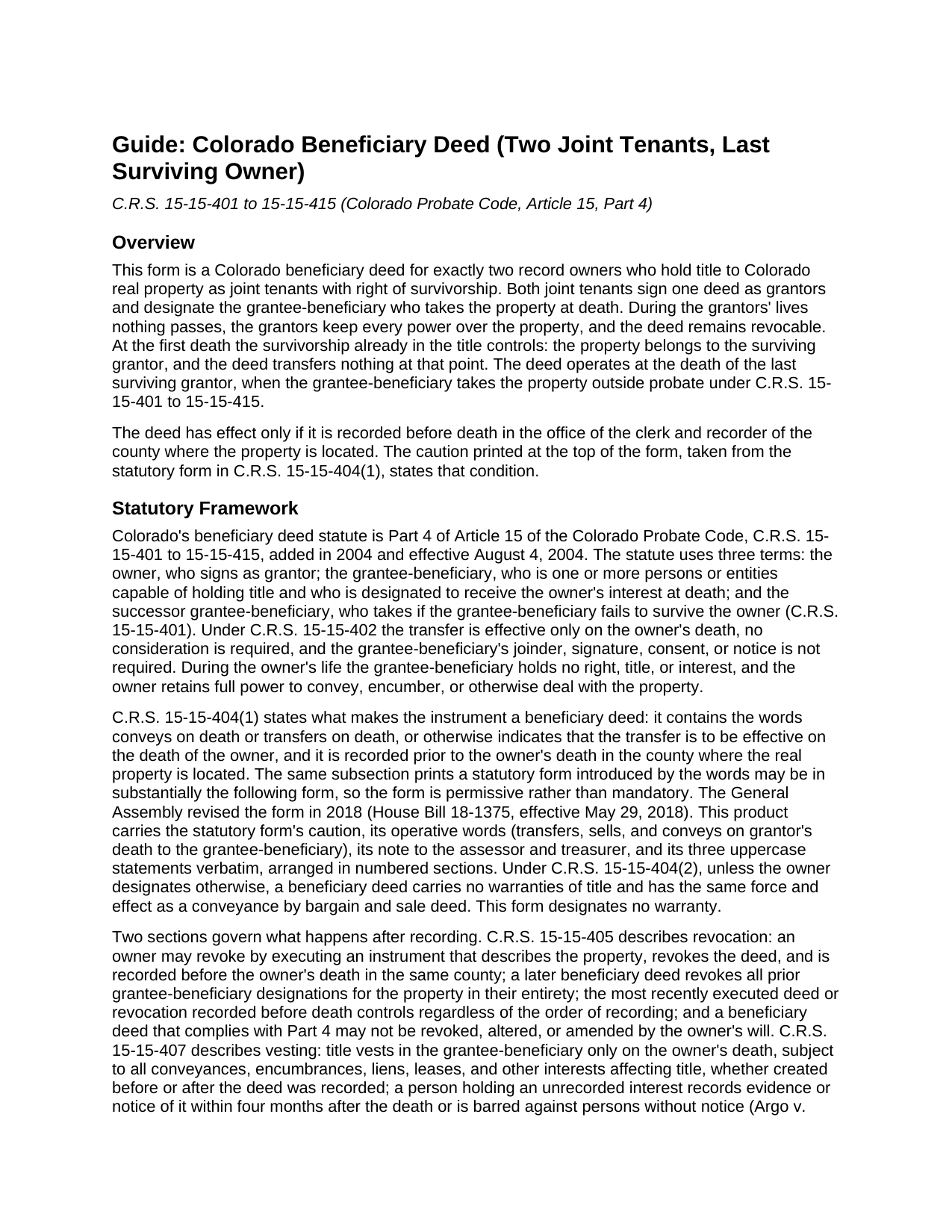
Pitkin County Beneficiary Deed (Two Joint Tenants, Last Surviving Owner) Guide
Line by line guide explaining every blank on the Beneficiary Deed (Two Joint Tenants, Last Surviving Owner) form.
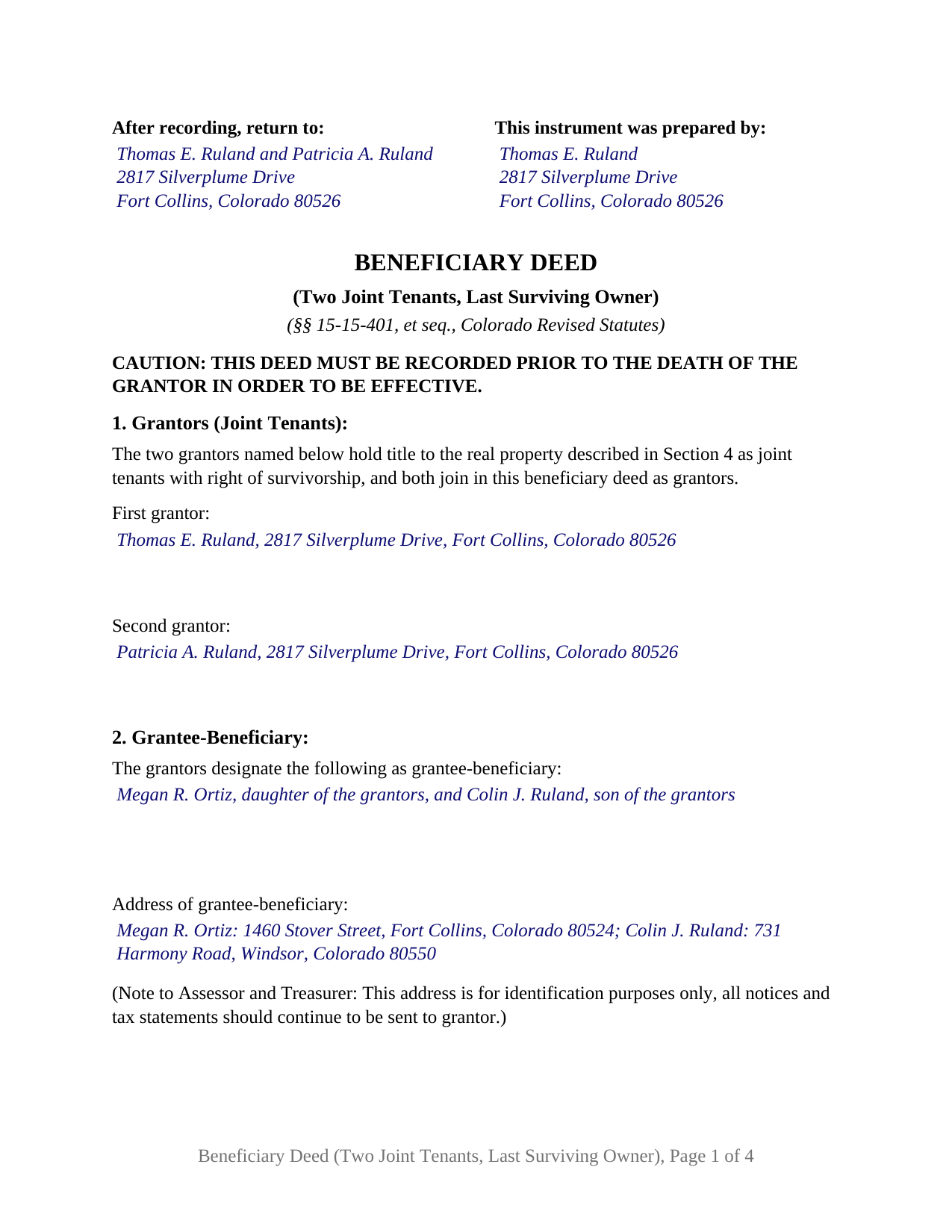
Pitkin County Completed Example of the Beneficiary Deed (Two Joint Tenants, Last Surviving Owner) Document
Example of a properly completed Colorado Beneficiary Deed (Two Joint Tenants, Last Surviving Owner) document for reference.
All 3 documents above included • One-time purchase • No recurring fees
Immediate Download • Secure Checkout
Additional Colorado and Pitkin County documents included at no extra charge:
Where to Record Your Documents
Pitkin County Clerk and Recorder
Aspen, Colorado 81611
Hours: 8:30 to 4:30 Mon-Thu; Friday until 5:00
Phone: (970) 920-5180
Recording Tips for Pitkin County:
- Bring your driver's license or state-issued photo ID
- Ensure all signatures are in blue or black ink
- White-out or correction fluid may cause rejection
- Ask about their eRecording option for future transactions
- Avoid the last business day of the month when possible
Cities and Jurisdictions in Pitkin County
Properties in any of these areas use Pitkin County forms:
- Aspen
- Meredith
- Snowmass
- Snowmass Village
- Woody Creek
Hours, fees, requirements, and more for Pitkin County
How do I get my forms?
Forms are available for immediate download after payment. The Pitkin County forms will be in your account ready to download to your computer. An account is created for you during checkout if you don't have one. Forms are NOT emailed.
Are these forms guaranteed to be recordable in Pitkin County?
Yes. Our form blanks are guaranteed to meet or exceed the applicable formatting requirements used for recording in Pitkin County, including margin requirements, font requirements, and other layout standards. This guarantee applies to formatting, not to the legal sufficiency of information entered by the user or the suitability of a form for a particular transaction.
Can I reuse these forms?
Yes. You can reuse the forms for your personal use. For example, if you have multiple properties in Pitkin County you only need to order once.
What do I need to use these forms?
The forms are PDFs that you fill out on your computer. The free Adobe Acrobat Reader is recommended, and most PDF apps also work. You do NOT enter your property information online - you download the blank forms and complete them privately on your own computer.
Are there any recurring fees?
No. This is a one-time purchase. Nothing to cancel, no memberships, no recurring fees.
How much does it cost to record in Pitkin County?
Recording fees in Pitkin County vary. Contact the recorder's office at (970) 920-5180 for current fees.
Questions answered? Let's get started!
Two Colorado owners who hold their home or land as joint tenants with right of survivorship can name, in a single recorded deed, who receives the property after both of them have died. This Colorado beneficiary deed, sometimes searched for as a transfer on death deed or TOD deed, is drawn for exactly that pattern: two joint tenants sign one deed as grantors, the survivorship already in their title carries the property to whichever of them lives longer, and the deed carries it to the named grantee-beneficiary at the death of the last surviving owner, outside probate.
A deed that waits for the second death
Colorado's beneficiary deed statute, C.R.S. 15-15-401 to 15-15-415, keys the transfer to the death of the owner, and for joint tenants the statute says which death that is. Under C.R.S. 15-15-408, a joint tenant may use a beneficiary deed to transfer his or her interest, but title vests in the grantee-beneficiary only if the joint tenant who signed is the last of all the joint tenants to die. A deed signed by a joint tenant who dies first is simply not effective, and it never makes the grantee-beneficiary a co-owner with the survivor. The same section provides that a beneficiary deed does not sever the joint tenancy.
This form puts that rule into the deed's own words. The operative section carries the statutory form's conveyance language, transfers, sells, and conveys on grantor's death to the grantee-beneficiary, and then states that the deed does not sever the joint tenancy, that it is not effective at the death of a grantor who is survived by the other grantor, and that title vests in the grantee-beneficiary only on the death of the last surviving grantor. Nothing changes while either grantor lives: C.R.S. 15-15-402 leaves the grantors every power to sell, mortgage, lease, or revoke, and the grantee-beneficiary holds no interest until the transfer takes effect.
Two grantors, two acknowledgments, one recorded instrument
The form recites exactly two record owners holding as joint tenants with right of survivorship, and both join in the deed as grantors. Each grantor has a block for a full legal name and mailing address, a signature block with a printed name and date, and a separate acknowledgment certificate completed by the notarial officer under Colorado's Revised Uniform Law on Notarial Acts. The two certificates are a feature of the form's layout rather than a statutory requirement, and they let the grantors sign on different days or before different notaries, including a notary in another state, whose acknowledgment Colorado recognizes under C.R.S. 24-21-511.
Married couples who took title as joint tenants, unmarried partners, siblings who inherited together, and a parent and adult child all appear in Colorado land records holding this way; the form reads the vesting deed's joint tenancy declaration under C.R.S. 38-31-101, not the relationship between the owners. The form is not set up as a sole owner's deed, as a deed for tenants in common, whose separate undivided interests pass on each owner's own death, or as a deed signed by a trustee, an entity, or an attorney-in-fact, and it carries no selector for any of those configurations. Three or more joint tenants are outside its two-grantor design.
Grantee-beneficiaries, successors, and shares
The grantee-beneficiary section accepts one or more natural persons, a trust named as the trust, or another entity capable of holding title, with an address box that satisfies the Colorado rule that a deed without the grantee's legal address is returned unrecorded (C.R.S. 38-35-109(2)). An optional section carries the statutory form's successor clause, restated for two joint tenants: if the grantee-beneficiary fails to survive the last surviving grantor, a named successor grantee-beneficiary takes instead. Where several grantee-beneficiaries are named and one dies first, C.R.S. 15-15-407(5) adds that share proportionately to the survivors' shares unless the deed provides otherwise, and no anti-lapse statute applies. The grantee-beneficiary takes at the last death subject to every mortgage, lien, and other interest then affecting title, and subject to a Medicaid recovery claim where one exists.
The statutory cautions, printed as the statute prints them
The Colorado statutory form in C.R.S. 15-15-404(1) is permissive, and this deed carries its fixed statements verbatim: the uppercase caution that the deed must be recorded before the grantor's death to be effective, the statement that the deed is revocable and revokes all prior beneficiary deeds for the property, the warning that executing a beneficiary deed may disqualify the grantor from Medicaid under Title 25.5, and the warning that the deed may not avoid probate. Revocation follows C.R.S. 15-15-405: a recorded revocation or a later recorded beneficiary deed controls, and a will cannot revoke or amend the deed.
Recording in the county where the land lies
Recording is the step that gives the deed effect. The deed is recorded with the clerk and recorder of the county where the property is located, before the death of the owner, and a deed that is signed but unrecorded at death transfers nothing. Colorado clerks record a deed for a flat fee, commonly quoted at forty-three dollars with the statutory surcharges, and a beneficiary deed carries no state documentary fee because it is made without consideration. The form is letter size, meets the one inch top margin and the half inch side and bottom margins that C.R.S. 30-10-406 requires, and reserves the top inch of the first page for the clerk's recording information. A Colorado beneficiary deed for two joint tenants is a planning instrument for the second death; the guide explains how divorce, a lifetime severance of the joint tenancy, and the survivor's own later deed or revocation interact with it.
The package includes the fillable beneficiary deed form with a non-recorded instructions cover page, a completed example filled in for a Larimer County fact pattern, and a guide that walks through every section, the signing and notarization rules, and the recording process. This description and the guide describe the form and the governing Colorado statutes in general terms; they are not legal advice.
Important: Your property must be located in Pitkin County to use these forms. Documents should be recorded at the county recording office listed above.
This Beneficiary Deed (Two Joint Tenants, Last Surviving Owner) meets all recording requirements specific to Pitkin County.
Our Promise
The documents you receive here are guaranteed to meet or exceed the applicable Pitkin County recording format requirements. If there is a rejection caused by our formatting, we will correct the issue or refund your payment. This guarantee applies to document formatting only and does not extend to information entered by the user, the selection of the form, or the legal effect of the completed document.
Save Time and Money
Get your Pitkin County Beneficiary Deed (Two Joint Tenants, Last Surviving Owner) form done right the first time with Deeds.com Uniform Conveyancing Blanks. At Deeds.com, we understand that your time and money are valuable resources, and we don't want you to face a penalty fee or rejection imposed by a county recorder for submitting nonstandard documents. We constantly review and update our forms to meet rapidly changing state and county recording requirements for roughly 3,500 counties and local jurisdictions.
4.8 out of 5 - ( 4,850 Reviews )
Rachel F. 5 out of 5 stars
Wonderful forms as long as you know what you need. Do some research ahead of time so you can avoid looking like an idiot ordering the incorrect form for your situation.
Thank you!
Michael F. 5 out of 5 stars
Very helpful and easy to use.
We deeply appreciate the trust you have placed in our services. Thank you for your valuable feedback and for choosing us.
ieva r. 5 out of 5 stars
Excellent! I was worried because I saw some negative reviews online but I really needed an e-recording company and they completed everything perfectly. I will most definitely recommend them and use them again in the future. All the staff was super nice and very helpful.
We appreciate your business and value your feedback. Thank you. Have a wonderful day!
JAMES E. 5 out of 5 stars
Easy to use and excellent software.
Thank you!
Lacee G. 5 out of 5 stars
Great real estate deed forms.
Thank you!
Jay G. 5 out of 5 stars
Impressed by their expeditious response to my request which was facilitated by their fabulous software.
Thank you!
Virginia S. 5 out of 5 stars
It was simple and I appreciate the site.
Thank you for your kind words and for choosing us.
Jo G. 5 out of 5 stars
The form was easy enough to purchase but I ended up not needing it. No fault of Deeds.com, but it was of no value to me.
Thank you for your feedback. We really appreciate it. Have a great day!
Richard S. 2 out of 5 stars
Not user friendly, and not an Adobe fan. The first page of Quitclaim Deed form cuts off the Parcel Identification line on the bottom. Also quite a few forms showed up to be downloaded , after I paid, so I was unsure if all the forms were part of the quitclaim package. I have adobe but was unable to locate the forms in adobe on my computer after I downloaded them. Just wanted to print out one quitclaim deed form, which would have taken less that 3 minutes. instead it took 97 minutes. Thank you, though, for having the form there.
Thank you for your feedback. We really appreciate it. Have a great day!
Rhonda D. 3 out of 5 stars
The boxes do not allow you to add the entire information. The after recording return to box would not let me add a zipcode.
Thanks for the feedback Rhonda, we’ll take a look at that input field.
Charlene H. 5 out of 5 stars
Deeds.com is a wonderful website. I highly recommend them and would use them again in the future.
Thank you, Charlene! We're so glad to hear you had a great experience. We truly appreciate your recommendation and look forward to helping you again in the future.
Kimberly S. 5 out of 5 stars
Worked very well. Seamless process with helpful directions.
Thank you for your feedback. We really appreciate it. Have a great day!
John Y. 5 out of 5 stars
Too much money for a form!
Thank you!
Lisa J. 5 out of 5 stars
I ordered a Lis Pendens form and it was exactly what I needed. Saved me a lot of time since I am self representing. Already filed it at courthouse! No problem!
Thank you for your feedback. We really appreciate it. Have a great day!
John T. 5 out of 5 stars
I bought a quitclaim deed package, and it was very easy to use. Prints nicely. Two thumbs up!
We appreciate your business and value your feedback. Thank you. Have a wonderful day!