District Of Columbia Quitclaim Deed (Corrective)
County Specific Legal Forms Validated as recently as September 24, 2026 by our Forms Development Team
About the District Of Columbia Quitclaim Deed (Corrective)
How to Use This Form
- Select your county from the list
- Download the county-specific form
- Fill in the required information
- Have the document notarized if required
- Record with your county recorder's office
What Others Like You Are Saying
"I am extremely happy with the products. I have used Quitclaim Deed. The instructions with a sample c…"
"Deeds.com is a godsend! Being able to download the pertinent state and county specific forms reassur…"
"I was happy with the way this worked and the quick responses. Unfortunately, my documents could not …"
"Look great and I thought my daughter wanted me to buy, but she had already bought the package so did…"
"The form was easy enough to purchase but I ended up not needing it. No fault of Deeds.com, but it wa…"
4.8/5 from 4,821 reviews. Read all
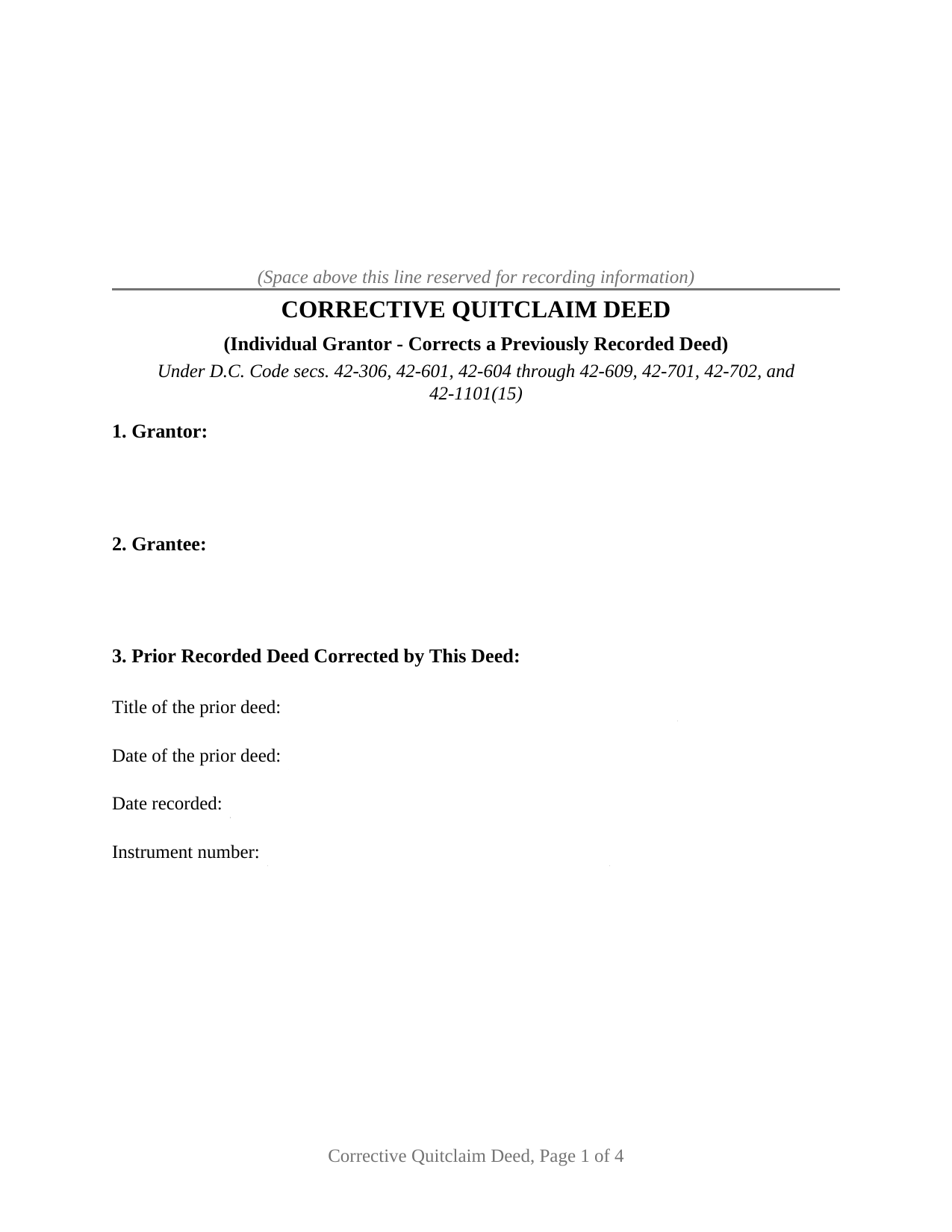
This District of Columbia quitclaim deed takes another deed as its subject. An individual grantor who already signed an instrument now in the land records signs again, and the new deed names the old one by title, date, recording date, and instrument number, sets the mistaken wording beside the corrected wording, and quitclaims the same interest to the same grantee, leaving the earlier conveyance standing in every other respect.
What a correction deed actually corrects
Errors arrive in the record in small and specific shapes. A lot number lands with two digits transposed. A middle initial disappears from a grantee's name. A property line omits the suffix the Office of the Surveyor assigns to a square. The transfer happened; the paper describing it is wrong, which is a different problem from a defect in how the deed was signed. Section 4 of this form is where the repair is written down, in two blanks: the matter as the prior recorded deed stated it, and the same matter as corrected. Keeping both versions on the face of the instrument is the point of the design: a title examiner reading the two deeds together sees which words the correction replaces.
One grantor, one prior deed, one correction
The configuration is deliberately narrow. The form recites one individual grantor, named as the person who executed the earlier deed, and one grantee entry carrying the grantee or grantees exactly as that deed named them, since a corrective quitclaim deed runs between the same parties as the transfer it repairs. Only the grantor signs, on one sealed signature line followed by one acknowledgment certificate; the grantee signs nothing, because D.C. Code section 42-407(1) keys acceptance for record to execution and acknowledgment by the party granting the interest. The operative text holds the instrument to its job: the correction reaches the matter stated in Section 4 and no other, the prior deed is ratified in all other respects, and no estate is created beyond the estate it conveyed. Adding a party, dropping a party, or changing the interest conveyed is a fresh transfer rather than a correction, and two record owners or an entity officer follow their own signature patterns.
The definition the District wrote into its tax chapter
Correction deeds have no chapter of their own in the D.C. Code, yet the District defines the instrument precisely, in the place where the money is. Section 42-1101(15) calls a deed that confirms, corrects, modifies, or supplements a prior recorded deed without additional consideration a supplemental deed. Section 42-1102(6) exempts supplemental deeds from the recordation tax, and section 47-902(8) exempts from the transfer tax a transfer which, without additional consideration, confirms, corrects, modifies, or supplements a transfer previously recorded. New money is the hinge on which both paragraphs turn: a deed passing for additional consideration leaves the definition and answers to the ordinary rates, 1.1 percent per tax below the $400,000 line and 1.45 above it.
A filing that travels with a second document
Form FP-7/C, the combined recordation and transfer tax return, carries the exemption claim by code provision or by paragraph number from Form ROD 7 and Form ROD 8. What sets this filing apart is what rides behind the return: Form ROD 4, the Recorder of Deeds list of documentation for an exemption claim, asks three items of a deed that corrects, confirms, modifies, or supplements a previously recorded document, the newly drafted deed, the FP-7/C, and a copy of the previously recorded document itself.
Sealed by the same hand that signed before
An estate in District real property comes into being only through a deed the grantor has signed and sealed, the rule at section 42-306(b), so the signature line ends in the bracketed scroll printed in the statutory forms at section 42-601, and the operative text adopts that notation as the grantor's seal. Nothing is warranted: title covenants attach in the District only where the express phrases of sections 42-604 through 42-608 appear, this deed prints none, and section 42-702 still carries across the grantor's whole present estate, which on a correction is the interest the earlier deed meant to convey.
What ships is the blank deed as a fillable PDF, a completed example filled in for a Michigan Park rowhouse whose recorded deed carried a transposed lot number, and a plain-language guide to the ten sections, the sealing and notarial steps, the exemption paperwork, and the filing itself. The materials are informational and are not legal advice.
Important: County-Specific Forms
Our quitclaim deed (corrective) forms are specifically formatted for each of the 1 counties in District Of Columbia.
After selecting your county, you'll receive forms that meet all local recording requirements, ensuring your documents will be accepted without delays or rejection fees.