District Of Columbia Quitclaim Deed (Married Grantor with Non-Owner Spouse Joinder)
County Specific Legal Forms Validated as recently as September 24, 2026 by our Forms Development Team
About the District Of Columbia Quitclaim Deed (Married Grantor with Non-Owner Spouse Joinder)
How to Use This Form
- Select your county from the list
- Download the county-specific form
- Fill in the required information
- Have the document notarized if required
- Record with your county recorder's office
What Others Like You Are Saying
"I liked the ease of use, however I would love to be able to add multiple APN’s and delete lines that…"
"Excellent support! They were patient and knowledgeable."
"Very timely service and retrieved information I was looking for"
"Nice and Easy: two of my favorite things."
"Excellent, thank you."
4.8/5 from 4,821 reviews. Read all
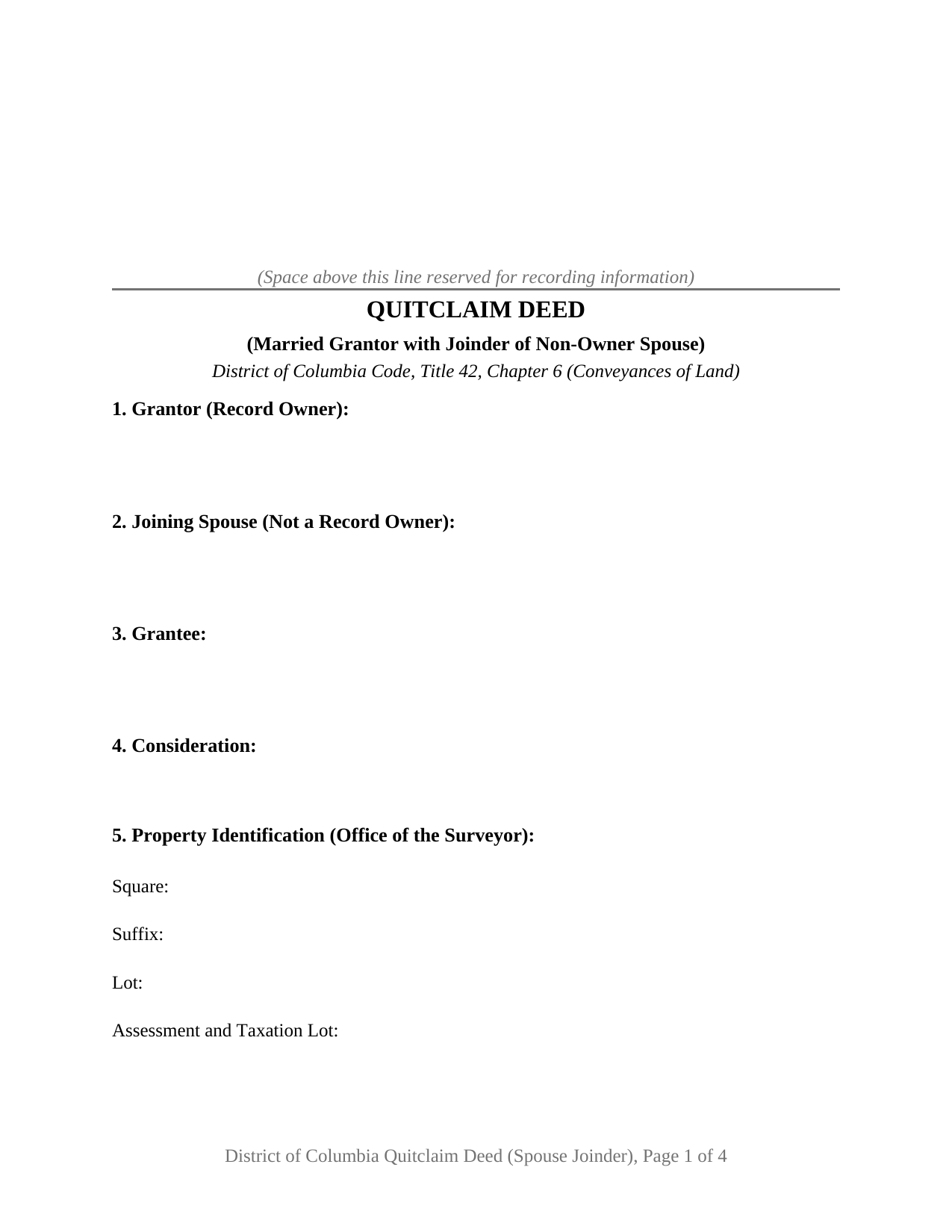
This District of Columbia quitclaim deed is signed by two people and conveys the interest of one. The married record owner releases the interest that owner holds in the property, and the owner's spouse, who holds no record title, signs a joinder block releasing any interest the spouse may have. The second signature is worth understanding, because District law does not ask for it.
A joinder the District stopped requiring in 2001
D.C. Law 13-292 rewrote section 19-102 of the D.C. Code effective April 27, 2001, abolishing the estates of dower and curtesy, and nothing took their place. The District has no homestead conveyance restriction and no spousal joinder statute for lifetime conveyances of solely titled real property, so an owner whose name alone appears in the vesting deed conveys alone. What the joinder accomplishes is narrower: the spouse quitclaims to the grantee any right, title, interest, claim, or estate the spouse may hold, so the release sits on the face of the recorded instrument rather than being inferred from an abolition statute. Because the spouse is releasing an estate to the extent one exists, that release is a conveyance in its own right, which is why the joinder line carries the same statutory seal notation as the grantor's line.
One conveying owner, two sealed signatures, two certificates
The form recites one grantor, described as the record owner, and one joining spouse, described as a person who is not a record owner. Its operative section states the marriage and states that record title stands in the grantor's name alone, then performs two acts: the grantor remises, releases, and quitclaims the described property to the named grantee, and the spouse joins to release whatever interest the spouse may hold, without covenant either way. Each signature rule ends in the bracketed seal notation printed in the statutory deed forms at D.C. Code section 42-601, because section 42-306(b) provides that an estate in District real property is created only by a deed signed and sealed by the grantor, and the operative text adopts each printed notation as that signer's seal. An acknowledgment certificate follows each line, so the two signers can appear before notarial officers on different dates. Solely titled property owned by a married person appears throughout the District's land records, in a rowhouse inherited before the marriage or a house refinanced into one name. Property standing in two names presents a different signature pattern, since each record owner conveys as a grantor; this form recites a single record owner.
A conveyance that promises nothing
A District quitclaim works by what it omits. Sections 42-604 through 42-608 of the D.C. Code attach title covenants only where express statutory phrases appear, such as warrant generally or with special warranty, and this deed carries none of them and says so. Section 42-702 still passes the grantor's whole present estate unless the deed limits it, so the grantee holds everything the grantor held at delivery, with no promise about its quality and with every lien, easement, and restriction of record riding through untouched.
Square, suffix, and lot, and one return signed by three people
Recording happens at a single office, the Recorder of Deeds within the Office of Tax and Revenue, since the District has no counties. The property is identified by square, suffix, and lot from the Office of the Surveyor rather than by parcel number, and the form gives each element its own blank alongside the Assessment and Taxation lot. Form FP-7/C, the recordation and transfer tax return, travels with the deed and is signed under oath by all parties to it, which on a joinder deed means three signers; the Recorder publishes Form ROD 2 as the addendum for signatures that outrun the return's space. The recordation and transfer taxes collected there each run to 1.1 percent of consideration under $400,000 and 1.45 percent at or above that line, computed on fair market value where consideration is nominal. The deed belongs on record within 30 days of signing, the fee for recording it is $30 including the statutory surcharge, and an unpaid District tax bill on the property stops the recording at intake.
The purchase delivers this joinder configuration as a fillable PDF, a completed example worked through for a $625,000 sale of a rowhouse held in one spouse's name, and a plain-language guide covering the numbered sections, the seal and acknowledgment formalities, the tax return, and recording. The materials are informational and are not legal advice.
Important: County-Specific Forms
Our quitclaim deed (married grantor with non-owner spouse joinder) forms are specifically formatted for each of the 1 counties in District Of Columbia.
After selecting your county, you'll receive forms that meet all local recording requirements, ensuring your documents will be accepted without delays or rejection fees.