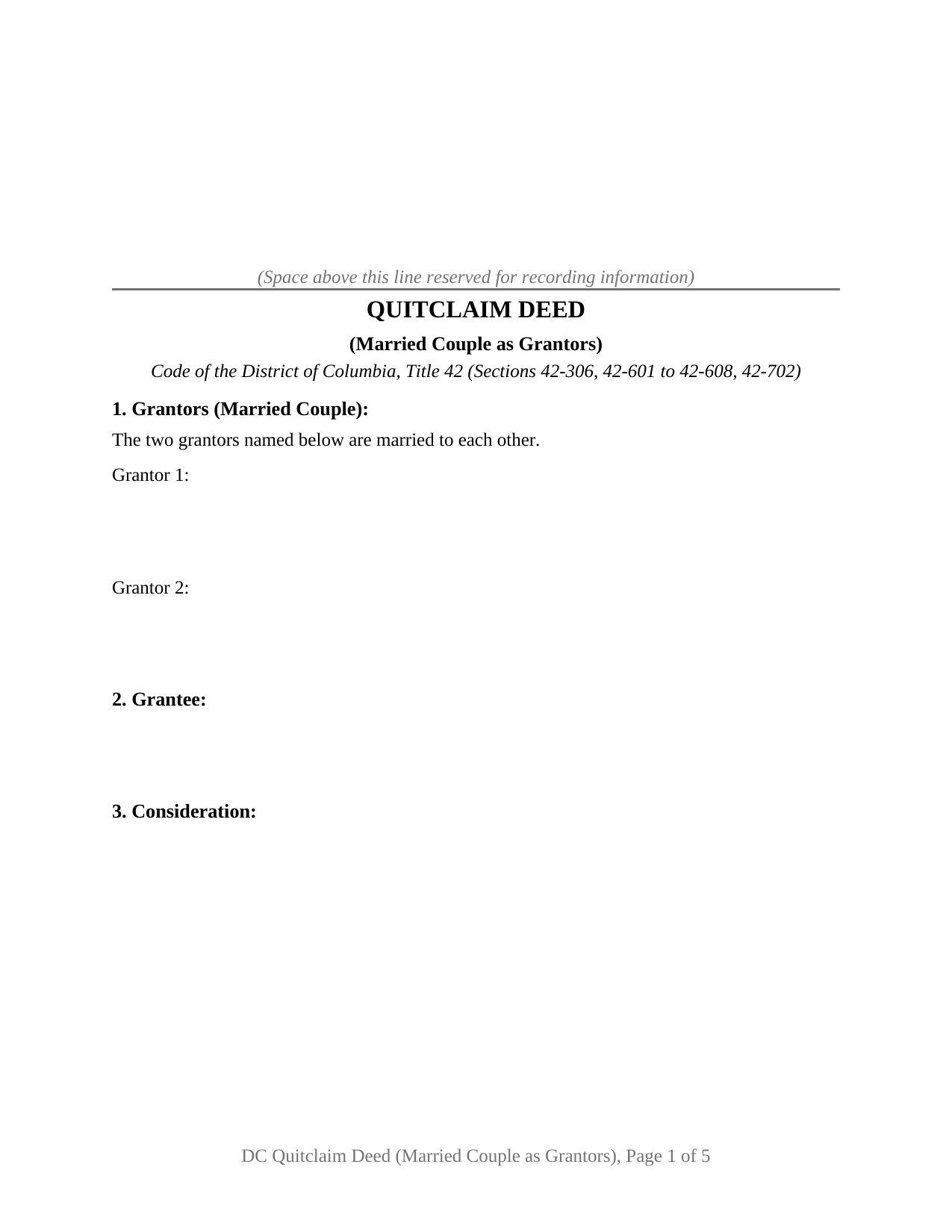
District Of Columbia Quitclaim Deed (Married Couple as Grantors)
County Specific Legal Forms Validated as recently as September 23, 2026 by our Forms Development Team
About the District Of Columbia Quitclaim Deed (Married Couple as Grantors)
How to Use This Form
- Select your county from the list
- Download the county-specific form
- Fill in the required information
- Have the document notarized if required
- Record with your county recorder's office
What Others Like You Are Saying
"Quick, easy way to get the forms I needed"
"Excellent Service"
"Excellent service"
"Breeze.... It feels silly to hire an attorney to do this for just one beneficiary. Thanks."
"Fast, easy, responsive."
4.8/5 from 4,821 reviews. Read all
When District of Columbia real estate stands in the names of a married couple, the cleanest release of the couple's whole position is a single deed built around the marriage itself. This quitclaim deed names two spouses as its grantors: the instrument recites that the two are married to each other, both sign and seal it, and together they release all of their right, title, and interest to the named grantee without warranty.
Configured for one marital unit
The form recites exactly two grantors and states, on the face of the record, that they are married to each other; the recital identifies the couple whose interests the deed carries. Whatever shape the couple's title takes, the conveyance reaches it: a tenancy by the entirety created by express words, a joint tenancy expressly declared, or the tenancy in common that D.C. Code section 42-516(a) supplies whenever a deed, even a deed to spouses, names no vesting. Section 42-702 then passes each spouse's whole estate unless the deed limits it, so the grantee ends up with everything both spouses hold at delivery. The land record shows this pattern wherever spouses hold Washington property together: parents deeding the family rowhouse to an adult child, a couple selling a jointly owned rental after relocating, spouses moving real estate toward an estate plan of their own design. The form recites a current marriage between the two grantors; unmarried co-owners and a spouse who holds title alone appear in other configurations of the instrument.
Release without promises
A District quitclaim conveys by omission as much as by words. D.C. Code sections 42-604 through 42-608 attach title covenants only where express statutory phrases appear in a deed, and this deed carries none of them, saying so plainly in its operative section. The grantee receives the couple's actual interest, whole but unwarranted.
Two seals, two certificates, one appointment
District law regards a deed as operative only when signed and sealed by the grantor (D.C. Code section 42-306(b)), so each spouse's signature line ends in the printed scroll drawn in the style of the section 42-601 statutory forms, and the operative text adopts the scroll as each signer's seal. An acknowledgment certificate follows for each spouse, printing the sentence of the District's own statutory short form, and married grantors commonly complete both certificates in a single sitting before one notary, the arrangement the completed example illustrates from start to finish. A spouse who cannot attend in person has a statutory path as well: the District permanently authorizes notarial acts for remotely located individuals by communication technology, with the certificate noting that the act was performed that way.
Family transfers and the exemption paperwork
A married couple's quitclaim very often moves property inside the family, and the District's deed taxes carry exemptions built for exactly that. A transfer without actual consideration to a spouse, a child, a grandchild, or a domestic partner is exempt from both the recordation tax and the transfer tax; the claim rides Form FP-7/C, the return every party signs under oath, and the Recorder of Deeds documents the relationship at intake with its own affidavit forms, ROD 19 for the parent-child gift the completed example works through. Outside that circle, a deed with no consideration is taxed on fair market value. Two intake rules finish the trip: the Recorder does not accept a deed while District taxes are owing on the property, and the recorded deed belongs on file within 30 days of signing.
The package delivers this married-couple quitclaim deed as a fillable PDF, a completed example showing every blank worked through for a realistic Washington gift from spouses to their daughter, and a plain-language guide covering each section, the sealing and acknowledgment formalities, the exemption paperwork, and the recording trip. The materials are informational and are not legal advice.
Important: County-Specific Forms
Our quitclaim deed (married couple as grantors) forms are specifically formatted for each of the 1 counties in District Of Columbia.
After selecting your county, you'll receive forms that meet all local recording requirements, ensuring your documents will be accepted without delays or rejection fees.