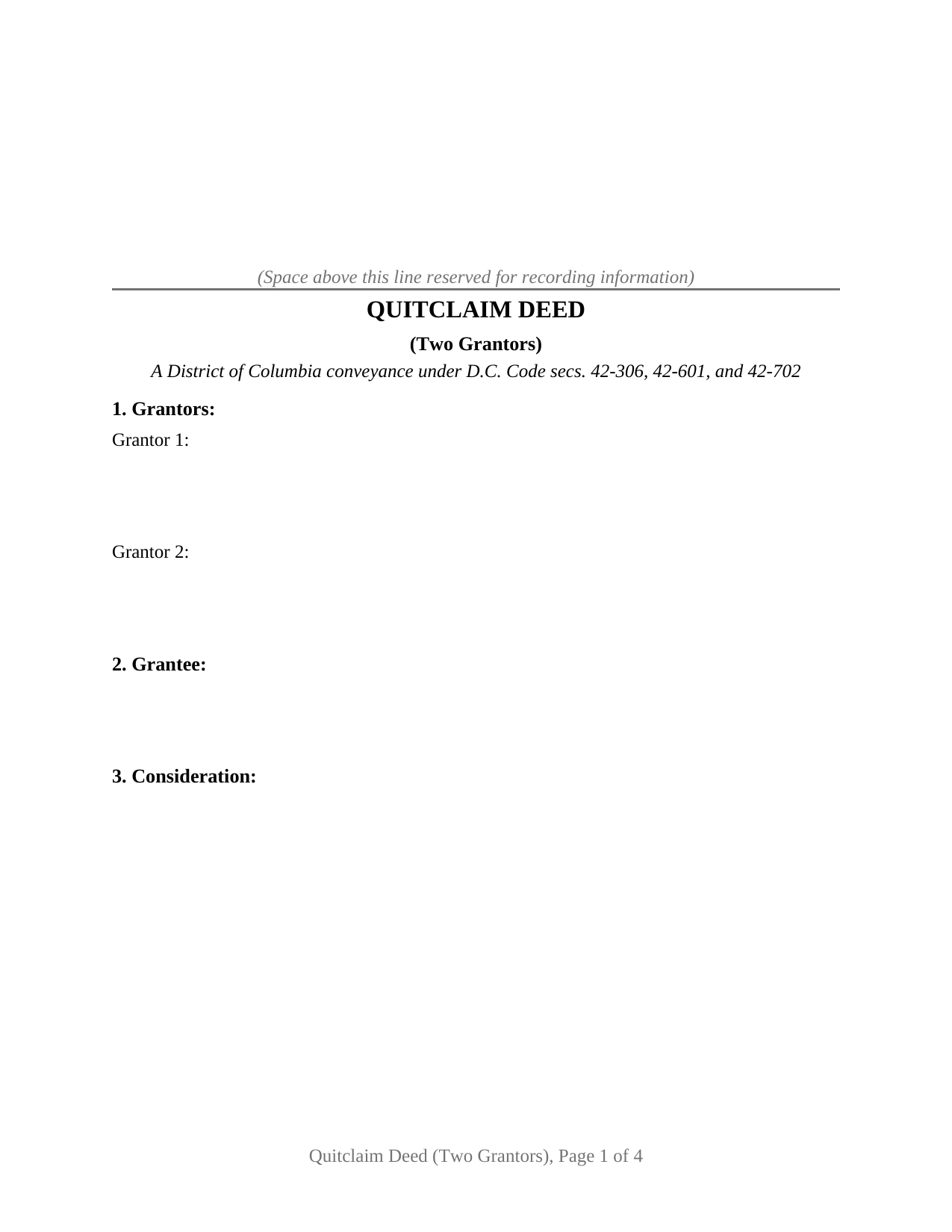
District Of Columbia Quitclaim Deed (Two Grantors)
County Specific Legal Forms Validated as recently as October 7, 2026 by our Forms Development Team
About the District Of Columbia Quitclaim Deed (Two Grantors)
How to Use This Form
- Select your county from the list
- Download the county-specific form
- Fill in the required information
- Have the document notarized if required
- Record with your county recorder's office
What Others Like You Are Saying
"Forms were easy to complete, with the instructions that were provided. Very satisfied!"
"My grandaughter in law got the info for me and it looks very help ul nThanks Doris"
"Quit Claim deed for North Carolina did not include all of the information I needed (two separate not…"
"Quick and easy download. Got everything I needed. I would recommend deeds.com"
"The documents requested were perfect! Very helpful, with instructions on how to complete and submit …"
4.8/5 from 4,821 reviews. Read all
District of Columbia real property held in two names moves as one complete title only when both owners convey, and this quitclaim deed is built around exactly that signature pattern: two grantors, one instrument, prepared for a single trip through the District's one recording office. The form releases both owners' right, title, and interest to the named grantee, without warranty, so the whole record interest travels in one deed.
Two grantors, two seals, one conveyance
The form recites exactly two record owners as grantors. Both sign, and each signature line ends in the printed seal scroll, because a District deed operates only when signed and sealed by the grantor under D.C. Code section 42-306(b); a two-grantor deed therefore carries two seal notations, one riding each signature line, with an adoption sentence in the operative text identifying the printed scroll as the seal of each signer. Ownership patterns that present two grantors run through the whole land record: two heirs holding fractional interests from an estate distribution, co-investors closing out a shared purchase, former spouses dividing real estate after a divorce decree, and married couples or registered domestic partners conveying property they hold together. Where a couple holds as tenants by the entirety, the two-signature architecture is not a convenience but the only path, since neither owner can sever or convey the entireties estate alone. A sole owner's conveyance follows a different pattern; this form is not set up for it.
A certificate for each grantor, wherever each grantor is
Two owners of the same District property rarely stand in the same room. The form carries a separate acknowledgment certificate for each grantor, so the two can appear before different notarial officers, on different dates, in different jurisdictions, and each certificate stands complete on its own. The certificates print the operative sentence of the District's own statutory short form, and the District gives a notarial act performed in another state the same effect as one performed at home, a point the Recorder of Deeds confirms in its published answers. The completed example runs this architecture at full stretch: one grantor acknowledges the deed before a Maryland notary, the other before a Virginia notary two days later, and the same instrument goes to record in the District without anything more.
What two releases in one instrument accomplish
Each grantor conveys that grantor's own present interest, and D.C. Code section 42-702 passes each one's whole estate unless the deed limits it, so the grantee ends the day holding everything the two grantors held at delivery. No covenant of title attaches: District covenants arise only from express statutory words, and this deed carries none of them, stating on its face that the conveyance is made without any covenant or warranty of title. The deed moves the interest; it makes no promise about the interest's quality.
One tax return, every party under oath
Recording mechanics reach both grantors. The deed travels with the District's combined recordation and transfer tax return, Form FP-7/C, executed under oath by all parties, both grantors and the grantee together, and the parties are jointly and severally liable for the recordation tax under section 42-1103(c). The 30-day recording clock of section 47-1431 runs from execution, a detail with real weight on a deed signed in two sittings: prompt recording after the second acknowledgment keeps the deed inside the window and ahead of the late-recording penalty. The property fields of the return run on the same square, suffix, and lot identifiers the deed's legal description section collects, so one set of Surveyor's Office data completes both documents.
The package delivers the two-grantor quitclaim deed as a fillable PDF, a completed example showing the form worked through for a realistic two-owner District of Columbia conveyance, and a plain-language guide covering each section, the sealing and acknowledgment formalities, and the trip through the Recorder of Deeds. The materials are informational and are not legal advice.
Important: County-Specific Forms
Our quitclaim deed (two grantors) forms are specifically formatted for each of the 1 counties in District Of Columbia.
After selecting your county, you'll receive forms that meet all local recording requirements, ensuring your documents will be accepted without delays or rejection fees.