District Of Columbia Quitclaim Deed (Interspousal)
County Specific Legal Forms Validated as recently as September 28, 2026 by our Forms Development Team
About the District Of Columbia Quitclaim Deed (Interspousal)
How to Use This Form
- Select your county from the list
- Download the county-specific form
- Fill in the required information
- Have the document notarized if required
- Record with your county recorder's office
What Others Like You Are Saying
"I believe you need more instruction on the use of the web site. I would type and nothing would appea…"
"Forms appear to be most current and instructions clear. Inserting grantor/grantee information onto f…"
"Like the setup Good idea on forms that help at a great price"
"Excellent service. Easy to use. Thank you."
"My first submission was super quick and easy. I had trouble with the second submission, as I was not…"
4.8/5 from 4,821 reviews. Read all
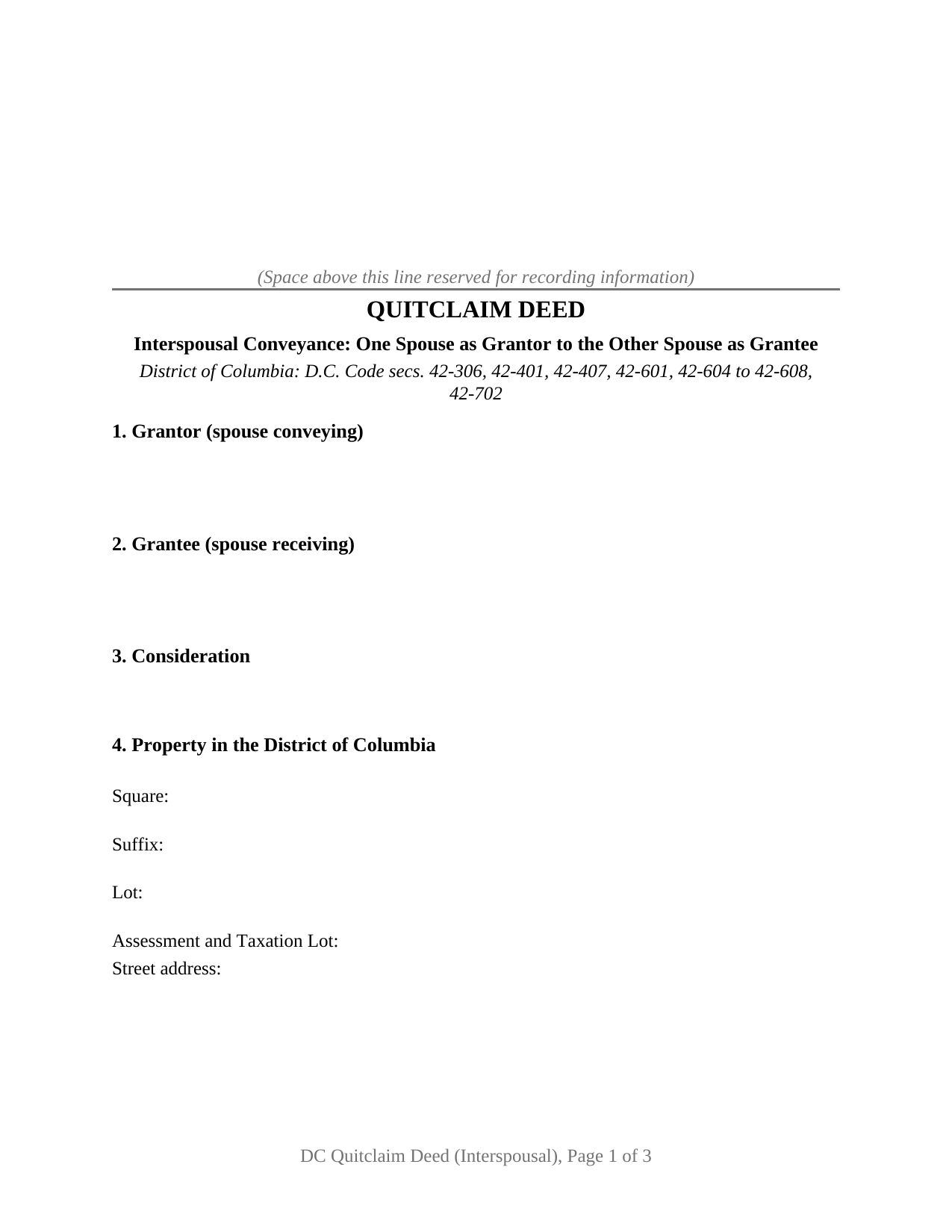
An interspousal quitclaim deed moves District of Columbia real property from one spouse to the other, and both ends of the transfer belong to the same marriage. This form is built for that shape: the spouse holding the interest signs as grantor, the other spouse is named as grantee, and the instrument states on its face that the two are married to each other.
The marriage sits on both sides of the deed
One grantor, described as the spouse conveying, and one grantee, described as the other spouse. Whatever interest the grantor holds is what travels: a whole title standing in one name, or one spouse's share of property the couple holds together. The District's land records fill with this shape. A house that came to one spouse by inheritance moves into the other spouse's name. A couple consolidates record title in the spouse who will keep the property. One spouse releases an interest as part of an agreed division of assets inside a continuing marriage. Because the deed names a single grantee, the receiving spouse takes in sole ownership, and a couple wanting a survivorship estate between them is looking at a two-grantee conveyance instead.
Nothing warranted, everything released
No District statute supplies a quitclaim form, and no covenant of title attaches to a District of Columbia deed unless express statutory words put it there. Sections 42-604 through 42-608 of the D.C. Code give shorthand effect to phrases such as warrant generally and with special warranty, and this deed carries not one of them, stating as much in its operative text. What section 42-702 does carry over is the grantor's whole present estate, so the grantee holds everything the grantor held at delivery, along with every lien, easement, and restriction already sitting on the title.
One signature, one seal, one certificate
A deed creates an estate in District real property only when the grantor signs and seals it, which is the rule in D.C. Code section 42-306(b), so the grantor spouse's signature line closes with the printed [Seal.] scroll that every statutory form in section 42-601 prints, and the operative text adopts that notation as the signer's seal. A single acknowledgment certificate follows, for the grantor, printing the operative sentence of the District's own short form at section 1-1231.15. The receiving spouse signs nothing on the deed itself: dower and curtesy were abolished in 2001, and no District statute asks a spouse to join a lifetime conveyance, so the grantee's signature would perform no legal work. A grantor away from the city may acknowledge the deed before a notary in another state, or by communication technology before a District notary under section 1-1231.13a.
Between spouses, both deed taxes step back
A deed between spouses made without actual consideration is exempt from the District's recordation tax and from its transfer tax, under sections 42-1102(7) and 47-902(5), taxes that otherwise reach a combined 2.2 or 2.9 percent of value. The exemption is claimed on Form FP-7/C, and the Recorder of Deeds looks for its Spousal Affidavit (ROD 20) as the supporting paper: a statement, sworn by both spouses before a notary, that they are presently married to each other. Hence the quiet asymmetry of this configuration, one signature on the deed and two on the affidavit. Where a deed between spouses passes without consideration and no exemption is claimed, the two taxes attach to fair market value rather than to a price.
Square, suffix, and lot, at a single counter
Recording happens in one place for the whole District, the Recorder of Deeds inside the Office of Tax and Revenue, because there are no counties to choose among and no county cover sheet to prepare. Property is identified by square, suffix, and lot from the Office of the Surveyor, figures that section 47-1431(a) makes part of the recorded copy, and that same section puts the deed on record within 30 days of signing. An unpaid District tax bill against the property halts recording at the counter under section 42-407(2), exempt deed or not.
What arrives is the blank deed as a fillable PDF, a completed example filled in for a Petworth rowhouse passing between spouses, and a guide walking the numbered sections, the seal and the certificate, the FP-7/C and ROD 20 paperwork, and the trip to the Recorder. These materials are informational and are not legal advice.
Important: County-Specific Forms
Our quitclaim deed (interspousal) forms are specifically formatted for each of the 1 counties in District Of Columbia.
After selecting your county, you'll receive forms that meet all local recording requirements, ensuring your documents will be accepted without delays or rejection fees.