District Of Columbia Quitclaim Deed (Individual Grantor by Attorney-in-Fact)
County Specific Legal Forms Validated as recently as October 2, 2026 by our Forms Development Team
About the District Of Columbia Quitclaim Deed (Individual Grantor by Attorney-in-Fact)
How to Use This Form
- Select your county from the list
- Download the county-specific form
- Fill in the required information
- Have the document notarized if required
- Record with your county recorder's office
What Others Like You Are Saying
"Easy to use, download, . Would use again."
"What a wonderful and easy task using deeds.com. I searched on line for the proper procedure to file …"
"Easy download, informative examples. Very good experience."
"My deeds were filed with Pinellas County Florida with a simple process and with no problems. 5 star …"
"Very nice forms offer, very thoughtful to include other related forms that may be necessary. The sit…"
4.8/5 from 4,821 reviews. Read all
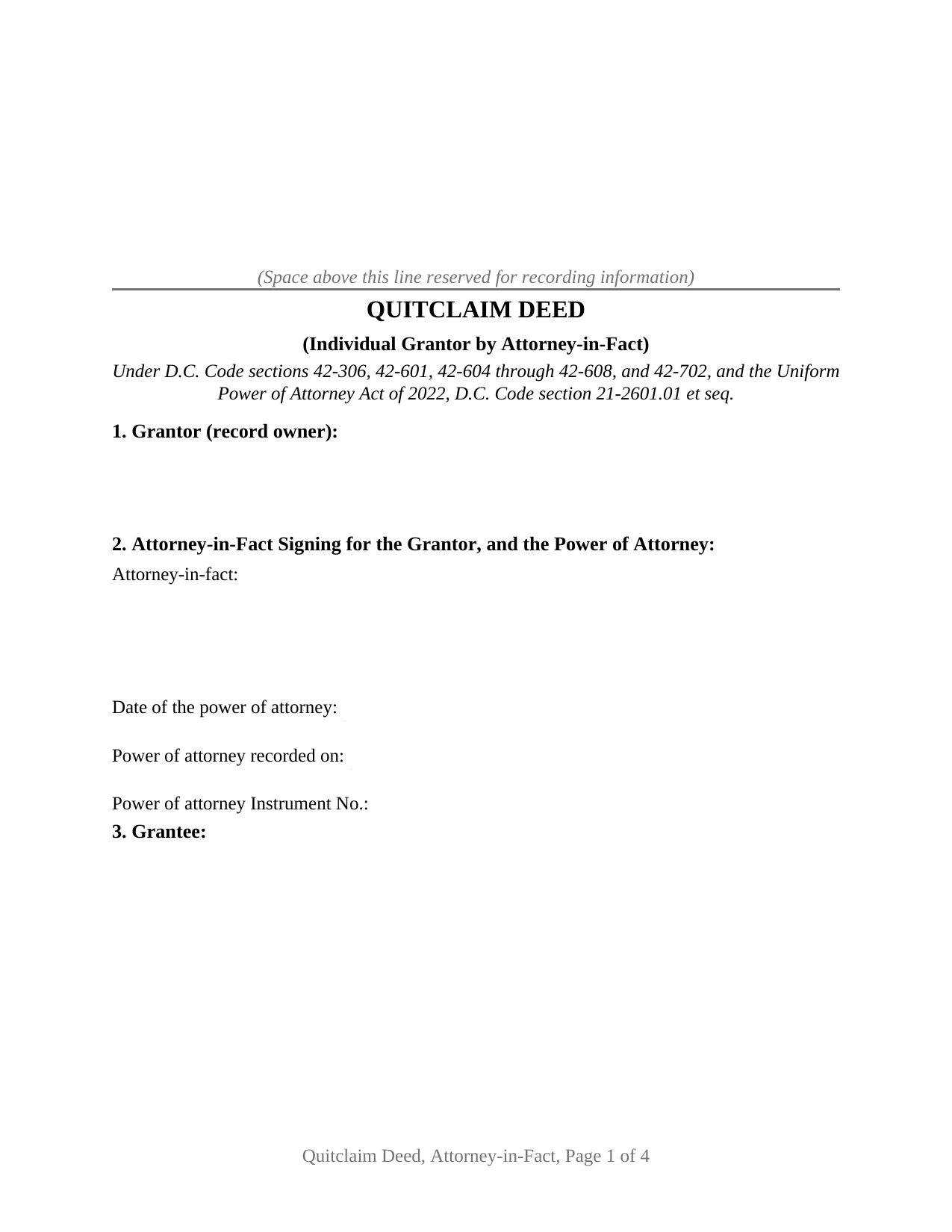
On this District of Columbia quitclaim deed the signature line belongs to the grantor, and the hand that signs it belongs to somebody else. One individual record owner releases whatever interest that owner holds in Washington real estate, without warranty, and an attorney-in-fact signs and seals the deed. D.C. Code section 42-306(b) allows exactly that: an estate in District real property is created by a deed signed and sealed by the grantor, in person or by power of attorney.
The one section that points at a second recorded document
Most deeds stand alone in the land records. This one does not. Under D.C. Code section 21-2603.03, a power of attorney authorizing an agent to sell, grant, or release an interest in real property is executed in the same manner as a deed and is recorded with or before the deed made under it; where it was recorded earlier, the deed carries its recording date and instrument number from the Office of the Recorder of Deeds. Section 2 is built for that: the agent's name and address, the date the principal signed, and two blanks for the recording reference.
Where an agent's power to quitclaim comes from
The District adopted the Uniform Power of Attorney Act of 2022, effective February 23, 2023, whose real property section answers the question this deed raises. Section 21-2602.04 provides that general authority with respect to real property authorizes the agent to sell, exchange, convey with or without covenants, quitclaim, release, and otherwise dispose of an interest in real property. The word quitclaim is in the statute. That authority arrives through a grant covering all acts a principal could do, under section 21-2602.01(c), or through a reference to the real property subject, which section 21-2602.02 incorporates whole. One limit rides along: under section 21-2602.01(b) an agent who is not an ancestor, spouse, or descendant may not create an interest in the agent.
A repealed section that still turns up in old forms
The same law repealed D.C. Code section 42-101, the 1901 provision that carried the District's deed-by-attorney rules, so a form citing section 42-101 for recording a power of attorney cites a section the Council removed in 2023. Those requirements live on in section 21-2603.03, along with a notice the power of attorney prints at the top of its own front page. That instrument is prepared and recorded separately and is not included in this package.
One sealed signature, one certificate, and the capacity written out
The configuration recites one grantor, one attorney-in-fact, and one grantee. A single signature rule closes with the bracketed seal notation the statutory deed forms of section 42-601 print, and the operative text adopts it as the seal of the grantor, because the District puts the seal inside the conveyance. One acknowledgment certificate follows, for the agent, with a name blank sized for the section 1-1231.15 agency wording. Either customary style works on that rule, the principal's name signed by the agent or the agent's own name with the capacity stated, and the printed name line carries the capacity. Patterns behind this shape recur: an owner who has moved away and will not travel to settlement, an owner abroad or on military orders whose power of attorney was signed overseas, and an owner in a care setting whose durable power was signed years earlier, which section 21-2601.10(c) keeps exercisable despite the lapse of time. The form recites a signature made under a power of attorney; an owner signing personally, and an entity or trustee executing under its own governing law, follow other patterns.
No covenants, and a tax that does not care who signed
Title covenants exist in a District deed only where the express words of sections 42-604 through 42-608 appear, and this deed prints none of them; section 42-702 still passes the grantor's whole present estate. The deed taxes are indifferent to the agency: recordation and transfer tax each take 1.1 percent of consideration under $400,000 and 1.45 percent at or above it, figured on Form FP-7/C. The no-consideration exemptions reach spouses, domestic partners, parents and children, and grandparents and grandchildren, so the sibling release in the completed example answers to value.
The package delivers the deed as a fillable PDF, a completed example worked through for an agent's release of a half interest in a Takoma rowhouse, and a plain-language guide covering the nine numbered sections, the agent's authority and its limits, the signing formalities, and recording. These materials are informational and are not legal advice.
Important: County-Specific Forms
Our quitclaim deed (individual grantor by attorney-in-fact) forms are specifically formatted for each of the 1 counties in District Of Columbia.
After selecting your county, you'll receive forms that meet all local recording requirements, ensuring your documents will be accepted without delays or rejection fees.