District Of Columbia Quitclaim Deed (Trustee Grantor)
County Specific Legal Forms Validated as recently as September 24, 2026 by our Forms Development Team
About the District Of Columbia Quitclaim Deed (Trustee Grantor)
How to Use This Form
- Select your county from the list
- Download the county-specific form
- Fill in the required information
- Have the document notarized if required
- Record with your county recorder's office
What Others Like You Are Saying
"Everything I expected. Faster and less expensive than my lawyer."
"You make the recording/registration process easy to follow - the value to price ratio is awesome!"
"There's nothing to say except it couldn't be easier."
"Easy @ useful"
"My county clerks office referred me to this website and I am so glad she did. This site is very easy…"
4.8/5 from 4,821 reviews. Read all
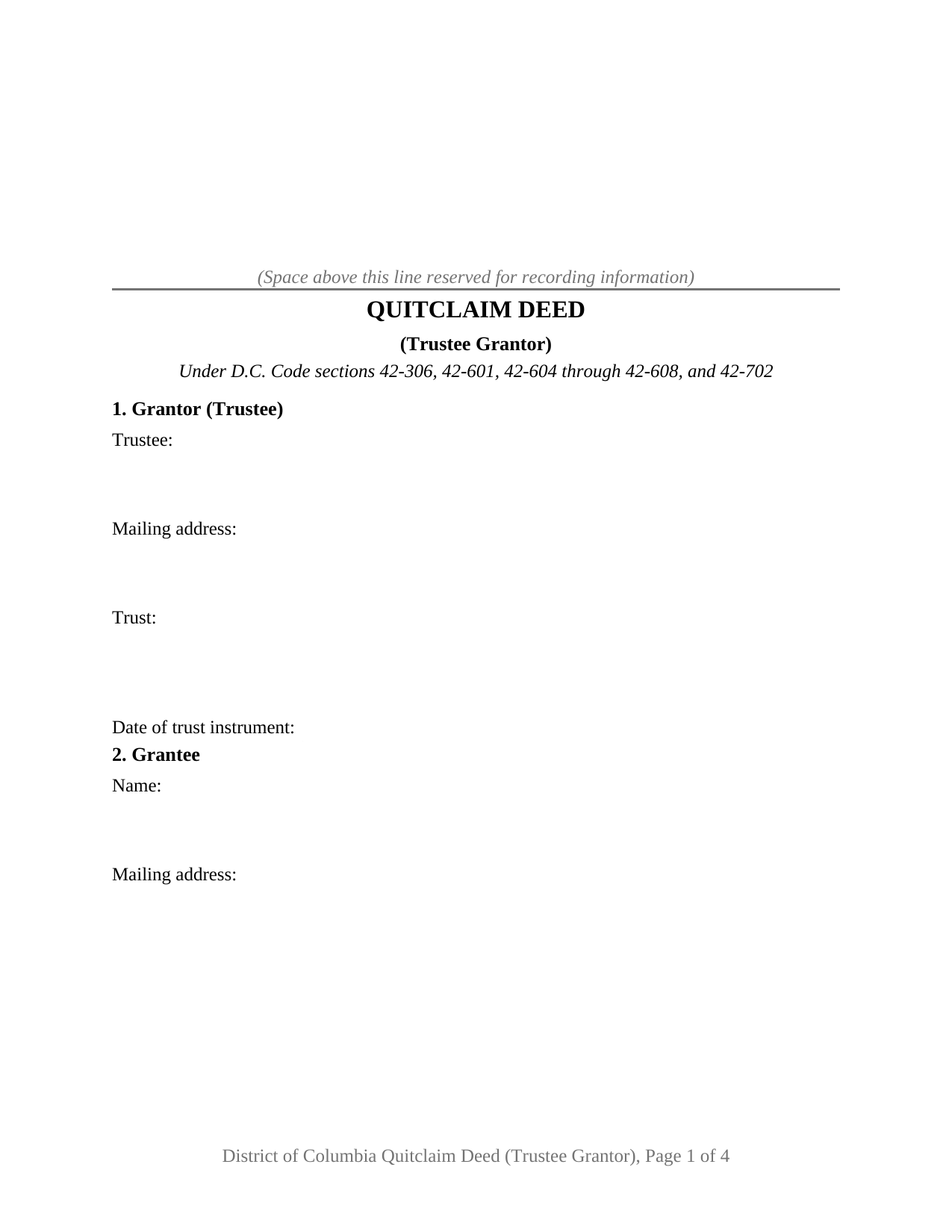
Every signature on this District of Columbia quitclaim deed is made in one capacity, and the deed prints that capacity three times: in the grantor section, which names the trustee alongside the trust and the date of its instrument; on the printed name line beneath the signature; and in the acknowledgment certificate, where the person appearing is identified as trustee. One trustee releases whatever interest the trust holds in Washington real estate, without warranty, and record title leaves the trust.
Where a trustee's power to sign comes from
Two provisions of the District's Uniform Trust Code stand behind the signature. Section 19-1308.15 hands a trustee the powers an unmarried competent owner has over individually owned property, and section 19-1308.16 enumerates particular powers without limiting that grant, among them the power to acquire or sell property, for cash or on credit, at public or private sale, and the powers exercisable with respect to an interest in real property. The trust instrument itself enlarges or narrows what those sections supply, which is why the form collects the trust's name and date rather than treating the trust as background detail. Section 8 states that the signer is the acting trustee, that record title stands in the trustee's name as trustee, that the deed neither creates nor amends the trust, and that nothing the signer holds individually travels with it.
The exemption a trustee borrows from the settlor
District deed taxes take 2.2 percent of a transfer below $400,000 and 2.9 percent at or above it, recordation and transfer tax together, measured against fair market value whenever a deed passes for nothing. Only one exemption paragraph is written for property leaving a revocable trust, and it is derivative. Section 42-1102(19) exempts a deed to property transferred by the trustee of a revocable trust if that transfer would otherwise be exempt had the grantor of the trust made it, and section 47-902(14) repeats the formula for the transfer tax. A trustee inherits whatever exemption the settlor could have claimed personally, so a transfer for no consideration to the settlor's child stays exempt when the trustee signs it. The completed example runs that path, and the guide traces the claim onto Form FP-7/C.
A deed that promises nothing and proves nothing
Title covenants in the District are opt-in: nothing warrants anything unless one of the phrases named in sections 42-604 through 42-608 puts it there, and section 42-702 nevertheless carries across the whole present estate the grantor holds. The form is just as modest about the trust, because it states a capacity, and a statement of capacity is not evidence of authority. That evidence is a separate paper, a certification of trust under section 19-1310.13, prepared apart from this package and not included in it, which sets out the trust's existence and date, the acting trustee, the powers, and the manner of taking title to trust property. Section 19-1310.12 completes the picture: a person dealing in good faith and for value with a trustee is not required to inquire into the extent of the trustee's powers.
The seal belongs to the grantor, not to the notary
Under D.C. Code section 42-306(b) an estate in District real property takes effect only through a deed the grantor has both signed and sealed, so the signature rule closes with the bracketed notation the statutory forms at section 42-601 print, and the operative text adopts it as the trustee's seal. The notarial officer's seal is a different instrument, governed by sections 1-1231.14 and 1-1231.15, and never stands in for it. One certificate follows the one signature, and the blank for the person appearing holds the signer's name with the trustee capacity written out. An acknowledgment taken outside the District carries the same effect under section 1-1231.10, and a District officer may take one from a remotely located signer by communication technology. No witness signs a District deed, and no spouse joins one.
Recording is a single stop for the whole District, the Recorder of Deeds inside the Office of Tax and Revenue, where the property answers to its square, suffix, and lot and the instrument is due on file within 30 days of signing. The purchase delivers the deed as a fillable PDF, a completed example worked through for a Capitol Hill rowhouse leaving a living trust for the settlor's son, and a plain-language guide covering the numbered sections, the trustee's powers, the sealing and acknowledgment formalities, the exemption paperwork, and the trip to the Recorder. The materials are informational and are not legal advice.
Important: County-Specific Forms
Our quitclaim deed (trustee grantor) forms are specifically formatted for each of the 1 counties in District Of Columbia.
After selecting your county, you'll receive forms that meet all local recording requirements, ensuring your documents will be accepted without delays or rejection fees.