District Of Columbia Quitclaim Deed (Trustee Grantee)
County Specific Legal Forms Validated as recently as October 7, 2026 by our Forms Development Team
About the District Of Columbia Quitclaim Deed (Trustee Grantee)
How to Use This Form
- Select your county from the list
- Download the county-specific form
- Fill in the required information
- Have the document notarized if required
- Record with your county recorder's office
What Others Like You Are Saying
"Your site is simple, easy to use, and an outstanding service."
"Seems like this is a very easy process to get what you need."
"easy to use to get copy of documents. given your website by recorder in the country offices."
"Easy, but it would be nice if there was an option for font size. It looks tiny, like 6 or 8."
"I am generally pleased with your products. However, I found it difficult to return to the package af…"
4.8/5 from 4,821 reviews. Read all
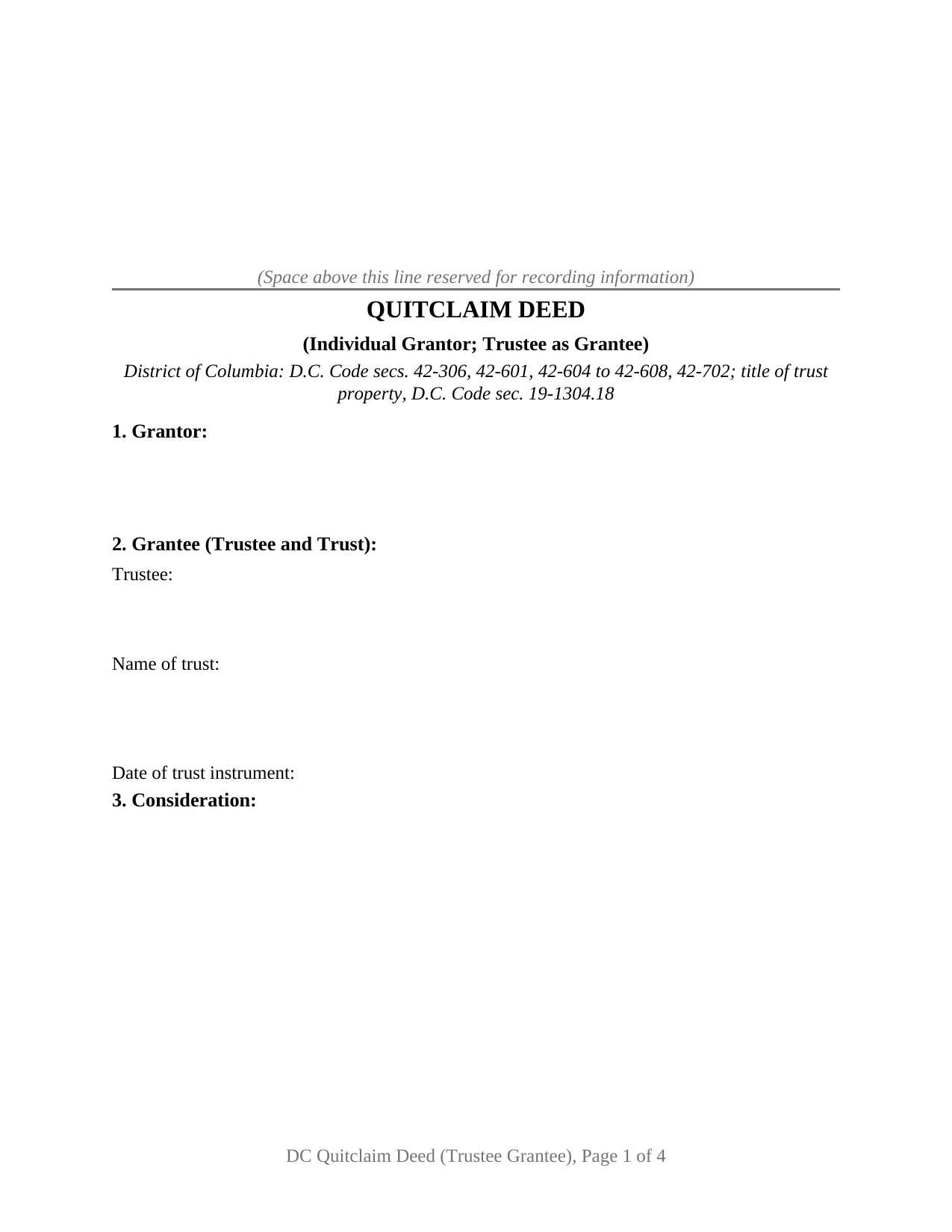
The grantee on this District of Columbia quitclaim deed is a trustee, and the deed says so in two places: in the grantee section, which names the trustee, the trust, and the date of the trust instrument, and in the operative section, where the grantee takes and holds as trustee rather than in an individual capacity. One individual grantor releases the interest that grantor holds in Washington real estate without warranty, and record title comes to rest in the trustee's name.
Three ways to title trust property, and the one this deed prints
District of Columbia trust law is unusually explicit about how trust property is titled. Section 19-1304.18 of the D.C. Code, part of the District's Uniform Trust Code, provides that property transferred to a trust may be titled in the name of the trust by reference to the instrument creating it, in the name of the current trustee as trustee of such trust, or in the name of the trustee as trustee of such trust. This form uses the middle formulation: a named individual or institution, identified as trustee, holding under a trust identified by name and by the date of its instrument. The three blanks in the grantee section exist for exactly those three items, and the conveyance section closes the loop by stating that the grantee holds under that trust instrument and that the deed neither creates nor amends the trust.
What the trustee receives, and what comes with it
A quitclaim conveyance in the District works by omission. Title covenants attach to a District of Columbia deed only where sections 42-604 through 42-608 of the D.C. Code find their express statutory words in it, so a deed carrying none of those phrases warrants nothing, and this one says as much on its face. Section 42-702 still passes the grantor's whole present estate unless the deed states a limitation, which means the trustee ends up holding everything the grantor held at delivery, along with every lien, easement, and restriction already on the title. Section 7 of the form accepts an informational listing of those matters, above a printed sentence confirming that listing them creates no warranty.
One sealed signature, and none from the trustee
Sealing is not decorative here. D.C. Code section 42-306(b) conditions the creation of a real property estate on a deed that the grantor has both signed and sealed, so the signature line ends in the bracketed notation drawn from the section 42-601 statutory forms, and the conveyance section adopts that notation as the grantor's seal. The trustee signs nothing: acceptance for record turns on execution and acknowledgment by the party granting the interest under section 42-407(1), which is why a single acknowledgment certificate follows the single signature. A grantor away from the city can acknowledge the deed before a notary in another state, whose act the District gives the same effect under section 1-1231.10, or before a District notary by communication technology under section 1-1231.13a.
When both deed taxes step aside for a revocable trust
Funding a living trust is the transfer this configuration meets most often, and the District's tax chapters address it directly. Section 42-1102(17) exempts from recordation tax a deed conveying bare legal title to the trustee of a revocable trust, without consideration, where the transferor is the beneficiary of that trust, and section 47-902(12) exempts the same transfer from transfer tax where the transferor is the current beneficiary. The claim rides Form FP-7/C, the recordation and transfer tax return signed under oath, by entering the code provision or its paragraph number from Form ROD 7 or ROD 8; the Recorder of Deeds lists the backup it expects on Form ROD 4, which for a revocable trust calls for the deed, the FP-7/C, and a copy of the complete trust. Outside those paragraphs, a no-consideration deed is taxed on fair market value rather than on a price, at a combined 2.2 or 2.9 percent. Recording happens at one office for the whole District, with the property identified by square, suffix, and lot from the Office of the Surveyor.
The purchase delivers the deed as a fillable PDF, a completed example worked through for a Brookland rowhouse funded into its owner's revocable trust, and a plain-language guide covering the numbered sections, the seal and acknowledgment formalities, the exemption paperwork, and the trip to the Recorder of Deeds. The materials are informational and are not legal advice.
Important: County-Specific Forms
Our quitclaim deed (trustee grantee) forms are specifically formatted for each of the 1 counties in District Of Columbia.
After selecting your county, you'll receive forms that meet all local recording requirements, ensuring your documents will be accepted without delays or rejection fees.