District Of Columbia Quitclaim Deed (Divorce)
County Specific Legal Forms Validated as recently as October 2, 2026 by our Forms Development Team
About the District Of Columbia Quitclaim Deed (Divorce)
How to Use This Form
- Select your county from the list
- Download the county-specific form
- Fill in the required information
- Have the document notarized if required
- Record with your county recorder's office
What Others Like You Are Saying
"The product I purchased looks great and I added Adobe to be able to copy it, but for some reason I c…"
"The download of forms, etc. was easy and the guides that were provided were good, but more informati…"
"Great selection of documents. Properly formatted form also included great instructions and the examp…"
"Awesome, so far. Thanks"
"Excellent product. I am so happy I found Deeds.com!"
4.8/5 from 4,821 reviews. Read all
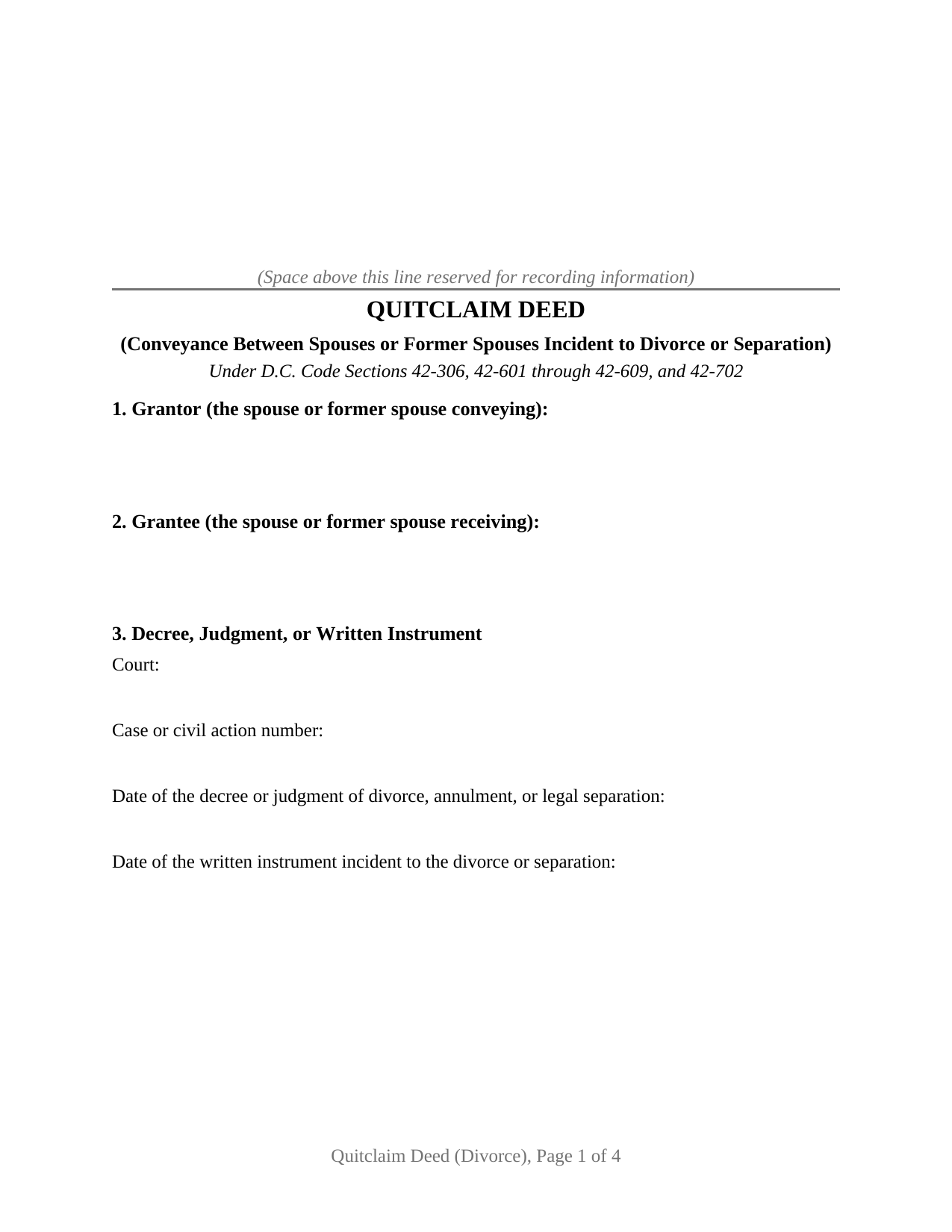
A judgment of absolute divorce can award the family home to one party and still leave the land records naming two. Closing that gap takes a deed. This quitclaim deed is built for that job in the District of Columbia: one spouse or former spouse releases whatever interest that person holds in Washington real estate to the other, without warranty, and Section 3 names the decree or agreement it performs.
What a decree orders, and what the land records show
D.C. Code Section 16-910 gives the Superior Court wide authority when a marriage ends. The court assigns each party that party's sole and separate property, then values and distributes everything else accumulated during the marriage, reaching it regardless of whether title is held individually or by the parties in a form of joint tenancy or tenancy by the entirety. A decree can therefore direct an interest neither owner could have severed alone. What it cannot do is sit in the land records: a title examiner finds a conveyance where a deed was recorded, not where a court file holds the answer.
One grantor, one seal, one certificate
The form recites a single grantor, the spouse or former spouse conveying, and a single grantee, the one receiving. Only the grantor signs, since D.C. Code Section 42-407(1) keys acceptance for record to execution and acknowledgment by the party granting the interest, so the deed carries one signature line and one acknowledgment certificate; both parties do sign Form FP-7/C, a separate return. The signature rule closes with the bracketed scroll the Section 42-601 statutory forms print, because Section 42-306(b) creates no estate in District real property except through a deed signed and sealed by the grantor; Section 9 adopts that notation as the seal. Four blanks in Section 3 take the court, the case number, and the dates of the decree and of any settlement agreement, so a deed signed while the case is pending and one signed afterward both have a place. Arrangements of this shape recur: a residence held by the entirety that a settlement agreement assigns to one party, a jointly titled rowhouse that one party refinances alone. The configuration is drawn for two people who are or were married to each other.
An exemption written for this transfer, with no price condition
Washington taxes a deed twice, recordation tax and transfer tax, each at 1.1 percent of consideration below $400,000 and 1.45 percent above it. Two paragraphs step aside. D.C. Code Section 42-1102(26) exempts from recordation tax deeds executed pursuant to a decree of divorce or of separate maintenance or pursuant to a written instrument incident to such divorce or separation, and Section 47-902(20) removes the transfer tax in nearly the same words. The phrasing repays attention: the District's better known family exemptions reach only transfers made without actual consideration, and these two carry no such condition. Money moving alongside, as an equalizing payment for one party's equity commonly does, does not push the deed outside them, and the completed example runs on that footing: a $92,500 payment, the exemption claimed. Backup is particular too: Form ROD 4, the Recorder of Deeds documentation list, asks three items of a deed pursuant to a divorce or of separate maintenance, the deed, Form FP-7/C, and the divorce decree and/or separation agreement itself. That court paper is the proof, where a spousal claim leans on an affidavit.
Released, not warranted, and the loan stays where it was
Nothing here promises anything about the title, and that comes from what the drafting leaves out. The phrases creating title covenants in the District live in D.C. Code Sections 42-604 through 42-608, and printing none of them is what makes an instrument a quit claim deed. Section 42-702 still carries across the estate the grantor holds at delivery, subject to every deed of trust, easement, and judgment already recorded, and Section 8 holds a listing of those matters under a printed sentence keeping it informational. And here is what most often catches people signing a deed after a divorce: moving record title out of one name leaves the note secured by that deed of trust exactly where it was, and only the lender changes that.
What ships is the deed as a blank fillable PDF, a completed example filled in for a Woodridge rowhouse released under a Judgment of Absolute Divorce, and a plain-language guide to the ten sections, the notarial steps, and the filing. The materials are informational and are not legal advice.
Important: County-Specific Forms
Our quitclaim deed (divorce) forms are specifically formatted for each of the 1 counties in District Of Columbia.
After selecting your county, you'll receive forms that meet all local recording requirements, ensuring your documents will be accepted without delays or rejection fees.