Florida Special Warranty Deed (Attorney-in-Fact Grantor)
County Specific Legal Forms Validated as recently as October 11, 2026 by our Forms Development Team
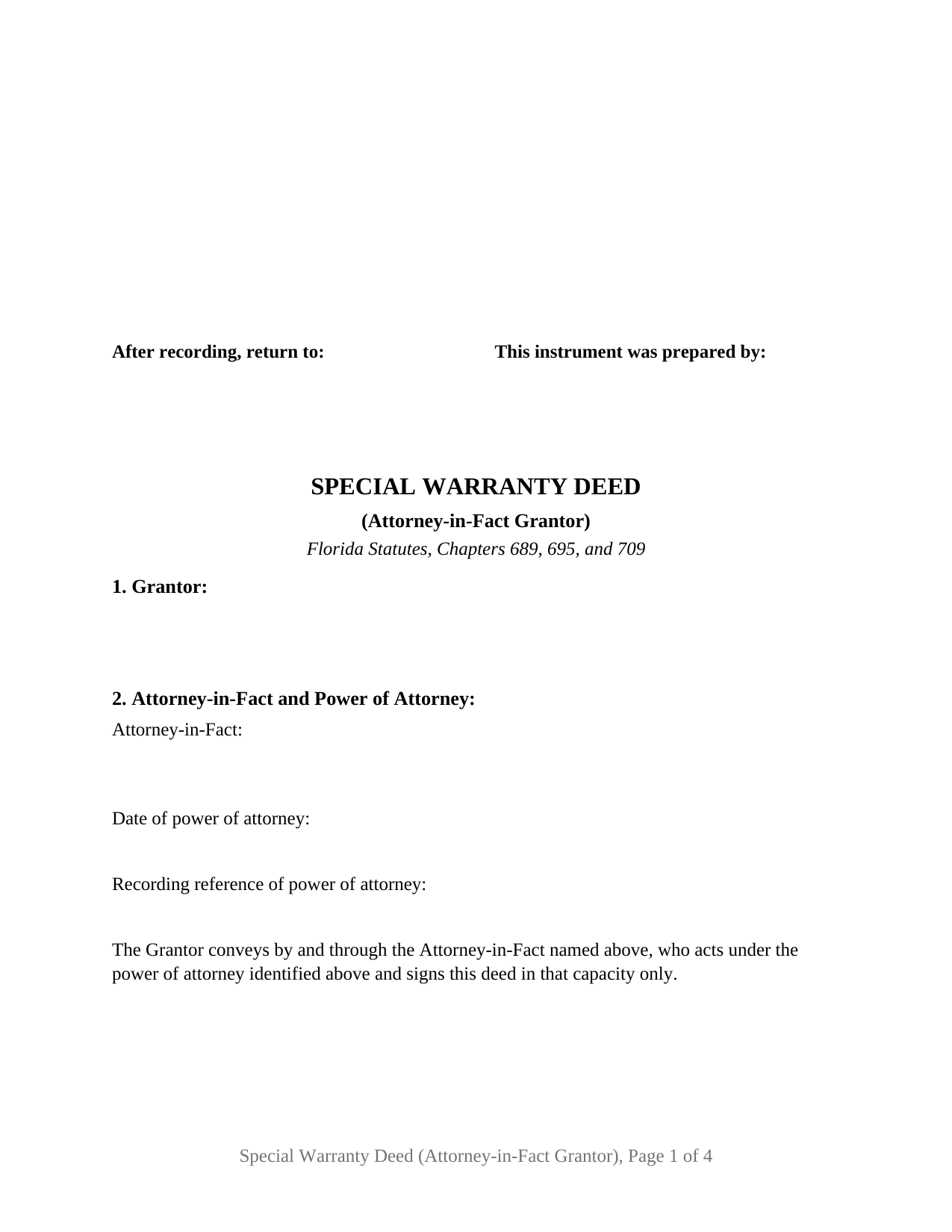
About the Florida Special Warranty Deed (Attorney-in-Fact Grantor)
How to Use This Form
- Select your county from the list
- Download the county-specific form
- Fill in the required information
- Have the document notarized if required
- Record with your county recorder's office
What Others Like You Are Saying
"Great service would use again"
"quick and easy to use"
"excellent and timely service."
"Love this site. Very informative and helpful!"
"First time user but very pleased with user friendly service and reasonable cost."
4.8/5 from 4,823 reviews. Read all
On this Florida special warranty deed the owner's name appears as grantor, and the signature beneath it belongs to someone else: the attorney-in-fact named in the owner's power of attorney. One grantor, a natural person, conveys real property in fee simple through one agent under a recorded power of attorney, warranting the title only against claims arising by, through, or under the grantor.
A signature that stands in for the owner's
Under section 709.2201(1) of the Florida Power of Attorney Act, an agent may exercise only the authority the power of attorney specifically grants; a clause letting the agent do all acts the principal could do grants nothing. The deed therefore identifies its authority on its face: Section 2 names the attorney-in-fact with the date and recording reference of the power of attorney, and the operative paragraph conveys by and through that agent. The attorney-in-fact signs under a block headed GRANTOR, BY ATTORNEY-IN-FACT, with the agent's own printed name and post office address beneath, the data section 695.26 asks of the person who executes the instrument. The grantor has no signature line.
Why the power of attorney is recorded first
Section 695.01(1) contains a rule written for this deed: an instrument executed under a power of attorney is not effectual against creditors or later purchasers for value without notice unless the power of attorney is recorded before their rights accrue. A power never yet recorded is recorded in the county where the land lies, before or with the deed, so the Section 2 reference points to an instrument in the same official records.
The certificate that names two people
Section 695.25(5) prints a statutory short form of acknowledgment for an individual acting as principal by an attorney in fact: the officer certifies that the instrument was acknowledged by the named attorney in fact, as attorney in fact, who is personally known or produced identification, on behalf of the named principal. The certificate on this deed reproduces that sentence, with the two boxes the officer marks for physical presence or online notarization, and reserves a labeled area for the rubber-stamp seal section 117.05 places below or beside the notary's signature. Two subscribing witnesses sign as well, with the printed name and post office address lines section 695.26 requires, and the first page keeps the top-right space the same section reserves for the clerk of the circuit court.
What the limited covenant reaches
The covenant is the grantor's, not the agent's, and it is measured by the grantor's own period of ownership: the grantor warrants and defends title against lawful claims of anyone claiming by, through, or under the grantor and against no one else, no other covenant of title arises, and the deed is not made under the section 689.02 statutory form. Section 7 records the instrument by which the grantor took title, where the covenant begins, and Section 8 lists the recorded matters the conveyance remains subject to as exceptions that create no further covenant. A separate sentence states that the attorney-in-fact makes no personal covenant.
One grantor, one agent, one certificate
The form recites exactly one grantor holding title in the grantor's own name, one attorney-in-fact, and one power of attorney, with a single signature block and a single acknowledgment certificate. An adult child selling a parent's rental property under a durable power of attorney while the parent is in long-term care, and a spouse completing a sale for a husband or wife stationed overseas, present the pattern this deed recites. The form is not set up as a deed by two owners conveying through agents, which presents two certificates, nor as a deed by a company, a partnership, or a trustee, each of which acknowledges on a different statutory form. It carries no joining-spouse block, so a married principal's homestead, which the Florida Constitution and section 709.2201(2)(b) require the spouse to join, presents a second signature the form does not carry. A conveyance for no consideration raises a separate question under section 709.2202(1), which permits an agent to make a gift only where the principal initialed that authority.
The download includes the deed as a fillable PDF, a completed example worked through a Pinellas County sale by an agent for her father under a recorded durable power of attorney, and a plain-language guide that treats every numbered section, the Chapter 709 authority rules, the witness and notary blocks, and the recording steps. The materials describe Florida law in general terms and are not legal advice.
Important: County-Specific Forms
Our special warranty deed (attorney-in-fact grantor) forms are specifically formatted for each of the 67 counties in Florida.
After selecting your county, you'll receive forms that meet all local recording requirements, ensuring your documents will be accepted without delays or rejection fees.