Florida Special Warranty Deed (Trustee Grantor)
County Specific Legal Forms Validated as recently as October 10, 2026 by our Forms Development Team
About the Florida Special Warranty Deed (Trustee Grantor)
How to Use This Form
- Select your county from the list
- Download the county-specific form
- Fill in the required information
- Have the document notarized if required
- Record with your county recorder's office
What Others Like You Are Saying
"Very useful and easy to use. Great value too. Especially liked the example."
"prompt, complete and efficient process --- kudos to you"
"Very simple to use website for remote recording of documents. I will definately use this platform fo…"
"Nice an easy. Just wondered if I can come back and still have my order (forms) available to get agai…"
"Nice service at a fair price. Website is not very user oriented. Messages accumulate in the messages…"
4.8/5 from 4,828 reviews. Read all
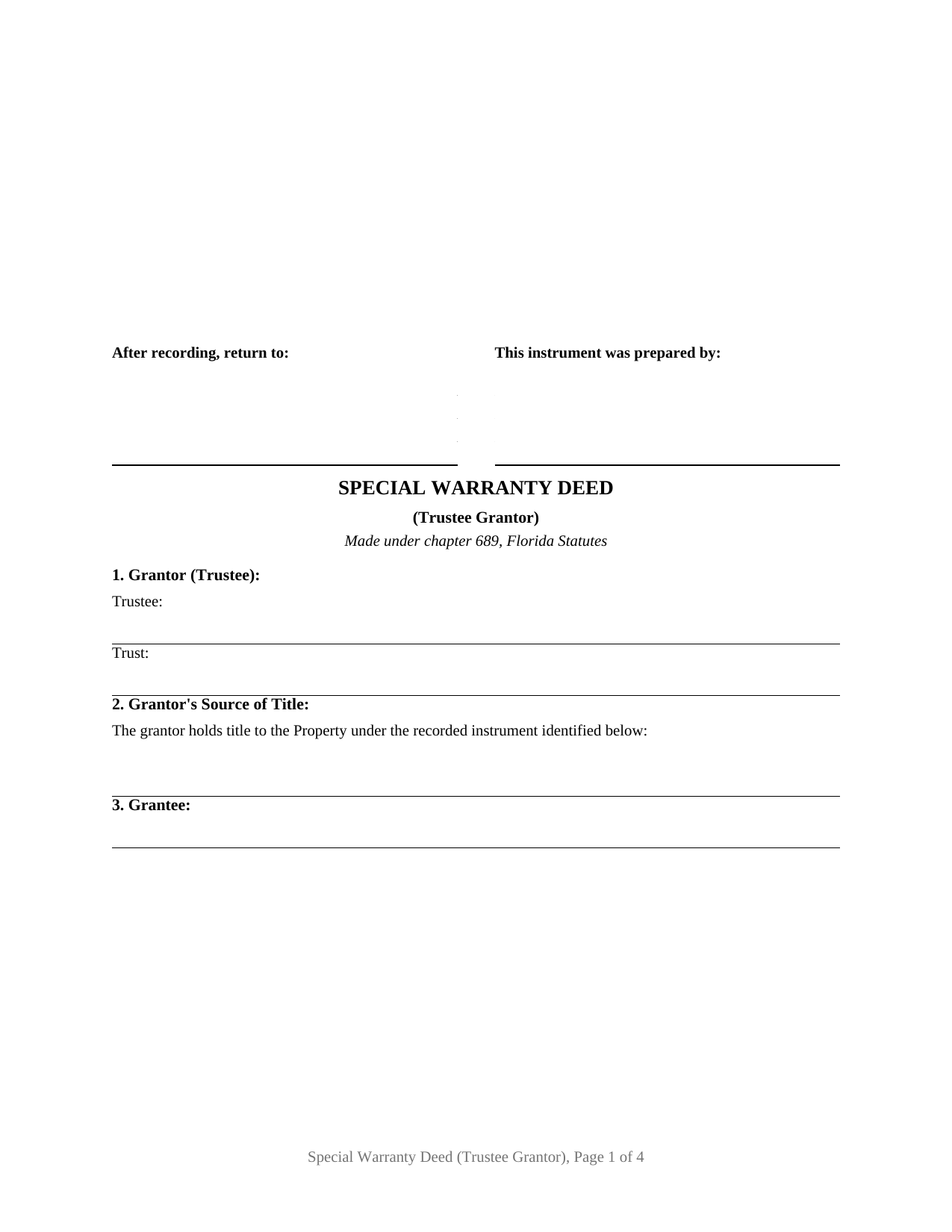
When Florida real property held in trust changes hands, the deed comes from the trustee, and the warranty a trustee gives ordinarily stops at the edges of the trust's own tenure. This special warranty deed prepares that conveyance: the trustee of an identified trust conveys the property in fee simple and warrants the title only against the lawful claims of persons claiming by, through, or under the grantor.
A warranty measured by the grantor's tenure
Florida writes two deed forms into statute. The warranty deed of section 689.02, Florida Statutes, carries full common-law covenants under section 689.03, reaching the entire history of the title; the quitclaim deed of section 689.025 conveys whatever interest the grantor holds with no covenant at all. The special warranty deed sits between them, and no Florida statute prescribes its form, so the instrument does the work itself: it conveys with ordinary words of conveyance, states an express covenant limited to claims arising by, through, or under the grantor, and states that no other covenant of title arises from the deed. Because section 689.03 attaches the full covenants to any deed substantially in the statutory form, that express limitation is what confines the promise to the grantor's own tenure, the posture that recurs wherever a fiduciary conveys property whose earlier chain of title the fiduciary never controlled.
Title held in trust, and what the record shows
Florida gives a purchaser from a trustee unusual statutory comfort, and one well-known trap. Under section 689.073, a recorded instrument that names the grantee as trustee and confers the power to protect, conserve, sell, lease, encumber, or otherwise manage and dispose of the described property vests the trustee with full power and authority of record, and a person dealing with that trustee takes free of unrecorded trust terms and beneficiary claims, with no duty to inquire. Section 689.07 is the other edge: a deed naming a grantee only as trustee, with no trust identified, can vest a personal fee simple instead. This form answers both statutes on its face. Section 1 identifies the trust by name and date, Section 2 identifies the recorded instrument through which the trustee holds title, and the operative sections recite that the trustee conveys in the stated capacity and not individually, with every covenant confined to that capacity.
One trustee, one trust, one certificate
The form recites exactly one grantor: the trustee of one identified trust, signing in that capacity. Its signature block is headed for the trustee, two subscribing witness blocks follow it, and a single acknowledgment certificate closes the deed, the statutory short form Florida prints for a trustee, whose name line carries the trustee's name and title of position on behalf of the trust. A successor trustee selling a residence after the settlor's death, a trustee of a revocable living trust selling investment property during the settlor's lifetime, and a land trustee conveying under recorded powers each present the pattern this deed recites. Co-trustees who sign together, a trustee who also conveys an individual interest in the same deed, and a grantor signing personally or for an entity each present a different signature and certificate architecture than this deed carries.
Signed and recorded like every Florida deed
The trustee signs before two subscribing witnesses under section 689.01, and since January 1, 2024, each witness's printed name and post-office address on the deed are recording requirements under section 695.26. The acknowledgment tracks the statutory short form of section 695.25(6), recording whether the trustee appeared by physical presence or by online notarization, with the representative capacity stated in the certificate and a reserved area under the officer's lines for the rubber-stamp seal section 117.05 places below or beside the signature. The first page reserves the 3-inch square at the top right for the clerk of the circuit court, and the documentary stamp tax of section 201.02, 70 cents per $100 of consideration in every county but Miami-Dade, is paid at recording; the Department of Revenue's trust rule analyzes a trustee's conveyance by beneficial ownership and consideration, and the guide walks through it.
The package pairs the fillable deed with a completed example, worked through a realistic Orange County fact pattern, and a plain-language guide that walks every numbered section, the witness and notary blocks, and the recording steps, with citations to the governing statutes. The materials are informational and are not legal advice; a Florida attorney can apply these rules to a specific trust and title.
Important: County-Specific Forms
Our special warranty deed (trustee grantor) forms are specifically formatted for each of the 67 counties in Florida.
After selecting your county, you'll receive forms that meet all local recording requirements, ensuring your documents will be accepted without delays or rejection fees.