Florida Special Warranty Deed (Corporation Grantor)
County Specific Legal Forms Validated as recently as October 10, 2026 by our Forms Development Team
About the Florida Special Warranty Deed (Corporation Grantor)
How to Use This Form
- Select your county from the list
- Download the county-specific form
- Fill in the required information
- Have the document notarized if required
- Record with your county recorder's office
What Others Like You Are Saying
"Everyone was very responsive and helpful. Thank you. I give you a 5!!"
"Such any easy process! Thank you!"
"Your Guide is very good but does not explain precisely where one can find the Instrument Number for …"
"The application was extremely easy to use with good instructions. Will definitely use a again."
"I wanted to do an Enhancement Life Quitclaim deed and the county government lady didn’t know what I …"
4.8/5 from 4,828 reviews. Read all
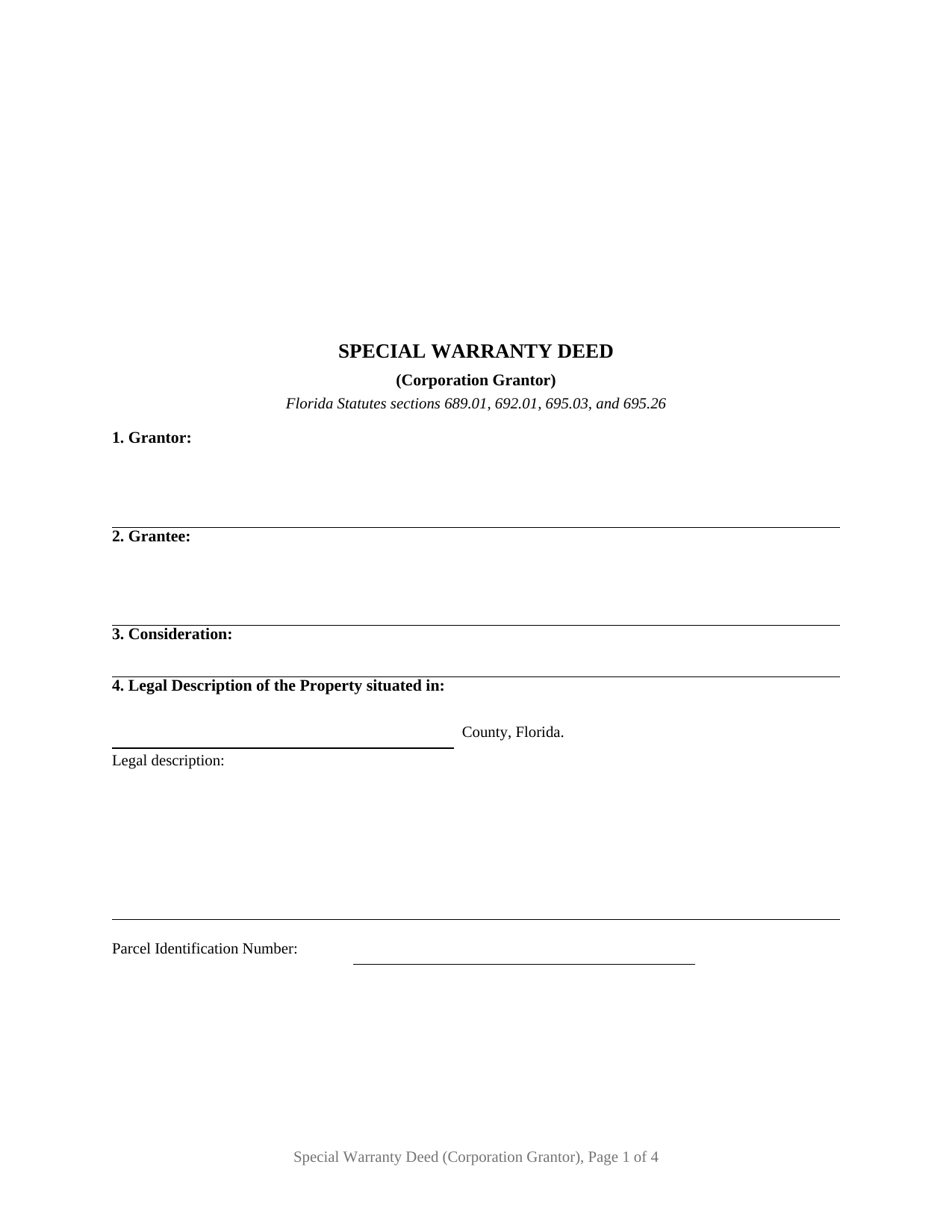
When a Florida corporation conveys real estate, two features set the deed apart from an everyday residential transfer: the warranty runs only for the corporation's own period of ownership, and Florida gives a corporation its own statutory way to sign. This special warranty deed form is built around both. The grantor is a corporation, the covenant reaches claims arising by, through, or under that corporation but against none other, and the execution block carries an officer signature line, a corporate seal space, and two witness blocks, so the completed deed satisfies either of Florida's corporate execution statutes.
A warranty measured by the corporation's own tenure
Florida prescribes no statutory special warranty form. Section 689.02 of the Florida Statutes supplies the statutory warranty deed, and section 689.03 gives a deed substantially in that form the full common-law covenants, reaching every defect back through the whole chain of title. A special warranty deed narrows the promise by express language: the grantor warrants and defends the title only against claims by, through, or under the grantor. A defect created by an earlier owner sits outside the covenant. This form states that limitation directly and adds that the deed is not made under the section 689.02 form, so the full statutory covenants do not attach by implication. The corporation stands behind what happened on its own watch and leaves earlier history to the title search and the transaction's title insurance.
Two statutory ways a Florida corporation signs
Section 689.01, the general statute of conveyances, calls for the grantor's signature in the presence of two subscribing witnesses and states that corporations may convey under that section or under sections 692.01 and 692.02. Section 692.01 is the corporate route: a deed sealed with the common or corporate seal and signed in the corporation's name by its president, any vice president, or its chief executive officer, with no recorded corporate resolution needed to evidence the signing officer's authority. This form provides for both routes at once. The officer signs under the corporate seal, two witnesses sign with the printed names and post-office addresses section 695.26 has required for recording since January 1, 2024, and the notary completes the statutory corporate acknowledgment short form from section 695.25(2).
What the form carries for a corporate seller
The deed's numbered sections collect the corporation's name and state of incorporation, the grantee's name and post-office address, the consideration, the county and legal description with a parcel identification number line, the street address, the source of title, and the recorded restrictions and easements the conveyance remains subject to, with a closing sentence stating that the listed matters are exceptions to the special warranty and create no additional covenant. The signature section recites the corporate capacity, and the officer who signs makes no personal promise; the covenant is the corporation's. The form recites exactly one corporate grantor; a company organized as an LLC, a partnership selling in the partnership name, and an individual seller each execute under different statutes and present a different signature architecture than this deed carries.
Recording with the clerk and the documentary stamp
The deed is recorded in the official records of the clerk of the circuit court in the county where the property is located, and the form reserves the blank space of at least 3 inches by 3 inches at the top right of the first page that section 695.26 sets aside for the clerk. Documentary stamp tax under section 201.02 is due at recording: 70 cents per $100 of consideration statewide, with Miami-Dade County following its own rate and surtax structure. Consideration under the statute includes any mortgage on the property, whether or not the grantee assumes it.
The package includes the blank deed as a fillable PDF, a completed example showing a realistic Orange County corporate sale, and a plain language guide that walks through every numbered section, the signing formalities, and the recording steps. The materials describe Florida law in general terms and are not legal advice.
Important: County-Specific Forms
Our special warranty deed (corporation grantor) forms are specifically formatted for each of the 67 counties in Florida.
After selecting your county, you'll receive forms that meet all local recording requirements, ensuring your documents will be accepted without delays or rejection fees.