Indiana Quitclaim Deed (Two Grantors)
County Specific Legal Forms Validated as recently as September 28, 2026 by our Forms Development Team
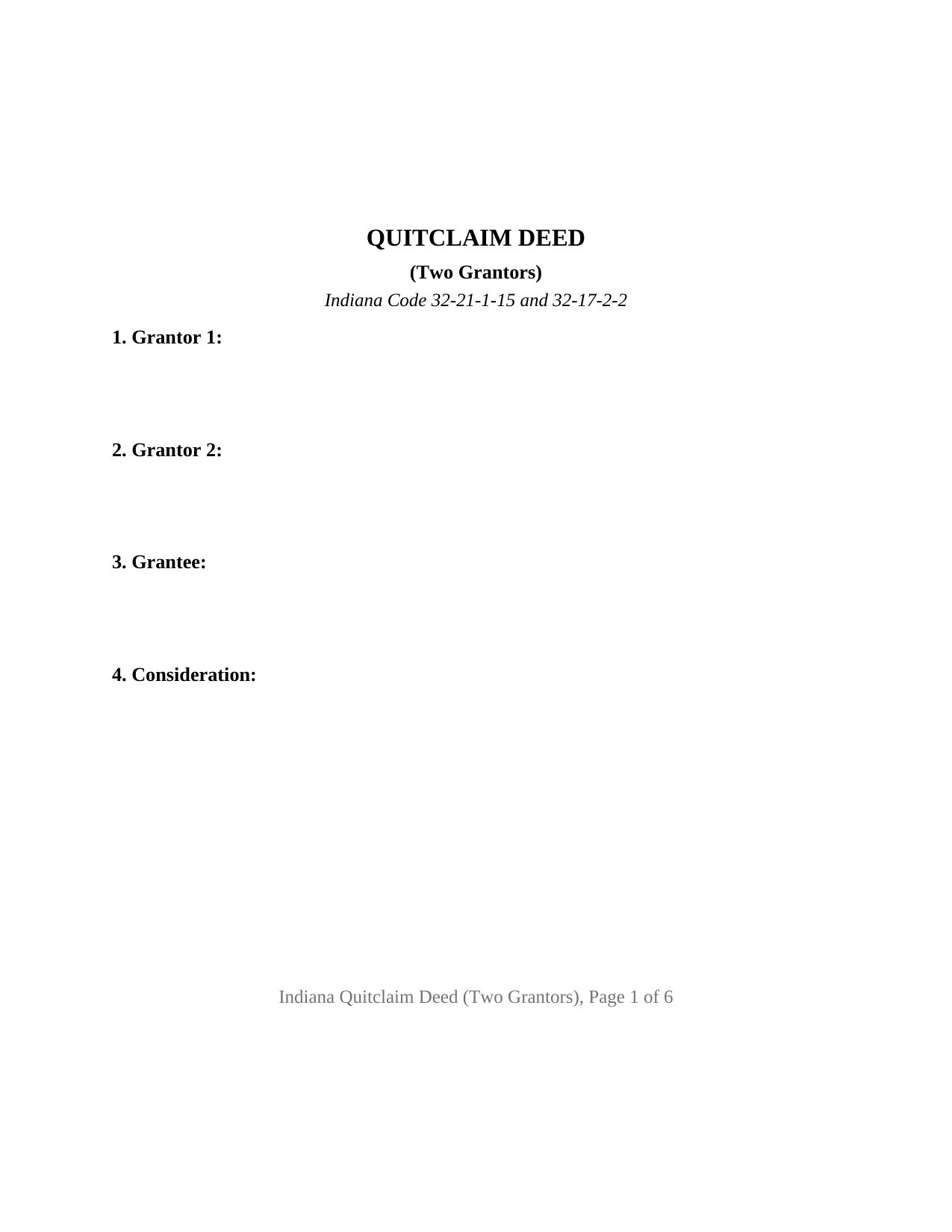
About the Indiana Quitclaim Deed (Two Grantors)
How to Use This Form
- Select your county from the list
- Download the county-specific form
- Fill in the required information
- Have the document notarized if required
- Record with your county recorder's office
What Others Like You Are Saying
"The Transfer On Death Deed did work for New Mexico! Though I did have to add the long property descr…"
"Love to work with your company"
"Excellent Service I was looking for a copy of deeds on a few properties. Researched online and ended…"
"Very user-friendly and easy to obtain exactly what I needed. I am impressed by the sample forms as w…"
"It was so easy to obtain the necessary documents."
4.8/5 from 4,828 reviews. Read all
Two record owners, one Indiana conveyance: this quitclaim deed carries two grantor sections, two signature blocks, and an acknowledgment certificate for each signer. The two grantor layout matches county title that stands in two names, with both owners joining in a single instrument that passes their combined interests to the grantee, without warranty of title.
When Both Names Must Leave the Record
Several Indiana ownership patterns put two names on a vesting deed. Two heirs or devisees commonly hold undivided fractional shares after an estate closes. Two co-buyers may hold as tenants in common or as joint tenants. And Indiana presumes that a conveyance to a married couple creates a tenancy by the entirety (IC 32-17-3-1), an estate that neither spouse conveys alone; Indiana case law holds that one spouse acting by that spouse's own signature cannot effectively pass the entireties estate, and IC 32-17-3-4 makes a deed executed jointly by both spouses sufficient to convey property held as tenants in common, joint tenants, or tenants by the entirety. In each of these patterns, clearing the whole title in one recording takes both owners on one deed, which is the pattern this form recites.
Each Grantor Passes What Each Grantor Holds
Indiana's statutory quitclaim wording under IC 32-21-1-15 turns on the operative word quitclaims, and IC 32-17-2-2 supplies the measure: the deed passes all the estate the grantor may convey by a deed of bargain and sale. With two grantors, that measure applies to each signer separately. Two tenants in common each pass an undivided half; two joint tenants pass the whole between them; spouses pass the unitary entireties estate together. The conveyance section of this form states that both grantors quitclaim their right, title, and interest, so the instrument reads as a quit claim deed in the wording Indiana practice recognizes, with no title covenants implied.
Two Signatures, Two Certificates
The form prints a signature block for each grantor, with the printed name line that IC 36-2-11-16(c) requires beneath each signature, and the grantor names reading identically in the body, the acknowledgments, and the signature blocks. Each grantor takes a separate acknowledgment certificate, so the two signers may acknowledge on different dates, before different notarial officers, or in different states; Indiana law does not demand a separate certificate per signer, and the two certificate layout is how this form keeps a divided signing day from stalling the recording. The form is not set up as a sole owner instrument, an entity or trustee conveyance, a deed signed under a power of attorney, or a deed for three or more grantors; each of those patterns prints a different signature and acknowledgment architecture.
From Two Owners to the County Record
The deed ends with the labeled statutory closings Indiana recorders check for, including the property tax statement address, the grantee mailing address, the preparer statement, and the redaction affirmation. Because a quitclaim deed that serves as a source of title for valuable consideration is a covered conveyance document under IC 6-1.1-5.5, the transaction may take a sales disclosure form through the county assessor, and the county auditor endorses the deed for taxation under IC 36-2-11-14 before the recorder of the county where the land lies accepts it. Once recorded, the deed holds its place in line: IC 32-21-4-1 gives priority to the instrument first recorded.
What the Download Contains
The download includes the two grantor Indiana quitclaim deed as a fillable PDF built to the state recording format, a completed example documenting a conveyance by two co-owners recorded in Allen County, and a guide that covers each section, both acknowledgment certificates, and the assessor, auditor, and recorder sequence. These materials describe Indiana law generally and are informational; they are not legal advice.
Important: County-Specific Forms
Our quitclaim deed (two grantors) forms are specifically formatted for each of the 92 counties in Indiana.
After selecting your county, you'll receive forms that meet all local recording requirements, ensuring your documents will be accepted without delays or rejection fees.