Indiana Quitclaim Deed (Trustee Grantor)
County Specific Legal Forms Validated as recently as September 18, 2026 by our Forms Development Team
About the Indiana Quitclaim Deed (Trustee Grantor)
How to Use This Form
- Select your county from the list
- Download the county-specific form
- Fill in the required information
- Have the document notarized if required
- Record with your county recorder's office
What Others Like You Are Saying
"Excellent service! Questions were answered promptly, and the entire process was easy and fast. Thank…"
"Document site was very easy to access and pull up what I needed."
"Extremely easy and fast recording of real estate records. I was impressed that it was less than 6 ho…"
"I just submitted a beneficiary deed and it was accepted immediate and then recorded the next day! I …"
"They are fantastic. I am a little technically challenged, but very helpful and respectful. Highly re…"
4.8/5 from 4,829 reviews. Read all
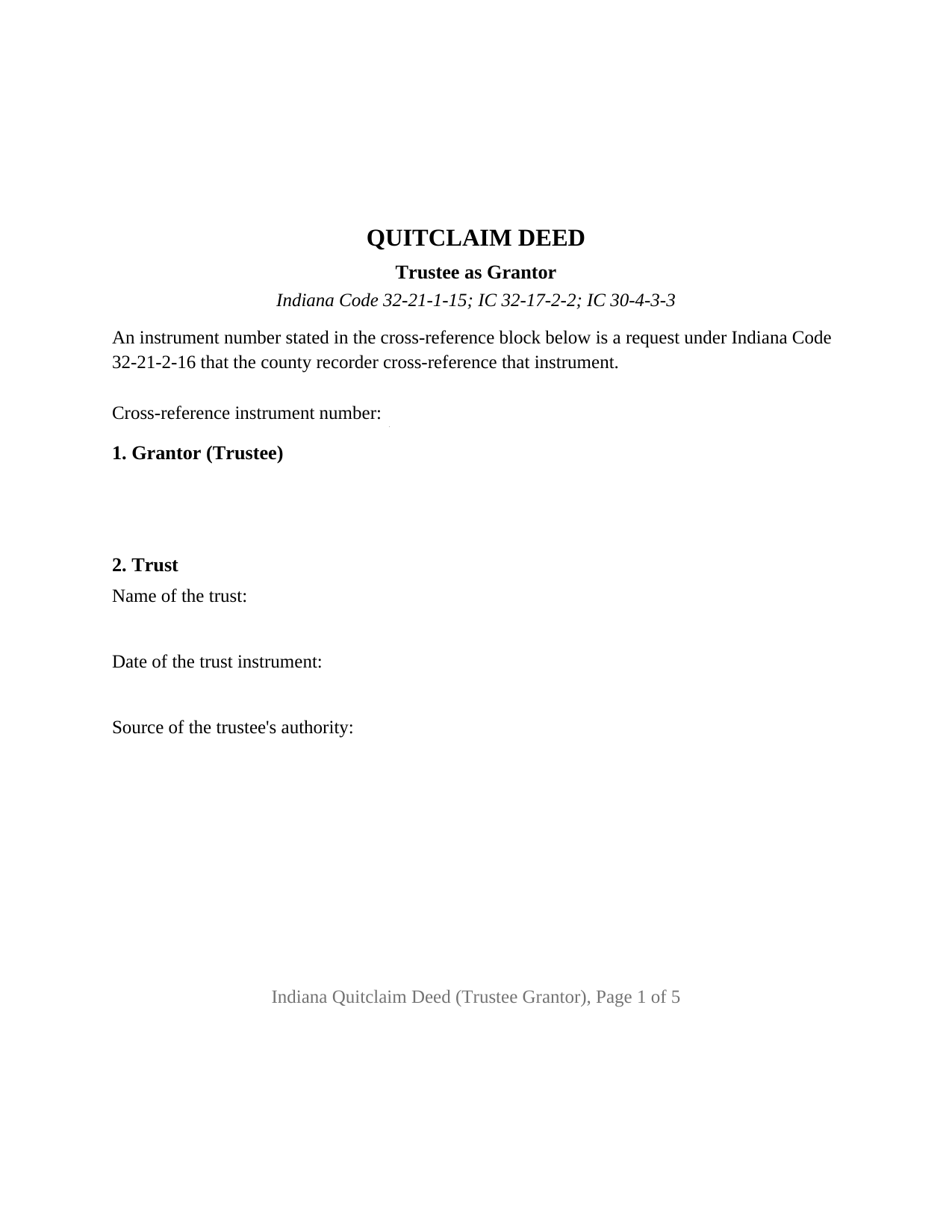
The signer on this Indiana quitclaim deed is a trustee. One trustee executes it as grantor, in a trustee capacity and not individually, and the deed moves whatever interest the trust holds in the described parcel to the grantee named in it, with no covenant of title attached. A single grantor section, a single signature line, and a single notarial certificate are what the form lays out.
A Deed Whose Real Question Is Authority
Legal title to Indiana trust real estate stands in the trustee under IC 30-4-2-6, so a deed out of a trust is signed by a person, not by the trust. That makes authority, rather than record ownership, the live question. IC 30-4-3-3(a) gives a trustee the power to deal with the trust estate and to buy, sell, or exchange and convey or transfer property without court authorization, and subsection (a)(18) adds the power to execute and deliver the instruments those powers need. The grant opens with a limit: except as provided in the terms of the trust. The trust instrument governs first, and Section 2 of this form collects the trust name, the date of the trust instrument, and the provision relied on, so the deed shows where the power came from.
Successor Trustees and the Joint Action Rule
Two provisions decide who signs. Under IC 30-4-3-4(d) a successor trustee, an additional trustee, or a surviving cotrustee may exercise all powers previously vested in the predecessor, the ground a successor trustee deed stands on after a settlor dies. IC 30-4-3-4(a) points the other way for shared offices: unless the terms of the trust provide otherwise, a power vested in two trustees is exercised jointly and a power vested in three or more by a majority. This form prints the single trustee configuration, so trust land with two acting trustees calls for an instrument carrying a signature block and a certificate for each of them.
What the Grantee Ends Up With
IC 32-21-1-15 builds Indiana's form on the verb quitclaims, and the reach of the release is measured by IC 32-17-2-2 at everything the signer could pass by a bargain and sale deed, so a mortgage, judgment lien, easement, or recorded restriction rides through untouched. Distinctive on the way out of a trust is IC 30-4-4-2(a): where the trustee commits no breach of trust in transferring an interest in trust property, the transferee holds that interest free of the trust and incurs no liability to the beneficiary. A buyer or beneficiary taking a trustee quitclaim deed leaves the trust arrangement behind, while taking the title exactly as the record leaves it.
One Trustee, One Certificate
The form recites one grantor, identified as trustee of the named trust, with one grantee entry. The signature block carries the printed name line of IC 36-2-11-16(c), that name reading the same way in the parties section, the certificate, and beneath the signature; one acknowledgment certificate follows, collecting the county of commission IC 33-42-9-12 makes certificate content. Record patterns presenting this configuration include a sole acting trustee selling trust land to a buyer, a successor trustee handing a residence to the beneficiary entitled to it under the trust, and a trustee returning a parcel to the settlor of a revocable trust. The form is not set up for cotrustees executing together, for a trustee on the receiving side of a conveyance, for an individual record owner, or for a corporate grantor or an attorney in fact.
What Consideration Decides at the Courthouse
The consideration entry drives the filing route. A sales disclosure form belongs to a transfer for valuable consideration under IC 6-1.1-5.5-1, so a trustee sale carries one to the county assessor while a distribution made for nothing does not. Either way the auditor's taxation endorsement under IC 36-2-11-14 comes before the recorder may take the deed, the charge is the flat statewide fee of IC 36-2-7-10, and no Indiana transfer tax applies. Filing in the county holding the land fixes priority under IC 32-21-4-1.
What the Download Contains
The purchase delivers three items: the fillable Indiana trustee quitclaim deed built to the state recording format, a completed example in which a successor trustee conveys a Tippecanoe County residence to a trust beneficiary, and a guide covering every entry, the certificate, and the county filing steps. A certification of trust under IC 30-4-4-5 is a separate instrument, prepared on its own and not part of this package. This material is informational and describes Indiana law generally; it is not legal advice.
Important: County-Specific Forms
Our quitclaim deed (trustee grantor) forms are specifically formatted for each of the 92 counties in Indiana.
After selecting your county, you'll receive forms that meet all local recording requirements, ensuring your documents will be accepted without delays or rejection fees.