Indiana Quitclaim Deed (Trustee Grantee)
County Specific Legal Forms Validated as recently as October 7, 2026 by our Forms Development Team
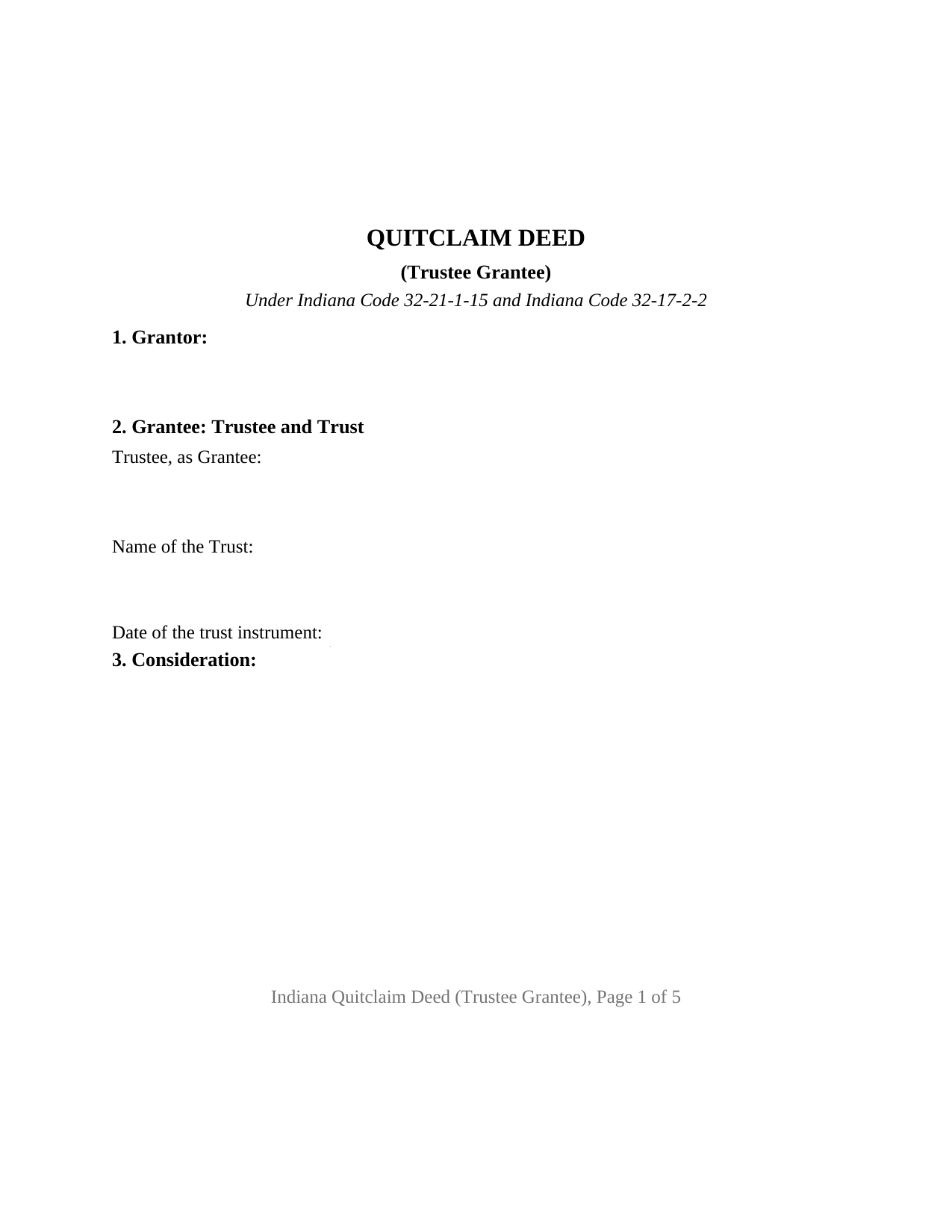
About the Indiana Quitclaim Deed (Trustee Grantee)
How to Use This Form
- Select your county from the list
- Download the county-specific form
- Fill in the required information
- Have the document notarized if required
- Record with your county recorder's office
What Others Like You Are Saying
"I really like the service and will be definitely be using it again to submit future deeds."
"Outstanding products and interface. DCM, IL Attorney"
"Amazingly simple, easy to download and use. Excellent service, Thank You"
"Found just what I needed!!! Instructions were easy to follow and I accomplished the task like a prof…"
"I was incredibly pleased with deeds.com—they handled my filing quickly and professionally, with both…"
4.8/5 from 4,828 reviews. Read all
Indiana keeps trust title in a person's name: the trustee takes the title to the trust property (IC 30-4-2-6). This Indiana quitclaim deed is configured for that receiving side: one grantor signs, and the grantee entry names the trustee, the trust, and the date of the trust instrument, so the record shows who holds title and in what capacity. What passes carries no warranty.
Title in Trust Reads Through the Trustee
IC 30-4-2-6 puts the title in the trustee and limits that estate to what is necessary to perform the trust, while IC 30-4-2-7 leaves the beneficiaries an equitable interest that appears nowhere on the deed. Indiana's definition of trust property reaches property titled in the name of the trustee or in the name of the trust (IC 30-4-1-2), and county indexes carry both styles. This form names the trustee as grantee and identifies the trust by name and date, the two elements IC 30-4-4-5 treats as a trust's identity. A search for a quit claim deed into a living trust describes this instrument.
What the Trust Receives
The operative word is the statutory one: IC 32-21-1-15 builds Indiana's quitclaim form on the verb quitclaims, and IC 32-17-2-2 measures the result as all the estate the grantor could pass by a deed of bargain and sale. A trust funded this way takes the grantor's record interest as the record leaves it, with any mortgage, judgment lien, easement, or mineral reservation still attached and no covenant of title behind it. The conveyance section states that measure and the trustee capacity together.
The Trust Instrument Stays Off the Record
Indiana lets a trustee act without publishing the trust. Under IC 30-4-4-1 a third person dealing with a trustee may assume without inquiry that the trustee holds the powers the trustee purports to exercise, absent actual knowledge otherwise. Subsection (c) is why recording a trust is a considered decision: where a trust that includes real estate is a public record in the county where the land sits, a third person dealing with the trustee is deemed to have actual notice of its terms. IC 30-4-4-5 supplies the middle path, a certification of trust reciting the trust's existence and date, the settlor, the acting trustee, the trustee's powers, revocability, and the manner of taking title. That certification is a separate instrument, not included in this package.
One Signature, and a Grantee Who Does Not Sign
The form recites one grantor executing in an individual capacity, one signature block, and one acknowledgment certificate collecting the notary's county of commission, an item IC 33-42-9-12 places in the certificate. The trustee named as grantee signs nothing here: IC 30-4-2-2 ties acceptance of the trust to a signature on the writing that evidences the trust or on a separate written acceptance. Record patterns presenting this configuration include a sole owner moving a residence into a living trust signed earlier that year, an owner conveying a rental parcel to the trustee of a relative's family trust, and an owner finishing the funding of a trust whose asset schedule lists the land. The form is not set up for cotrustees taking title together, for co-owners of record signing as grantors, for a conveyance back out of a trust, or for an entity grantor or an attorney in fact.
The Line the County Auditor Reads
A deed to a trustee meets Indiana property tax law at IC 6-1.1-12-37, which counts as a homestead a residence owned by a trust and described in IC 6-1.1-12-17.9. That section conditions the trust's entitlement to the listed deductions on the auditor's determination that the occupying individual, upon verification in the body of the deed or otherwise, holds a beneficial interest in the trust or a rent free right of occupancy under a qualified personal residence trust. Because the statute looks at the deed itself, this form carries a conditional section for that statement. Filing follows: the auditor endorses the deed for taxation under IC 36-2-11-14, and the county recorder takes it on the twenty five dollar charge of IC 36-2-7-10, with no Indiana transfer tax.
What the Download Contains
The package holds the fillable Indiana quitclaim deed to a trustee, built to the state's recording format, a completed example in which a Vanderburgh County owner conveys her residence to herself as trustee of her living trust, and a guide covering each entry, the certificate, and the filing steps. These pages describe Indiana law in general terms; they are informational and are not legal advice.
Important: County-Specific Forms
Our quitclaim deed (trustee grantee) forms are specifically formatted for each of the 92 counties in Indiana.
After selecting your county, you'll receive forms that meet all local recording requirements, ensuring your documents will be accepted without delays or rejection fees.