Indiana Quitclaim Deed (Divorce)
County Specific Legal Forms Validated as recently as September 22, 2026 by our Forms Development Team
About the Indiana Quitclaim Deed (Divorce)
How to Use This Form
- Select your county from the list
- Download the county-specific form
- Fill in the required information
- Have the document notarized if required
- Record with your county recorder's office
What Others Like You Are Saying
"This service is the absolute BOMB! I wish every business ran as fast and efficiently as you all do! …"
"It worked great. But it turns out I didn't need it."
"Couldn't believe how simple it was to do such a very important family support task and the price was…"
"Amazingly simple, easy to download and use. Excellent service, Thank You"
"Why is Dade County not listed for the Lady Bird Deed?"
4.8/5 from 4,836 reviews. Read all
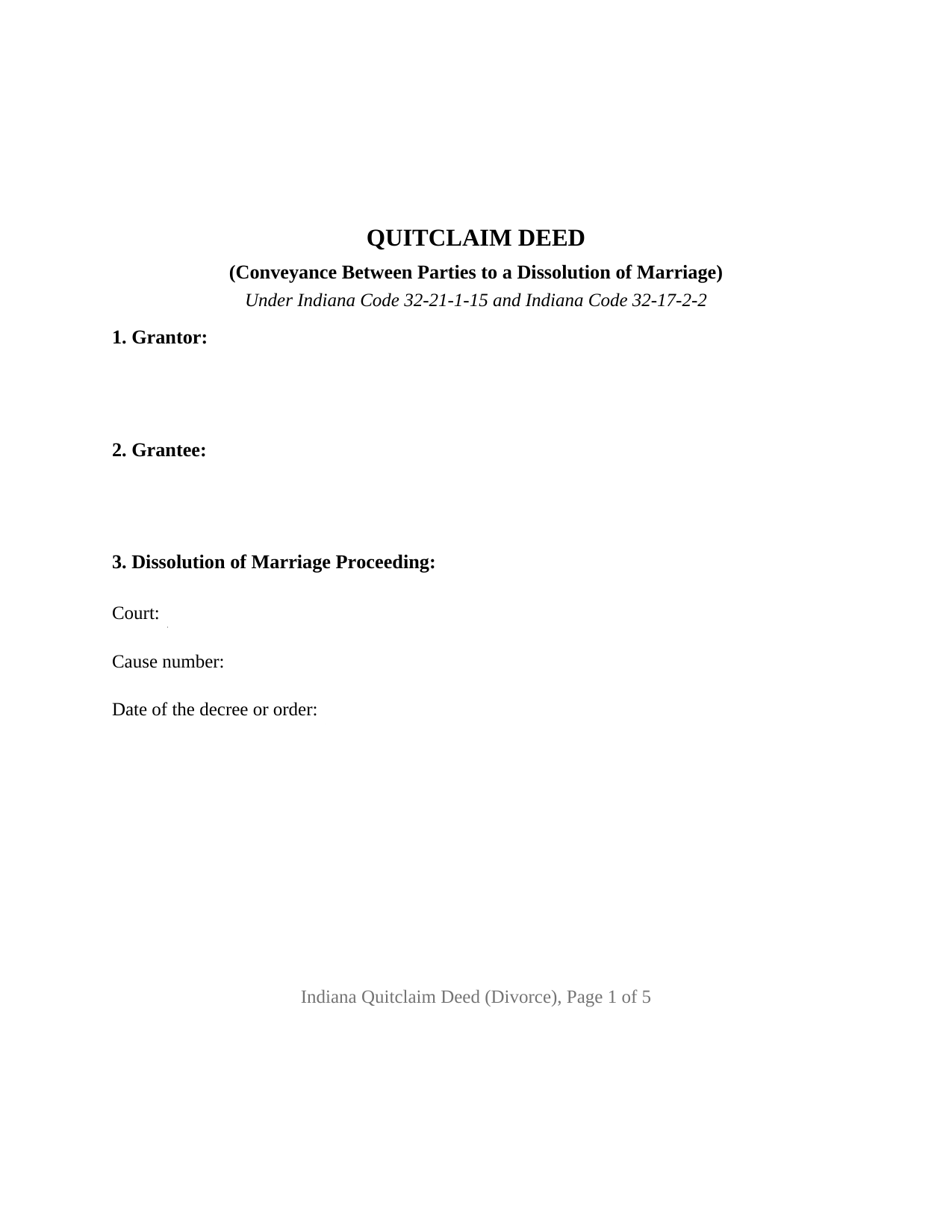
A dissolution decree decides who keeps the house. What it does not do by itself is move the parcel into the grantor and grantee index, where a title examiner reads it years later. This Indiana quitclaim deed does that work: one party to the dissolution signs as Grantor, the other is named as Grantee, and Section 3 identifies the court, the cause number, and the date of the decree or order the conveyance carries out.
Two Routes From a Decree to the County Record
Indiana gives a dissolution court both. Indiana Code 31-15-7-4 lets the court divide the property of the parties, including by setting a parcel over to one of them. Where a party then does not convey, Indiana Trial Rule 70(A) lets the court enter a judgment divesting the title of any party and vesting it in others, with the effect of both a judgment and of a conveyance executed in due form of law, and Trial Rule 70(C) allows a copy of that judgment to be recorded in the deed records as constructive notice. The other route is the ordinary conveyancing one: the party signs a deed that indexes under the two names the decree names. This form prepares that instrument.
What a Quitclaim Carries Between Divorcing Parties
The operative word is statutory. Indiana Code 32-21-1-15 builds the Indiana form on quitclaims, and Indiana Code 32-17-2-2 fixes the reach at all the estate the signer could pass by a deed of bargain and sale. A mortgage both parties signed, a judgment docketed against either of them, and a recorded easement all survive it, and no covenant of title stands behind them. What moves is an interest in land: a promissory note is a separate contract with a lender, and no deed ends one. A search for a quit claim deed after a divorce lands on this statutory wording rather than on a warranty deed with the covenants crossed out.
A Name the Decree May Have Changed
Indiana Code 31-15-2-18 has the court grant a restored maiden or previous married name upon entering the decree, leaving the signer's name at a distance from the name printed on the vesting deed. Indiana Code 36-2-11-16(c) wants one name reading the same way through the deed, the certificate, and the printed line under the signature, so Section 6 pairs the prior recorded instrument with the grantor's name as that instrument shows it, and the chain reads through both names on one page.
One Grantor, One Certificate, One Cause Number
The form recites exactly one Grantor signing in an individual capacity, one Grantee, one signature block above the printed name line, and one acknowledgment certificate, which collects the county of commission that Indiana Code 33-42-9-12 makes certificate content. The Grantee signs nothing. Record patterns presenting this configuration include a decree awarding the marital residence to one party and directing the other to convey, a parcel assigned by a settlement agreement the court approved under Indiana Code 31-15-2-17, and a signer reaching the notary months later under a restored name. Land the parties hold by the entireties answers to Indiana Code 32-17-3-1(b), under which the interest of neither party is severable during the marriage. It is not set up for a sale to an outside buyer, for an entity or trustee signer, for a deed under a power of attorney, or for a conveyance made by a person the court appoints.
Three County Desks
Consideration ordinarily decides the first stop, and a divorce transfer has an answer of its own: Indiana Code 6-1.1-5.5-2(a)(2) counts a document for a compulsory transaction resulting from divorce among the conveyance documents the sales disclosure chapter reaches, while state instructions place it outside the disclosure filing fee. The auditor's taxation endorsement under Indiana Code 36-2-11-14 comes next, and the recorder takes the deed on the flat twenty five dollar charge of Indiana Code 36-2-7-10, with no Indiana transfer tax. Filing where the land lies fixes priority from the time of recording under Indiana Code 32-21-4-1.
Three files arrive with the purchase: the fillable Indiana divorce quitclaim deed, built to the state's recording format; a completed example in which a Fort Wayne residence passes between former spouses under an Allen County decree; and a guide covering every entry, the certificate, and the county filing sequence. The decree is a court record, obtained and filed on its own. These pages describe Indiana law in general terms and are informational; they are not legal advice.
Important: County-Specific Forms
Our quitclaim deed (divorce) forms are specifically formatted for each of the 92 counties in Indiana.
After selecting your county, you'll receive forms that meet all local recording requirements, ensuring your documents will be accepted without delays or rejection fees.