Indiana Quitclaim Deed (Married Grantor with Non-Owner Spouse Joinder)
County Specific Legal Forms Validated as recently as October 21, 2026 by our Forms Development Team
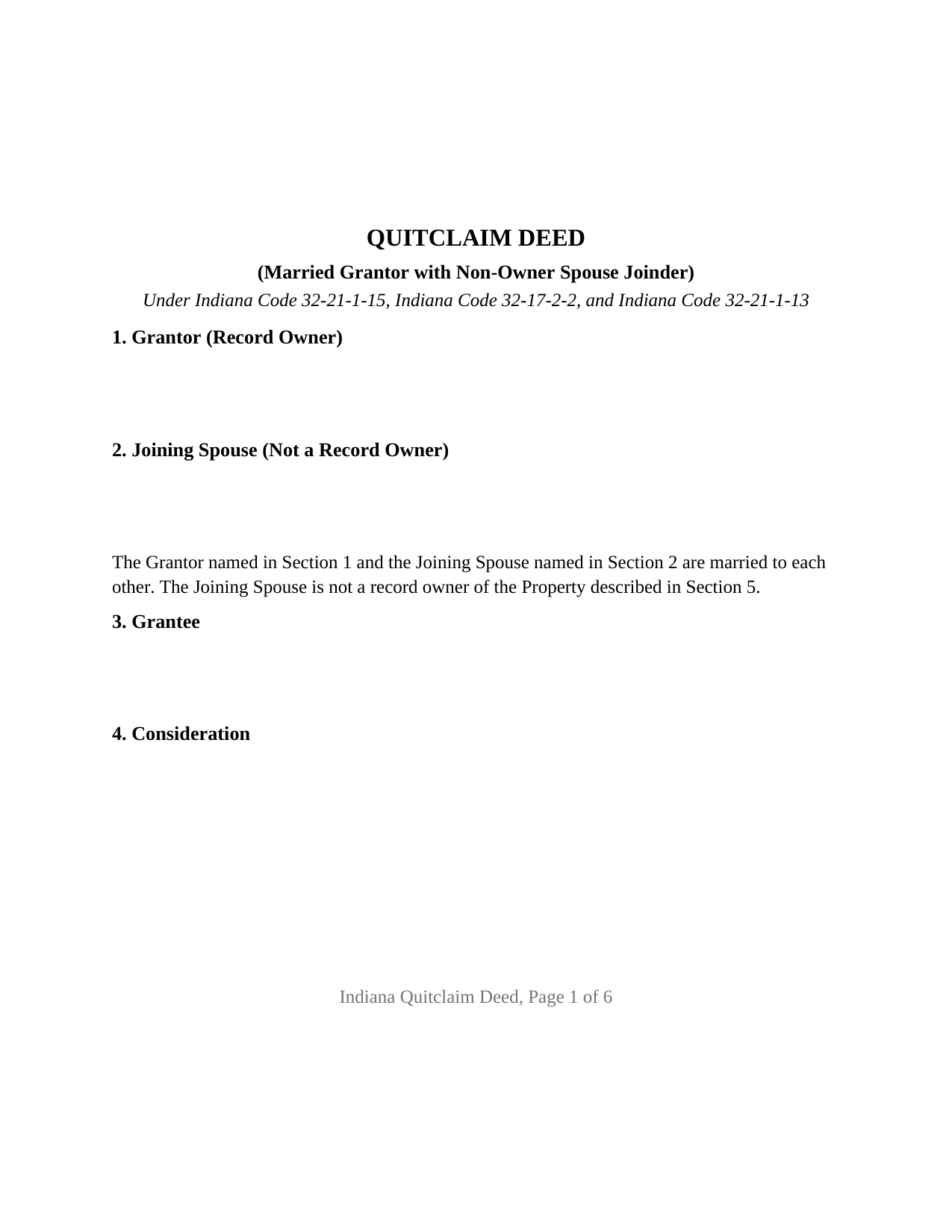
About the Indiana Quitclaim Deed (Married Grantor with Non-Owner Spouse Joinder)
How to Use This Form
- Select your county from the list
- Download the county-specific form
- Fill in the required information
- Have the document notarized if required
- Record with your county recorder's office
What Others Like You Are Saying
"It was easy to find the forms I was looking for and the guided steps and examples of how to use the …"
"Quick, user-friendly, and complete! Thank you"
"I am very happy with this service"
"Thanks, it was a big help!!!"
"A refreshingly easy service to use. They offer auxiliary forms as a courtesy. Theres no "gotcha…"
4.8/5 from 4,829 reviews. Read all
Indiana asks for one signature on this deed and gets two. The record owner is married, holds the parcel in that owner's name alone, and quitclaims it; the spouse, who is not on the record, signs the same instrument and releases any interest that spouse may have. This Indiana quitclaim deed is configured for that pair of signers, and neither gives a covenant of title.
A Second Signature the Statutes Do Not Ask For
Indiana retired the rules that once made a spouse's signature necessary on a lifetime deed. Dower and curtesy are abolished by IC 29-1-2-11. IC 29-1-2-3.1 goes further: an instrument a married owner executes without the spouse's joinder has the same effect as if the spouse had joined, and it extinguishes the spouse's claim to one third of the real property and any other right, choate or inchoate, arising from the marital relationship. IC 31-11-7-2 puts a married woman's property rights on the same footing as an unmarried woman's. The joinder here is an addition to the record rather than a statutory condition: a later reader of the chain finds the spouse's release on the face of the deed.
What the Joining Spouse Passes
The operative word for both signers comes from IC 32-21-1-15, and IC 32-17-2-2 fixes its reach: a release or quitclaim carries all the estate the signer could lawfully convey by a deed of bargain and sale. For a spouse who is not a record owner, that may be a real interest and it may be nothing, since the release is measured by what the spouse holds, not by what the deed says about it. The instrument states that the two are married and that the spouse is not a record owner, then quitclaims any interest the spouse may have, including any arising by reason of the marital relationship, without warranty. An Indiana quit claim deed with spousal joinder, or a marital interest release, is this instrument.
One Name on the Record, Two Signers on the Deed
The form recites one grantor signing in an individual capacity and one joining spouse identified in the instrument as a non-owner, with a single grantee entry. Each signs above the printed name line that IC 36-2-11-16(c) requires, and each takes an acknowledgment certificate, so the two can appear before a notarial officer on different dates or in different states; that second certificate is the form's own architecture rather than an Indiana requirement. Record patterns presenting this configuration include a parcel that reached one spouse through an estate distribution, a home bought before the wedding and never re-titled, and a sole owner moving that parcel to an adult child. The form is not set up for real estate titled in both spouses, a conveyance by co-owners of record, an entity or trustee instrument, or a deed signed under a power of attorney.
Two Signers, Twice the Name Matching
A joinder doubles the identity work Indiana recorders review. IC 36-2-11-16(c) calls for the printed name of each person executing the instrument beneath that person's signature, reading the same way in the body, in the acknowledgment, and on the printed name line, for the spouse exactly as for the grantor. The deed then closes with the statements Indiana places at the end of a conveyance: the tax statement address and the grantee's street address under IC 32-21-2-3(e), the preparer statement, and the redaction affirmation of IC 36-2-11-15.
Three Offices and One Deadline
Because a quitclaim deed that becomes a source of title for value falls inside the IC 6-1.1-5.5 definition of a conveyance document, a sales disclosure form reaches the county assessor first. The auditor's taxation endorsement under IC 36-2-11-14 follows, and the recorder for the county holding the parcel then takes the instrument on the flat twenty five dollar fee of IC 36-2-7-10; Indiana adds no transfer tax. A separate timing rule sits beside this: once a transfer on death deed is of record, IC 32-21-1-15(b) voids a later conveyance not itself recorded before the owner's death, and that designation instrument is prepared and recorded on its own, outside this package.
What the Download Holds
Three files come with the purchase: the quitclaim deed as a fillable PDF formatted to Indiana's recording standards, a completed example in which a Monroe County owner and his spouse convey to a married couple, and a guide covering the entries, both certificates, the joinder, and the county filing sequence. These pages describe Indiana law generally and are informational, not legal advice.
Important: County-Specific Forms
Our quitclaim deed (married grantor with non-owner spouse joinder) forms are specifically formatted for each of the 92 counties in Indiana.
After selecting your county, you'll receive forms that meet all local recording requirements, ensuring your documents will be accepted without delays or rejection fees.