Michigan Quitclaim Deed (Divorce)
County Specific Legal Forms Validated as recently as September 21, 2026 by our Forms Development Team
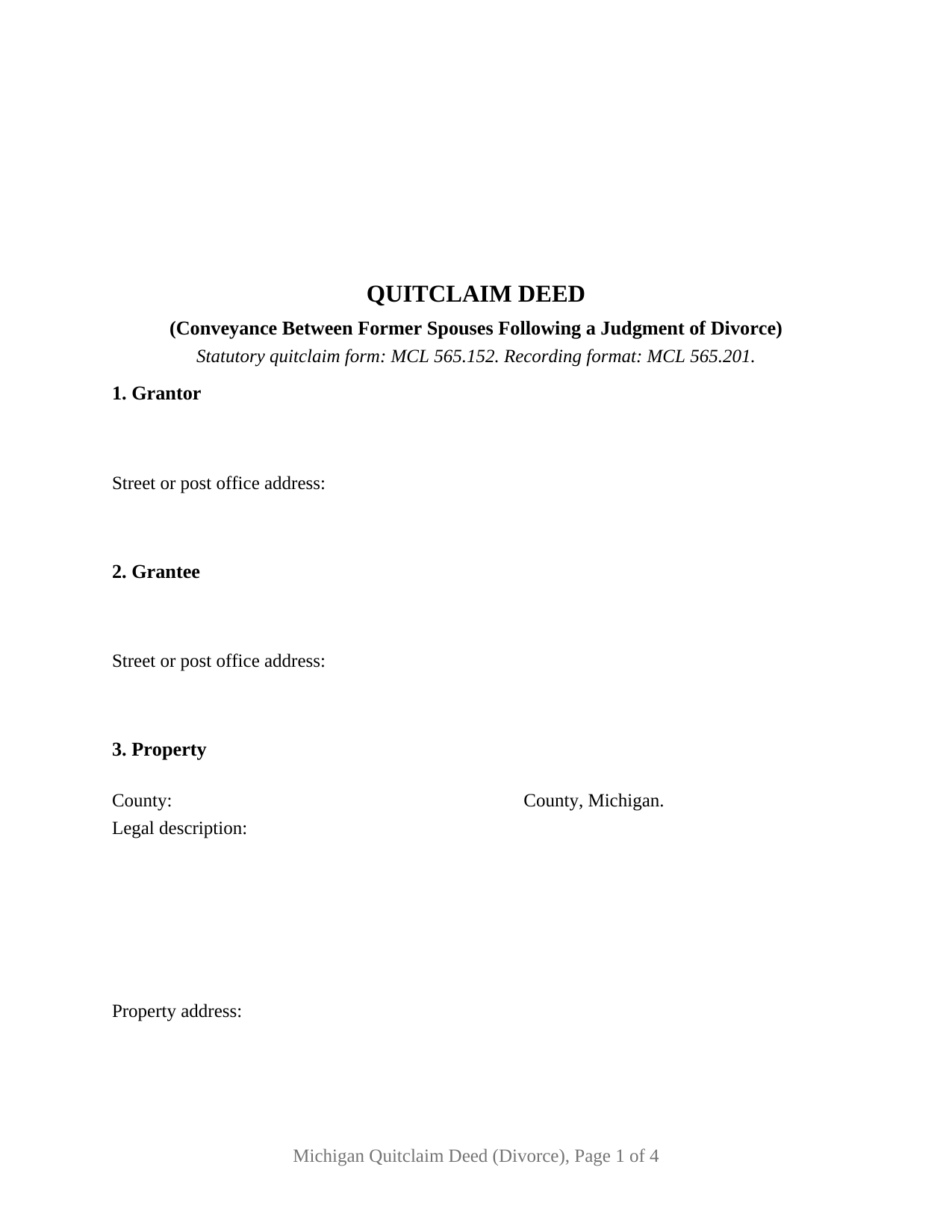
About the Michigan Quitclaim Deed (Divorce)
How to Use This Form
- Select your county from the list
- Download the county-specific form
- Fill in the required information
- Have the document notarized if required
- Record with your county recorder's office
What Others Like You Are Saying
"Very satisfied. In the middle of COVID19 I was able to complete important paperwork even though I wa…"
"So far this has been a great experience. Very easy to use the deeds.com website and download the for…"
"Nice service at a fair price. Website is not very user oriented. Messages accumulate in the messages…"
"I say I really do love Deed.com! Super easy to navigate and easy to get what you need for paperwork …"
"Easy to use quick responses with accurate information and great customer service. No need to say mor…"
4.8/5 from 4,815 reviews. Read all
A Michigan judgment of divorce settles who keeps the house. It does not rewrite the deed. Record title stays as the register of deeds indexed it, in both names, until an instrument moves one former spouse's interest to the other. This quitclaim deed is that instrument: one former spouse signs as Grantor, the other is named as Grantee, and Section 5 identifies the judgment by court, case number, and date of entry.
What the divorce has already done to the title
One change happened without anybody signing. MCL 552.102 provides that a husband and wife owning real estate as joint tenants or as tenants by the entireties become tenants in common upon being divorced, unless the ownership is otherwise determined by the judgment. The entirety estate that kept either spouse from conveying alone is gone, and each former spouse holds a separately conveyable undivided interest. Section 8 moves that interest in the statutory quitclaim words of MCL 565.152, passing what the Grantor holds at delivery with no covenant or warranty of title behind it.
Why the judgment is not the deed
A divorce judgment carries real force over land. Under MCL 552.401 a circuit court may award one party property owned by the other, and the judgment, on becoming final, carries the force and effect of a quitclaim deed of the real estate; MCL 552.104 allows a certified copy of a divorce decree to be recorded with the register of deeds of any Michigan county. What a judgment does not carry is the content MCL 565.201 makes a condition of receipt: a first line naming one recordable event, a recordable legal description, the grantee's address, total value or a stated exemption, and the drafter's business address. A deed supplies them, and the record then reads in one name.
One grantor, one grantee, one certificate
The form recites exactly one Grantor, the former spouse whose interest is leaving the record, and one Grantee, the former spouse who keeps the property. It carries one signature line, one printed name line beneath it in the form MCL 565.201(1)(a) requires, and one acknowledgment certificate carrying the notary items MCL 55.287 lists, including the county in which the notary is acting. The Grantee signs nothing. Title patterns presenting this configuration run through Michigan records: a marital home deeded over once the judgment awards it, and a jointly held rental parcel released to the party who took it in the property settlement. What the form is not set up as: a deed reciting two grantors, an instrument that modifies or enforces the judgment, or a deed whose signer acts for an entity, as a trustee, or under a power of attorney.
The tax lines a court ordered transfer fills in
The two transfer taxes are computed on total value, the state act charging $3.75 for each $500 under MCL 207.525 and the county act $0.55 under MCL 207.504. An exemption reaches an instrument only where its own face cites the subparagraph claimed, so Section 6 carries a line for each act. A court ordered transfer has its own letter in each: MCL 207.526(l) and MCL 207.505(j) reach a judgment or order of a court of record making or ordering a transfer, unless a specific monetary consideration is specified or ordered by the court. MCL 211.27a(7)(h) draws the property tax line in the same place, excluding a transfer pursuant to such a judgment from the transfers that uncap taxable value, while the exclusion at MCL 211.27a(7)(a) speaks of spouses rather than former spouses.
What the deed leaves behind
Recording happens at the register of deeds where the land lies, at the flat $30 fee of MCL 600.2567; Wayne County works from the charter county schedule it adopted for 2026. Recording buys priority, since MCL 565.29 voids an unrecorded conveyance against a later good faith purchaser who records first. It buys nothing from the lender, because the note obligation stays where the loan documents put it, and liens, easements, and restrictions of record ride along untouched.
The download delivers this deed as a blank fillable PDF, a completed example filled in for a Jackson County subdivision lot conveyed under a judgment entered June 12, 2026, and a plain language guide covering each section, the notarization, recording, and the Property Transfer Affidavit the new owner files with the local assessor inside 45 days. Often searched as a quit claim deed after divorce, the form and these materials describe Michigan law in general terms and are not legal advice.
Important: County-Specific Forms
Our quitclaim deed (divorce) forms are specifically formatted for each of the 83 counties in Michigan.
After selecting your county, you'll receive forms that meet all local recording requirements, ensuring your documents will be accepted without delays or rejection fees.