Michigan Quitclaim Deed (Married Couple as Grantors)
County Specific Legal Forms Validated as recently as October 9, 2026 by our Forms Development Team
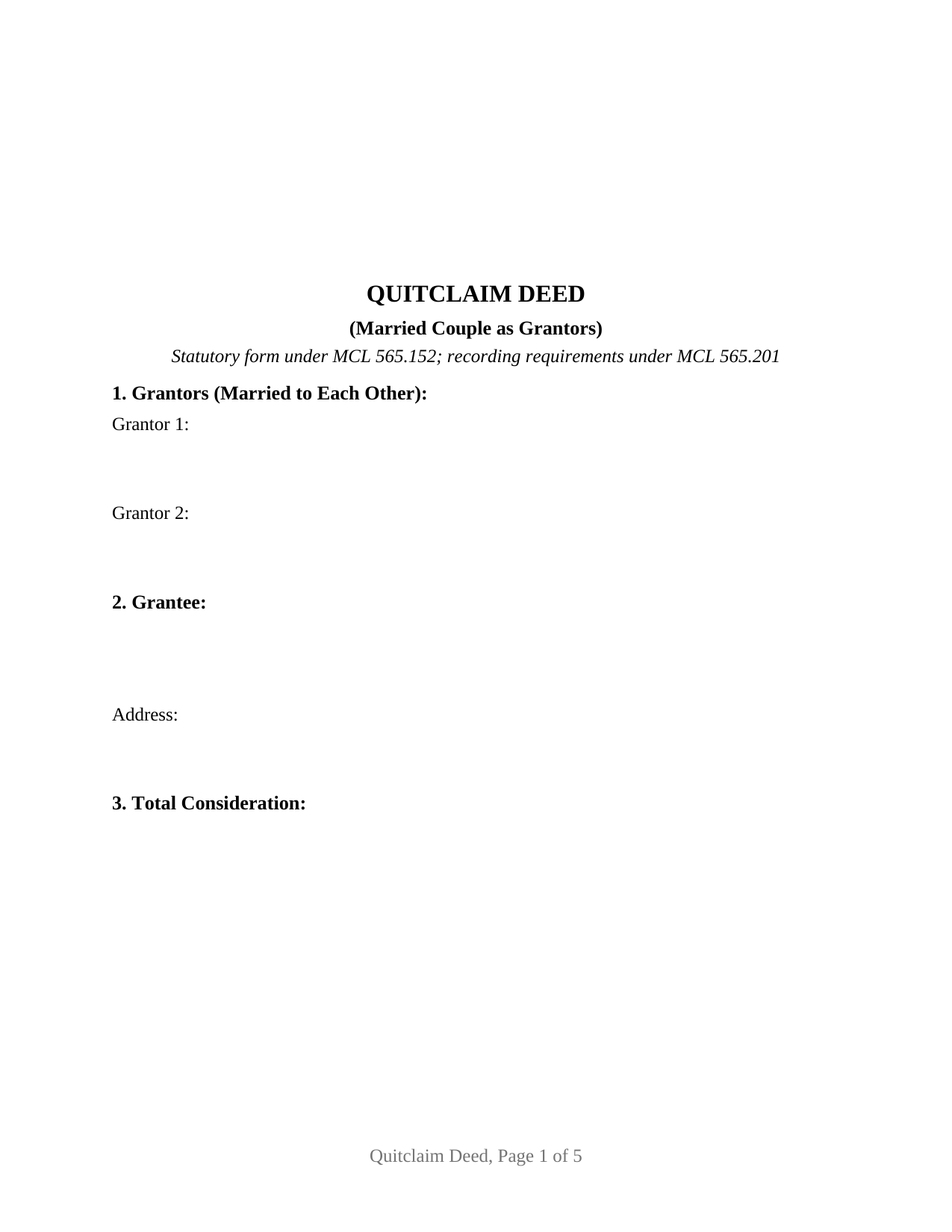
About the Michigan Quitclaim Deed (Married Couple as Grantors)
How to Use This Form
- Select your county from the list
- Download the county-specific form
- Fill in the required information
- Have the document notarized if required
- Record with your county recorder's office
What Others Like You Are Saying
"Very easy!"
"Using your site was simple, and the forms downloaded as expected."
"I got a blank, a sample and detailed instructions, I'm happy. If the recorder's office had a form as…"
"Got the quit claim forms, amazing really. Easy to understand, looked great when completed, accepted …"
"Took it to the Courthouse and the Register of Deeds said,"well Done" Thanks you so much."
4.8/5 from 4,828 reviews. Read all
Spouses who convey Michigan real estate together are the whole design of this quitclaim deed: the grantor section names a married couple and states that the two grantors are married to each other, both spouses sign above printed-name lines, and an acknowledgment certificate closes the deed for each of them. The operative words come from the statutory form at MCL 565.152, so the couple quit claims the described property to the grantee for the stated consideration, passing their combined interest as it stands at delivery, without warranty of title.
One estate, two signatures
Michigan folds a married couple's ownership into a single estate. When a deed runs to two people who are married to each other, MCL 554.45 and MCL 557.71 presume a tenancy by the entirety: one undivided title with survivorship built in, shielded by MCL 600.6023a from execution on a judgment against just one spouse, and beyond the reach of either spouse acting alone. In Tkachik v Mandeville, the Michigan Supreme Court treated the estate as one that neither spouse can convey, encumber, or devise unilaterally, and divorce converts what remains into a tenancy in common under MCL 557.101. A conveyance out of a couple's title is therefore a two-signature event, and this deed pairs every element, grantor block, signature line, printed name, and notary certificate, spouse for spouse.
Husband and wife as the grantors
The form recites exactly two grantors who are married to each other, conveying in a personal capacity. The marital statement sits in the grantor section beside the couple's names, mirroring the husband-and-wife or married-couple wording in the deed that gave them title, and the conveyance section then passes the couple's interest, including any interest held by the entirety, in one operative sentence. What the form is not set up as: a deed by one spouse alone, a transfer between the spouses themselves, a conveyance by co-owners who are not married, or an execution by a trustee or attorney-in-fact; each of those follows a different signing pattern. With a certificate for each spouse, the couple can appear before the notary together or at different times, Michigan's remote electronic notarization framework under the Michigan Law on Notarial Acts reaches a deed like this one, and no subscribing witnesses have been part of Michigan deed execution since 2002.
From the couple to the family trust
The pattern that most often presents a married couple as quitclaim grantors is trust funding: spouses holding a home or cottage by the entirety move it into their revocable living trust while both are living. The completed example carries that transfer through every entry, with an Oakland County couple conveying their platted subdivision lot to themselves as trustees of their family trust for one dollar and completing the deed's exemption citation line for each transfer tax act, since MCL 207.526 and MCL 207.505 each excuse an instrument whose consideration is under one hundred dollars. Where a trustee takes title this way, a certificate of trust can evidence the trustee's authority in the record, and MCL 565.434 has that certificate recorded as a separate document beside the deed.
Onto the record
At the register of deeds of the county where the land lies, the deed leads with a one-line statement of what it is, since MCL 565.201 reads the first line of print for the recordable event, and it presents the grantee's mailing address and the drafter's name and business address among the same statute's conditions of receipt. Once recorded, the deed holds its place under Michigan's race-notice rule, and MCL 565.29 says in terms that taking by quitclaim does not of itself undo the good faith of a grantee who records first.
The download delivers three pieces: the blank quitclaim deed as a fillable PDF, a completed example that walks the Oakland County trust-funding transfer line by line, and a plain language guide to every section, the signing and notarization of both spouses, and the recording steps. Often searched as a quit claim deed for a husband and wife, the form and its materials describe Michigan law in general terms and are not legal advice.
Important: County-Specific Forms
Our quitclaim deed (married couple as grantors) forms are specifically formatted for each of the 83 counties in Michigan.
After selecting your county, you'll receive forms that meet all local recording requirements, ensuring your documents will be accepted without delays or rejection fees.