Michigan Quitclaim Deed (Trustee Grantee)
County Specific Legal Forms Validated as recently as October 9, 2026 by our Forms Development Team
About the Michigan Quitclaim Deed (Trustee Grantee)
How to Use This Form
- Select your county from the list
- Download the county-specific form
- Fill in the required information
- Have the document notarized if required
- Record with your county recorder's office
What Others Like You Are Saying
"Very easy user friendly thank you for that"
"Applied for my Notice of Commencement to be recorded and it went very smoothly and fast. Will use ag…"
"Wonderful forms! Thanks for making this available."
"Easy to use, understand and pay on the website."
"I was very pleased with the end results regarding Quitclaim deeds."
4.8/5 from 4,832 reviews. Read all
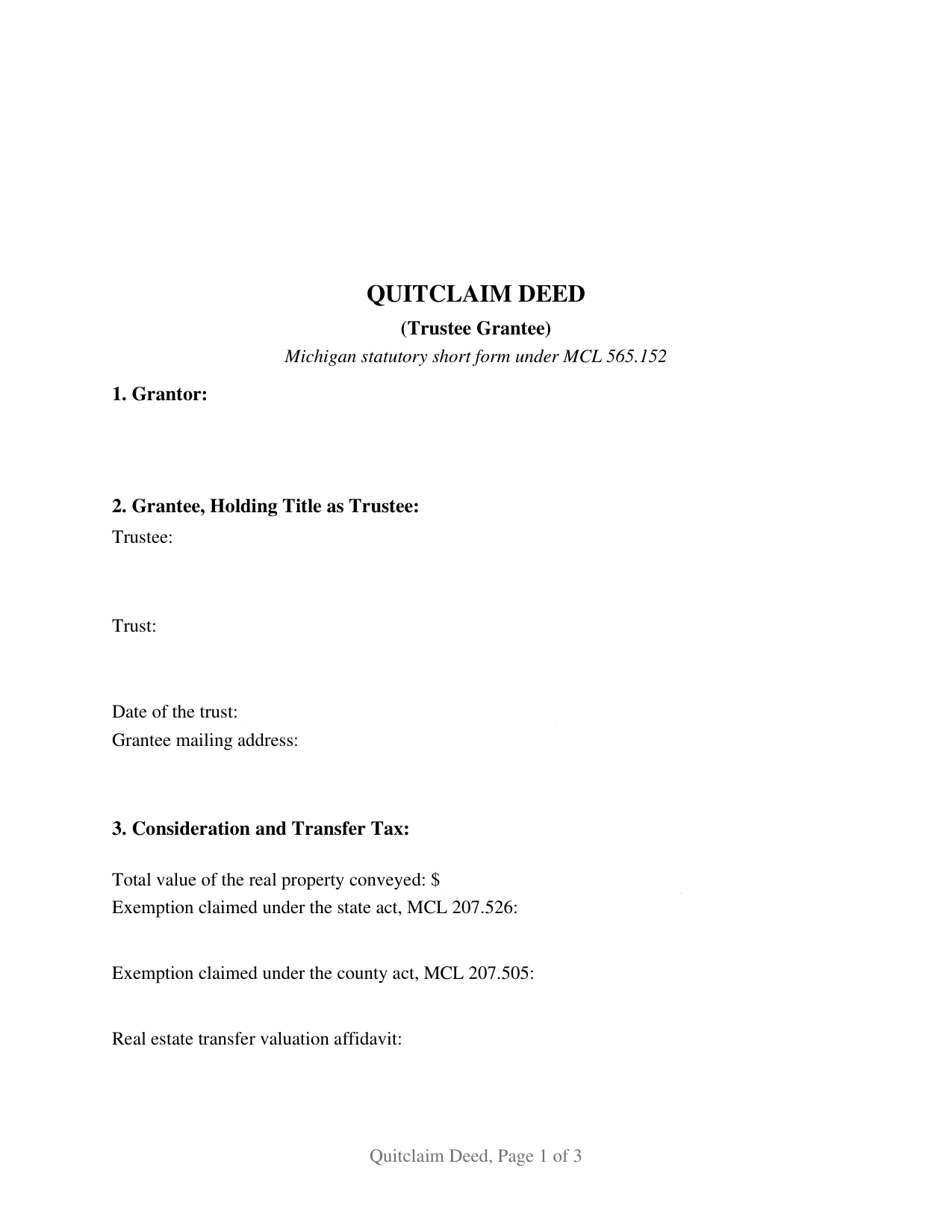
The grantee line is what distinguishes this Michigan quitclaim deed. It names a person, states that the person takes in a trustee capacity, and identifies the trust by name and by the date of the trust instrument. One individual signs as Grantor, and the interest lands in the hands of a trustee rather than in the hands of an owner holding for himself or herself.
Why the trustee is named and the trust is not
Michigan land records vest title in the trustee, not in the trust as an abstract entity, so a grantee clause reading only in favor of a trust leaves a register of deeds and a later title examiner without a person to work with. This form collects four things in its grantee section: the trustee, the trust, the date of the trust, and the trustee's mailing address, which MCL 565.201(1)(d) makes a condition of recording for every grantee. The completed example adds the words and any successor trustee to the grantee line, so the record follows the office rather than the individual currently holding it. Section 7 then performs the transfer in the statutory words of MCL 565.152, under which the grantor quit claims the described premises, passing the interest held at delivery with no covenant or warranty of title behind it.
What the register of deeds record can show about trustee authority
A deed states the capacity in which its grantee takes. Evidence of the trustee's power to sell, mortgage, or convey later comes from a certificate of trust under MCL 700.7913, prepared and recorded separately from the deed under MCL 565.434 and not included in this package. Recording that certificate has a defined payoff in Michigan: MCL 565.435 gives a party relying on a recorded certificate of trust existence and authority the protection of a good faith purchaser under MCL 565.29, with no obligation to examine the trust agreement itself. Checklists that still cite MCL 565.432 and MCL 565.433 for certificate contents are working from repealed sections; 2018 PA 492 struck both, effective December 27, 2018, leaving content to the EPIC provision.
One grantor, one trustee grantee
The architecture is single throughout: one grantor block, one signature line with the printed name MCL 565.201(1)(a) places beneath it, and one acknowledgment certificate carrying the notary items MCL 55.287 lists, including the county of commission and the county in which the notary is acting. The grantee signs nothing. Ownership patterns presenting this configuration turn up regularly in Michigan records: an owner moving a parcel into a trust drawn in that owner's own estate plan, an heir releasing an undivided share to the trustee already administering the rest of the family land, a co-owner clearing a stale interest out of the chain in favor of the trustee who now holds the parcel. What the form is not set up as: a deed by two record owners, which recites two signature blocks; a deed out of a married couple's title, which MCL 554.45 and MCL 557.71 treat as one entirety estate neither spouse can convey alone; or an execution in a trustee or attorney in fact capacity on the grantor side, a capacity this deed does not state.
The assessment question behind a transfer into trust
Value belongs on the face of the deed, where MCL 207.525 and MCL 207.504 look for it, and an exemption operates only when the instrument cites the subdivision claimed, separately for each act because the two lists differ. The property tax question is the one peculiar to trusts. A conveyance to a trust counts as a transfer of ownership under MCL 211.27a(6)(c), which would reset taxable value, but MCL 211.27a(7)(g)(i) excludes a conveyance in which the settlor or the settlor's spouse conveys and the sole present beneficiary is the settlor or the settlor's spouse, and MCL 211.27a(7)(g)(ii) reaches residential property whose sole present beneficiaries are named close relatives of the settlor. The new owner still files Treasury Form 2766 with the local assessor within 45 days.
Delivered here: the blank fillable deed, a completed example that fills every entry for an unplatted Ingham County parcel moving to a family trustee, and a plain language guide to each section, the notarization, and recording at the flat thirty dollar fee of MCL 600.2567. Often searched as a quit claim deed to a trust or a deed to trustee, this Michigan quitclaim deed and its materials describe Michigan law in general terms and are not legal advice.
Important: County-Specific Forms
Our quitclaim deed (trustee grantee) forms are specifically formatted for each of the 83 counties in Michigan.
After selecting your county, you'll receive forms that meet all local recording requirements, ensuring your documents will be accepted without delays or rejection fees.