Michigan Quitclaim Deed (Married Grantor with Non-Owner Spouse Joinder)
County Specific Legal Forms Validated as recently as October 9, 2026 by our Forms Development Team
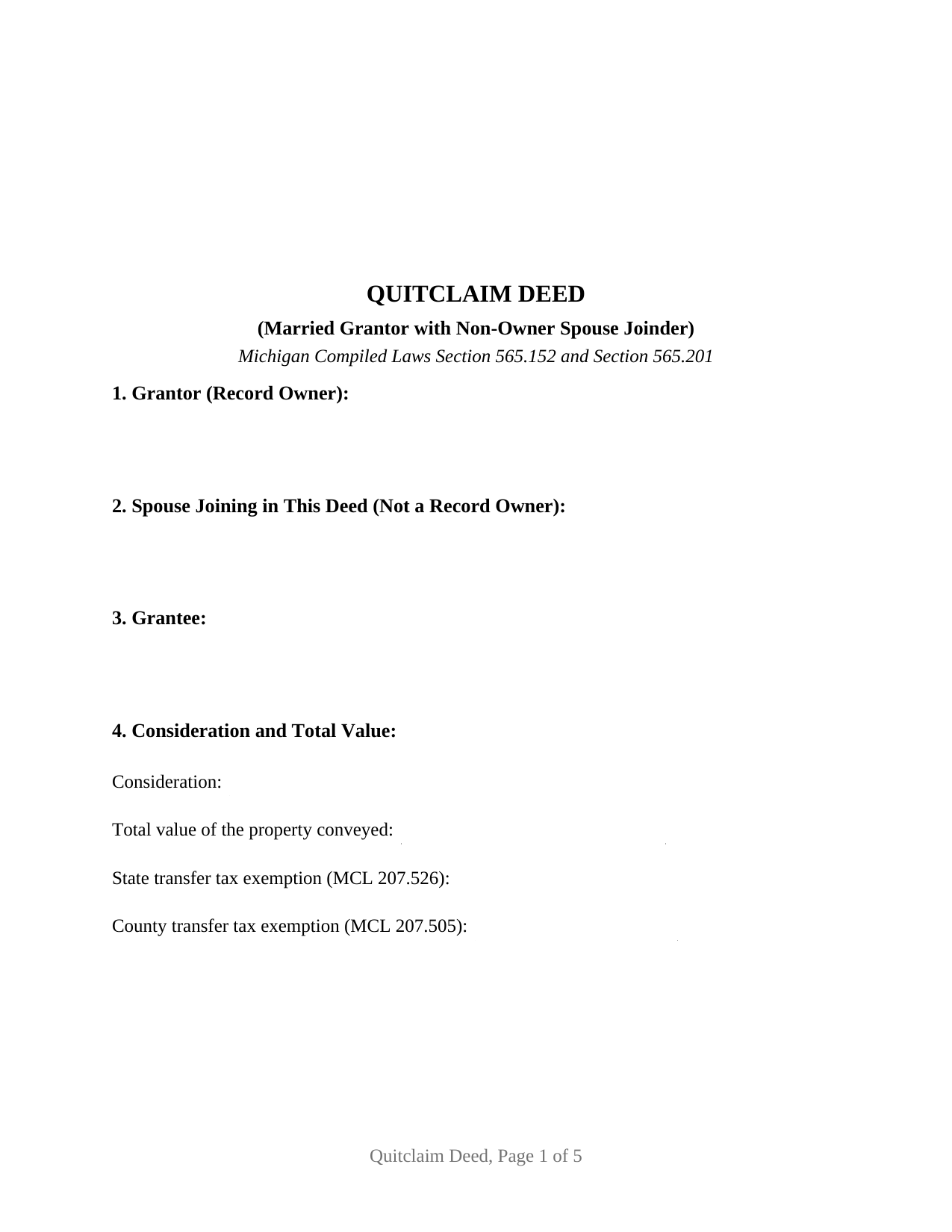
About the Michigan Quitclaim Deed (Married Grantor with Non-Owner Spouse Joinder)
How to Use This Form
- Select your county from the list
- Download the county-specific form
- Fill in the required information
- Have the document notarized if required
- Record with your county recorder's office
What Others Like You Are Saying
"Easy but a little overpriced"
"I was very impressed with the Mineral Deed form, especially with the instructions to fill it out AND…"
"Your PDF form Personal Representative's Deed was exceedingly helpful."
"Awesomeness a true life saver I'm very appreciative."
"Found what I needed, thanks."
4.8/5 from 4,828 reviews. Read all
One spouse owns the Michigan property, the other does not, and both of them sign this deed. The form recites a single Grantor, a married person holding record title alone, and adds a second signature line for that owner's spouse, who joins for one purpose: to quit claim and release any right or claim the spouse holds or might one day assert in the land.
Why a spouse who owns nothing signs
Nothing in current Michigan law compels that signature. A deed of land titled in one spouse's name alone is complete when the record owner signs before a notary and the register of deeds accepts it. The second signature is a title-clearing measure, and Michigan closing practice keeps asking for it because the record cannot show what a marriage may later produce: a contribution claim, an equitable claim never put on paper, a judgment not yet entered. A release taken at the closing table answers those in one line.
The 2017 change that moved the reason
For 171 years the answer here was dower: a married man selling land held in his own name obtained his wife's signature to bar her dower right, which is why older Michigan deeds carry a marital-status statement. MCL 558.30, effective April 6, 2017, abolished dower and made it unenforceable by statute or at common law, preserving only elections tied to a husband's death before that date. What remains sits in the divorce statutes. MCL 552.401 lets a circuit court award one spouse property owned by the other where the claiming spouse contributed to its acquisition, improvement, or accumulation, and gives the final decree the same force and effect as a quitclaim deed of the real estate. That is the interest a buyer of separately titled Michigan land now asks the other spouse to release.
What the joinder section says
The deed keeps the two acts apart. Section 8 conveys: for the stated consideration the Grantor quit claims the property described in the deed, in the statutory words of MCL 565.152, passing the interest held at delivery and giving no covenant or warranty of title. Section 9 joins: the person signing there is married to the Grantor and is not a record owner, joins solely to quit claim and release to the Grantee any right, title, interest, or claim in the property, including any claim arising from the marriage, and warrants nothing. One interest moves, so the instrument evidences the single recordable event MCL 565.201(3) allows.
One conveyance, two signers
Two signature lines, two printed-name lines, and two acknowledgment certificates carry that structure onto paper. Michigan reads the printed name beneath each signature against the name in the certificate, under MCL 565.201(1)(a) and (1)(b), so the joining spouse's name appears in its own numbered section, beneath the signature, and in that signer's certificate. Ownership patterns presenting this configuration run through Michigan records: a parcel bought before the marriage and sold years afterward, a home that came to one spouse by inheritance during the marriage, a residence in one name deeded out to a relative or a purchaser. The form is not set up for a couple who both hold record title, where MCL 554.45 presumes a tenancy by the entirety and each spouse conveys as an owner, nor for a sole owner who is unmarried, where the joinder section has nobody to sign it.
Recording where the land lies
Michigan charges one fee per instrument at the register of deeds, 30 dollars under MCL 600.2567 whatever the page count, and a charter county may adopt its own schedule, as Wayne County did as of January 1, 2026. Total value belongs on the face of the deed, where MCL 207.504 and MCL 207.525 look for it, taxed at a combined 4.30 dollars per 500 dollars of value when neither exemption line is filled in. The completed example carries a taxable 120,000 dollar transfer of an unplatted six-acre Macomb County parcel and works that arithmetic through, along with the two Land Division Act statements MCL 560.109 places in deeds for unplatted land.
The download is the fillable deed built for this configuration, a completed example filled in entry by entry, and a plain language guide to every section, the signing and notarization of both signers, and recording. Often searched as a quit claim deed with spousal joinder. The materials describe Michigan law in general terms; they are not legal advice.
Important: County-Specific Forms
Our quitclaim deed (married grantor with non-owner spouse joinder) forms are specifically formatted for each of the 83 counties in Michigan.
After selecting your county, you'll receive forms that meet all local recording requirements, ensuring your documents will be accepted without delays or rejection fees.