Michigan Quitclaim Deed (Corrective)
County Specific Legal Forms Validated as recently as October 9, 2026 by our Forms Development Team
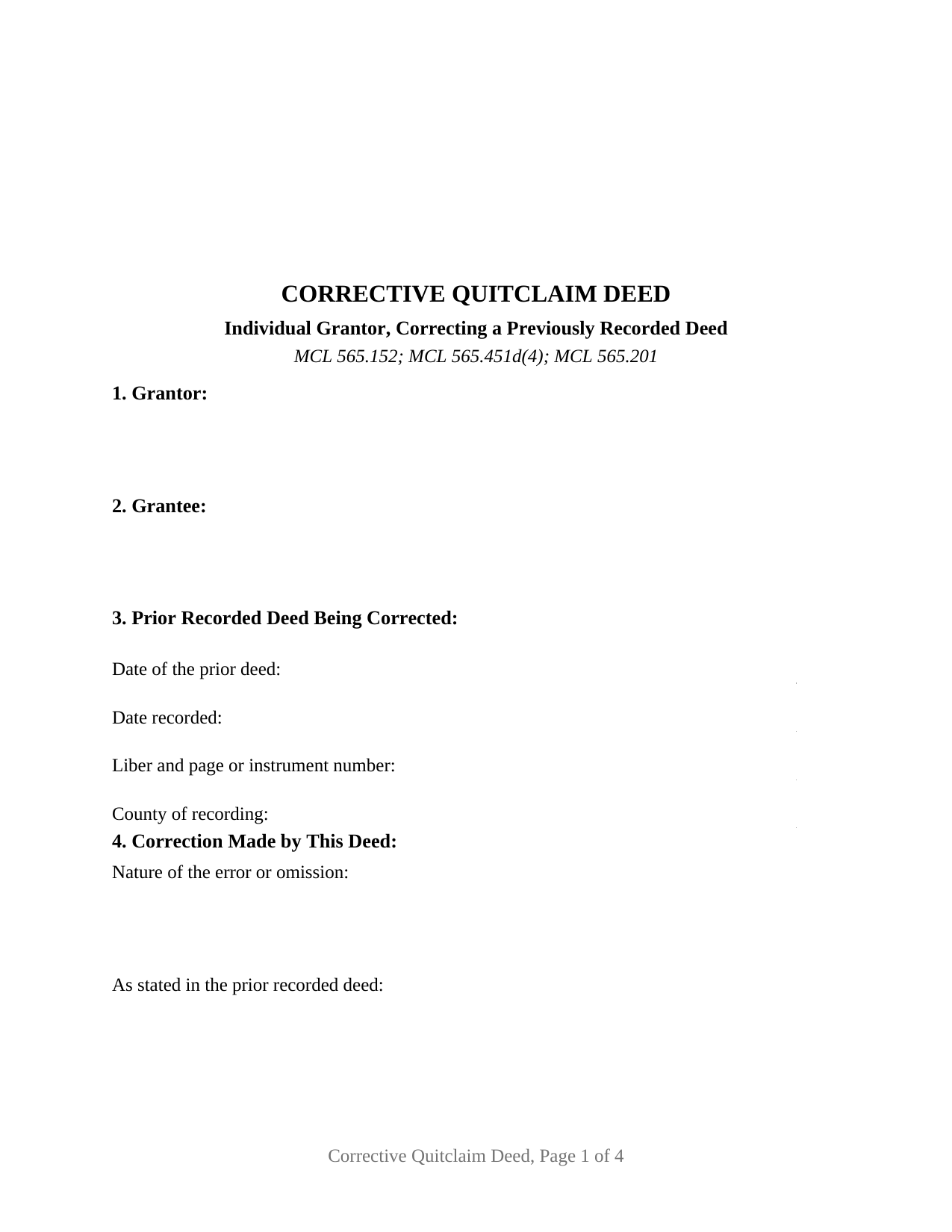
About the Michigan Quitclaim Deed (Corrective)
How to Use This Form
- Select your county from the list
- Download the county-specific form
- Fill in the required information
- Have the document notarized if required
- Record with your county recorder's office
What Others Like You Are Saying
"Pretty good forms, they would probably be better if I read the directions but..."
"Great system!"
"Very easy to do. Got papers I was needed very quickly. Thank you"
"This was easy and much cheaper than getting a lawyer. Thanks! - From alabama"
"The system was simple to use. The rep that answered my questions could have been a little more forth…"
4.8/5 from 4,832 reviews. Read all
A mistake in a recorded Michigan deed stays where it is. The register of deeds indexes what was filed, and the record grows forward, so the repair is a second instrument that points at the first and states the change. This corrective quitclaim deed is that second instrument. One individual grantor signs it, it identifies the earlier deed by date, recording date, liber and page or instrument number, and county, and it quit claims the property to the grantee with the error corrected.
The subsection that names the practice
Michigan prescribes no statutory corrective deed form, but one section describes the route. MCL 565.451d, added in 2012, lets an affidavit correct a scrivener's error or an error about the proper place of recording. Subsection (4) then preserves the other path: the section does not prohibit recording a corrected version of the previously recorded document indicating the corrective changes and making reference to that document by liber and page number or by another unique identifying number. This deed is drawn to that sentence. The two paths part at subsection (2)(b), under which an affidavit does not alter the substantive rights of any party unless that party executes it. Here the grantor executes, so the grantor's own interest passes in the statutory quitclaim words of MCL 565.152, with no covenant of title attached.
Old wording and new wording, side by side
Section 4 does the corrective work in three entries: the nature of the error or omission, the wording as it stands in the recorded deed, and the wording as this instrument states it. Setting the two versions beside each other is what makes the change legible to a later examiner. The mistakes behind this pattern are small and specific: a plat lot number transposed in preparation, a name spelled one way in the body of a deed and another beneath the signature, a unit number missing from an otherwise complete description. The completed example carries the first of those through every entry, correcting a Saginaw County description that reached Lot 14 when the parties had dealt in Lot 41.
One grantor, one earlier deed
The form provides for exactly one individual grantor signing in a personal capacity, one grantee, and one previously recorded deed, with a single signature line, the printed-name line MCL 565.201(1)(a) places beneath it, and one acknowledgment certificate. What the form is not set up as: an instrument that adds a grantee who took nothing under the earlier deed or drops one who did, which performs a fresh conveyance rather than a correction; a deed whose signer acts for an entity, as a trustee, or under a power of attorney, capacities this instrument does not state; or a corrected version of a deed out of a married couple's entirety title, which under MCL 554.45 and MCL 557.71 neither spouse conveys alone.
The exemption written for this instrument
Both Michigan transfer tax acts speak to correction, in different words under different letters. The state act exempts, at MCL 207.526(n), a written instrument to confirm title already vested in a grantee, including a quitclaim deed to correct a flaw in title. The county act exempts, at MCL 207.505(l), instruments to confirm titles already vested in grantees, such as quitclaim deeds to correct flaws in titles. Because the two lists are not identical, Section 8 carries a citation line for each act beside the line stating total value.
What the recording counter reads first
MCL 565.201 sets the conditions of receipt: one recordable event named on the first line of print, two and one half inches left unprinted atop page one, black type of at least 10 point on white 20 pound paper, an address for the grantee, and the drafter's name and business address. The statewide fee is 30 dollars per instrument under MCL 600.2567, with a charter county free to adopt its own schedule. Filing the correction does not retire the earlier deed; both documents sit in the chain under their own recording numbers, which is why the identification in Section 3 earns its place.
The download delivers this corrective quitclaim deed as a blank fillable PDF, a completed example filled in entry by entry for the Saginaw County plat error described above, and a plain language guide to each section, the notarization, and the recording steps. Often searched as a correction deed or a corrective quit claim deed, the form and these materials describe Michigan law in general terms and are not legal advice.
Important: County-Specific Forms
Our quitclaim deed (corrective) forms are specifically formatted for each of the 83 counties in Michigan.
After selecting your county, you'll receive forms that meet all local recording requirements, ensuring your documents will be accepted without delays or rejection fees.