Michigan Quitclaim Deed (Two Grantors)
County Specific Legal Forms Validated as recently as October 9, 2026 by our Forms Development Team
About the Michigan Quitclaim Deed (Two Grantors)
How to Use This Form
- Select your county from the list
- Download the county-specific form
- Fill in the required information
- Have the document notarized if required
- Record with your county recorder's office
What Others Like You Are Saying
"documents and guidance need to properly comply with court"
"so far appears to meet my needs!"
"EASY, PAINLESS, LOVED THE USER FRIENDLY INSTRUCTIONS"
"Very Happy. Forms saved me from making some very silly mistakes had I done them on my own."
"Couldnt have been easier. Docs recorded the next day!"
4.8/5 from 4,828 reviews. Read all
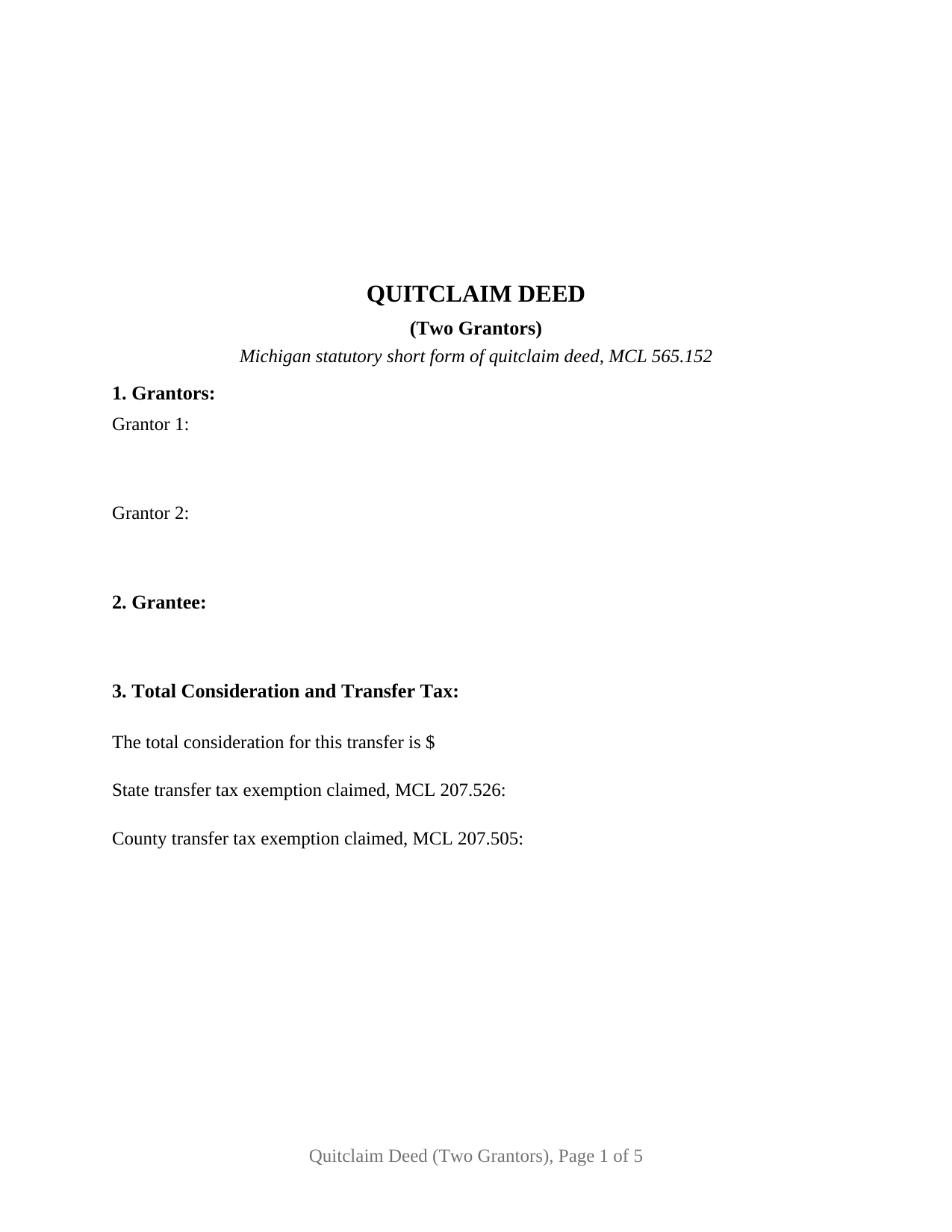
Two record owners join in one Michigan quitclaim deed on this form built for exactly two grantors: the grantor section carries two name-and-address blocks, the signature section carries two signature lines with a printed name beneath each, and two acknowledgment certificates close the document. The operative section rests on the statutory quitclaim form at MCL 565.152, so both grantors' interests pass to the grantee together, as they stand at delivery, with no covenant or warranty of title attached.
Two grantors, one instrument
The two-grantor configuration mirrors how Michigan co-ownership unwinds in the record. Two tenants in common, often co-heirs whose undivided interests arrived through the same estate, release both shares to a single buyer in one recorded instrument, and two joint tenants closing out a shared purchase convey together. The completed example walks the first pattern: two co-heirs of a Genesee County farm parcel quit claim their undivided interests to the third co-heir who is buying them out, for a stated 60,000 dollars. The form recites exactly two individual grantors signing in a personal capacity, with no marital recital and no statement of how the two hold title between themselves; a sole owner, a group of three or more owners, an entity, or a trustee follows a different execution pattern.
What the second signature carries
Each of two co-owners holds an interest the other cannot convey. Under MCL 554.43 and MCL 554.44, two co-owners who are not married to each other hold as tenants in common unless their deed expressly declared a joint tenancy, and each undivided share moves only on its own holder's signature. A quitclaim deed signed by one cotenant passes one share; a quitclaim deed signed by both passes both, and MCL 565.3 fixes the ceiling at the estate the grantors could lawfully convey. The operative sentence here is written in the plural for that reason: the undersigned grantors quit claim the Property together with all of the grantors' right, title, and interest. Where the two hold as joint tenants with full rights of survivorship, Albro v Allen, 434 Mich 271 (1990), adds a second reason for two signatures, since one cotenant's conveyance cannot defeat the other's contingent remainder and a conveyance of the whole takes both.
Names that match, three times over
Michigan's recording statute polices signatures by name matching, and a two-signer instrument doubles the surface. MCL 565.201(1)(a) requires each signer's name printed beneath the signature, and MCL 565.201(1)(b) makes a discrepancy between that printed name and the name recited in the acknowledgment a reason for the register of deeds to refuse the instrument. Each grantor's name on this form appears in matching form in the grantor section, under the signature line, and in that grantor's certificate. The certificates also carry the notary content Michigan expects, including the county of commission and the acting county, and the two-certificate layout lets the grantors acknowledge on different days, in different counties, or in different states; the completed example records its two acknowledgments two days apart.
Stating the price and the tax
Transfer tax rides on the face of a Michigan deed. The form states the total consideration where the transfer tax acts look for it, and carries a separate exemption citation line for the state act, MCL 207.526, and the county act, MCL 207.505, because the two exemption lists are not identical. On a taxable conveyance the register collects 3.75 dollars per 500 dollars of value under the state act and 55 cents per 500 under the county act, computed on the stated total; the example's 60,000 dollar buyout carries 516 dollars of combined transfer tax. For unplatted land, the deed also carries the Land Division Act content: the division-rights sentence of MCL 560.109(3) and the exact right to farm text of MCL 560.109(4), which the example completes for its 20-acre township parcel.
The download includes the two-grantor quitclaim deed, sometimes searched as a quit claim deed for two owners, as a blank fillable PDF, a completed example that fills every entry for the Genesee County fact pattern described above, and a plain language guide to each section, the notary rules, and recording with the register of deeds, where the statewide fee is a flat 30 dollars per instrument. The materials describe Michigan law in general terms and are not legal advice.
Important: County-Specific Forms
Our quitclaim deed (two grantors) forms are specifically formatted for each of the 83 counties in Michigan.
After selecting your county, you'll receive forms that meet all local recording requirements, ensuring your documents will be accepted without delays or rejection fees.