Michigan Quitclaim Deed (Individual Grantor by Attorney-in-Fact)
County Specific Legal Forms Validated as recently as October 9, 2026 by our Forms Development Team
About the Michigan Quitclaim Deed (Individual Grantor by Attorney-in-Fact)
How to Use This Form
- Select your county from the list
- Download the county-specific form
- Fill in the required information
- Have the document notarized if required
- Record with your county recorder's office
What Others Like You Are Saying
"Needed copy of deed in trust. Found info here, paid on line and then printed the docs. Easy to use, …"
"Great form and easy to complete. Sending a sample and instructions was very helpful. Thank you!"
"Made a hard task easy! Very smooth and we were printed and ready to go"
"Documents are great and easy to use, just wish there was a page helping to know where to mail docume…"
"Easy, simple and fast. I am familiar with deeds in my state and these looked correct. The common mis…"
4.8/5 from 4,829 reviews. Read all
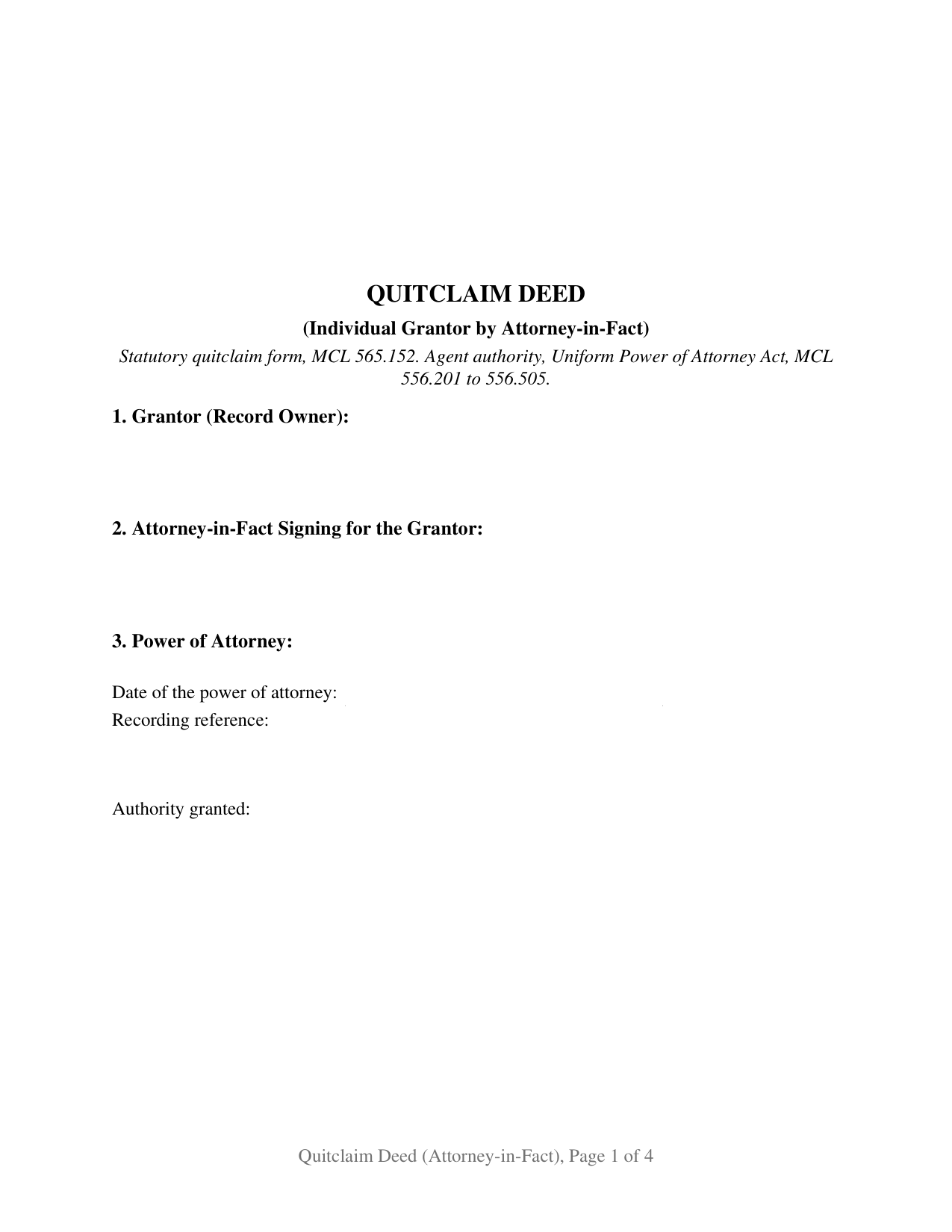
The hand that signs this Michigan quitclaim deed is not the hand of the owner whose interest moves. The record owner is named as Grantor and never touches the paper; an attorney-in-fact, named in a section of its own, signs in the owner's name under a power of attorney, and one acknowledgment certificate records that agent's appearance.
Authority the deed has to point to
An agent's power over Michigan land comes from the Uniform Power of Attorney Act, 2023 PA 187, MCL 556.201 to 556.505, effective July 1, 2024, which replaced the durable power of attorney sections of the Estates and Protected Individuals Code. MCL 556.304 does the work here: language granting general authority with respect to real property authorizes the agent to sell, exchange, convey with or without covenants, quitclaim, release, encumber, lease, or otherwise dispose of an interest in real property. The verb quitclaim sits in the statute itself. Other acts stay off that list, because MCL 556.301(1) lets an agent make a gift, create or change rights of survivorship, or act on an inter vivos trust only where the power expressly grants it. A quitclaim at market value is a sale; a quitclaim for a dollar is a gift, and the figure on the deed tells them apart.
Three entries for the power, one line for the signature
The form recites one individual Grantor and one attorney-in-fact, and it gives the power of attorney a numbered section of its own: the date the principal signed it, the liber and page or instrument number where it has been recorded, and the authority relied on. Below that sit one signature line, one printed-name line carrying the agent's name and capacity, and one certificate naming the agent as attorney-in-fact for the owner, so the name under the signature matches the name in the certificate, as MCL 565.201(1)(a) and (1)(b) contemplate. Configurations presenting this pattern run through Michigan land records: an owner who has moved into a care community while an adult child holds the durable power, an owner living out of state on the closing date, a parcel sold while its owner is medically unable to appear. What the form is not set up as: a deed the owner signs personally, a deed reciting two record owners, an entity deed whose signer acts under a business statute, or a deed by a personal representative, conservator, or trustee, whose authority is a will, a court order, or a trust instrument rather than an agency the owner created.
The power of attorney is recording material too
Michigan land records have carried powers of attorney since 1846. MCL 565.36 provides that a letter of attorney containing a power to convey lands may be recorded in the county where the land sits, once acknowledged, and that the record of it reads in evidence like a recorded conveyance. MCL 565.37 provides that a recorded power is not deemed revoked by any act of the principal unless the revocation is recorded in the same office. Title practice puts the power of record with or ahead of the deed for that reason, and Michigan Land Title Standard 3.17 is titled for the strict construction given a power of attorney to convey an interest in real property.
Filing where the land sits
Recording happens at that county's register of deeds, at the $30.00 instrument fee of MCL 600.2567, subject to the charter-county schedule Wayne County adopted for 2026. MCL 565.201 governs receipt: one recordable event on the first line of print, an unprinted two and one half inches atop page one, black type of at least 10 point on white 20 pound stock, the grantee's address, and the drafter's business address. Total value appears on the face for the two transfer tax acts, with a citation line for the state exemption list and a second for the county list.
The download delivers this deed as a blank fillable PDF, a completed example filled in for an Ottawa County sale, and a plain language guide to every section, the agent's acknowledgment, the notarization, and recording, including the Property Transfer Affidavit the new owner files with the local assessor. Often searched as a quit claim deed signed under a POA or by power of attorney. The materials describe Michigan law in general terms and are not legal advice.
Important: County-Specific Forms
Our quitclaim deed (individual grantor by attorney-in-fact) forms are specifically formatted for each of the 83 counties in Michigan.
After selecting your county, you'll receive forms that meet all local recording requirements, ensuring your documents will be accepted without delays or rejection fees.