Michigan Quitclaim Deed (Interspousal)
County Specific Legal Forms Validated as recently as October 9, 2026 by our Forms Development Team
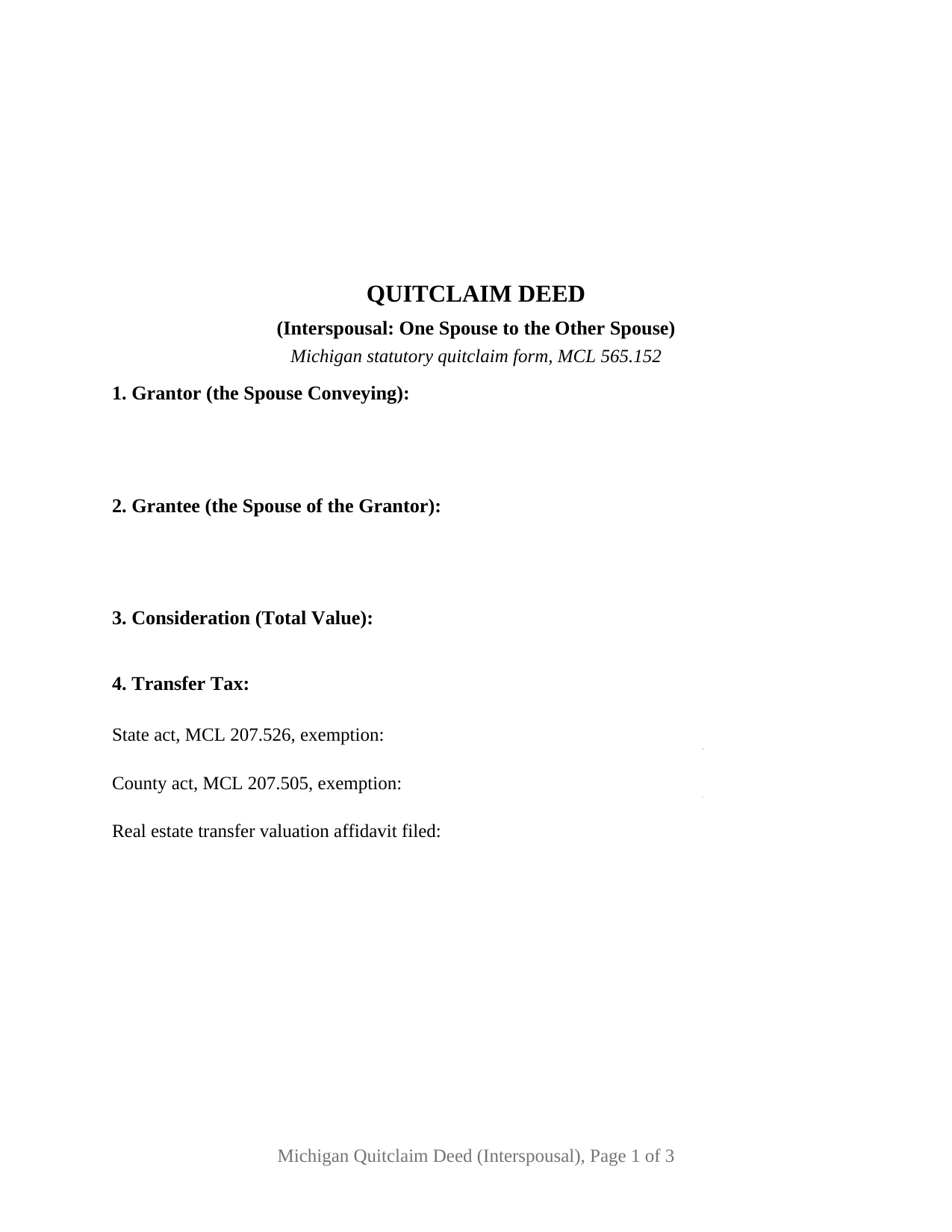
About the Michigan Quitclaim Deed (Interspousal)
How to Use This Form
- Select your county from the list
- Download the county-specific form
- Fill in the required information
- Have the document notarized if required
- Record with your county recorder's office
What Others Like You Are Saying
"FANTASTIC. Sometimes we think know something, glad I found out I was wrong before it was too late."
"I am so very happy with the service provided by Deeds.com. The process was simple and saved me a lot…"
"EVERYTHING WENT WELL, HAD NO PROBLEMS DOWNLOADING MY FORMS. THE ORDER QUICK AND EASY. THANKS IF I EV…"
"amazing time and cost saving service for me. Thank you."
"Easy to use!"
4.8/5 from 4,828 reviews. Read all
Both people named on this Michigan quitclaim deed are married to each other. One signs as Grantor and lets go of an interest in the property; the other is named as Grantee and is left holding it. Only one of the two conveys, so the deed carries a single signature line, one printed name beneath it, and one acknowledgment certificate; the receiving spouse never signs.
The one direction a single spouse can convey
Michigan puts a married couple's title largely out of either spouse's individual reach. Under MCL 554.45 and MCL 557.71, a conveyance to two married persons presumptively creates a tenancy by the entirety, and Michigan case law treats that estate as one neither spouse can convey or encumber alone. One statutory exception is this deed's whole transaction: MCL 557.101, in force since 1927, provides that where a husband and wife own an interest in land as tenants by the entirety, the tenancy may be terminated by a conveyance from either one to the other of his or her interest. Section 10 performs that conveyance in the statutory quitclaim words of MCL 565.152, passing whatever the Grantor holds at delivery with no covenant or warranty of title.
One grantor, one grantee, one marriage
The form recites one Grantor and one Grantee and states on its face that the two are married to each other, since that relationship drives both the conveyance and its tax treatment. Title patterns presenting this configuration appear throughout Michigan records: a parcel that has always stood in one spouse's name alone moving into the other spouse's name, and a couple ending an entirety so record title reads in one name before a refinance. What the form is not set up as: a conveyance by both spouses to a grantee outside the marriage, which recites two grantors on one instrument; a deed placing title in both spouses, which recites two grantees and draws the MCL 554.45 entirety presumption; or an execution by a trustee or attorney in fact, capacities this deed does not state. Dower having been abolished by MCL 558.30 in 2017, marriage adds no further signature line here: both halves of the marriage are already on the instrument, one giving and one receiving.
The tax lines a spousal transfer fills in
Michigan collects two transfer taxes at recording, $3.75 per $500 of value under MCL 207.525 and $0.55 per $500 under MCL 207.504, and an exemption operates only when cited on the instrument's face. A conveyance between spouses has its own letter in each act: MCL 207.526(i) and MCL 207.505(i) exempt a conveyance from a spouse or married couple creating or disjoining a tenancy by the entireties in the grantors or the grantor and his or her spouse. The deed carries a citation line for each act, because the two exemption lists are not identical, plus a line recording whether a real estate transfer valuation affidavit accompanies the instrument. Property taxes run a parallel course: MCL 211.27a(7)(a) states that a transfer of property from one spouse to the other spouse is not a transfer of ownership, and MCL 211.27a(7)(b) reaches a transfer whose sole purpose is to create or disjoin an entirety.
Onto the record in one of 83 counties
The signed deed goes to the register of deeds where the land lies, at the flat $30 fee of MCL 600.2567; Wayne County operates under the charter-county schedule it adopted effective January 1, 2026. MCL 565.201 sets what the office accepts: a first line of print naming the single recordable event, 2-1/2 inches of blank space atop page one, 10 point black print on white 20 pound paper, the Grantee's street or post office address, and the drafter's name and business address. Recording also fixes priority, since MCL 565.29 voids an unrecorded conveyance against a later good faith purchaser who records first. It adds no promises: a mortgage lien, easement, or restriction of record rides along afterward, and the note obligation stays where its own documents put it.
The download delivers the interspousal quitclaim deed as a blank fillable PDF, a completed example filling in every entry for a Washtenaw County conveyance between spouses, and a plain language guide to each section, the notarization, and recording, including the Property Transfer Affidavit due to the local assessor within 45 days. Often searched as an interspousal transfer deed or a quit claim deed between husband and wife, the form and these materials describe Michigan law in general terms and are not legal advice.
Important: County-Specific Forms
Our quitclaim deed (interspousal) forms are specifically formatted for each of the 83 counties in Michigan.
After selecting your county, you'll receive forms that meet all local recording requirements, ensuring your documents will be accepted without delays or rejection fees.