Minnesota Transfer on Death Deed (Married Owners Tenant-in-Common Interest with Spousal Joinder)
County Specific Legal Forms Validated as recently as November 1, 2026 by our Forms Development Team
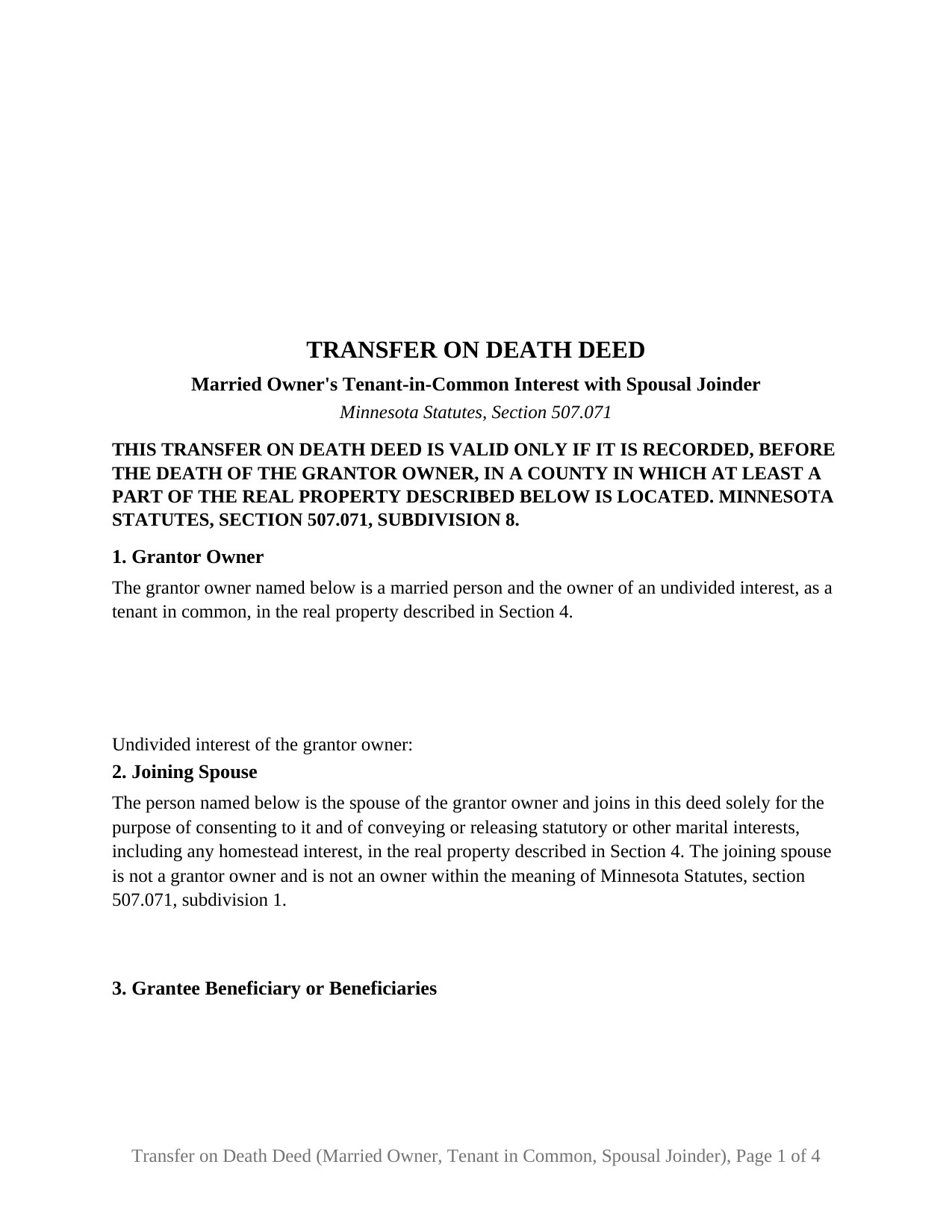
About the Minnesota Transfer on Death Deed (Married Owners Tenant-in-Common Interest with Spousal Joinder)
How to Use This Form
- Select your county from the list
- Download the county-specific form
- Fill in the required information
- Have the document notarized if required
- Record with your county recorder's office
What Others Like You Are Saying
"Easy to use."
"This was perfect for providing the necessary forms. Easy to enter needed information. I would recomm…"
"THE PROCEDURE IN GETTING THIS MECHANICS LIEN PROCESSED HAS SO FAR BEEN RELATIVELY SIMPLY - BETTER TH…"
"Very easy user friendly thank you for that"
"This was a very easy and organized system to use."
4.8/5 from 4,839 reviews. Read all
A married Minnesota owner who holds an undivided share of real property as a tenant in common can name who receives that share at death, outside probate and without touching the co-owner's share. This transfer on death deed is set up for that owner, with the owner's spouse joining in a labeled capacity, under Minnesota Statutes, section 507.071.
One undivided share, conveyed alone
Section 507.071, subdivision 1, defines a grantor owner to include a tenant in common, and the deed conveys and quitclaims, effective on the death of the grantor owner, all of the grantor owner's undivided interest as a tenant in common in the described property. Fixed text states that the deed does not convey, sever, or affect the interest of any other tenant in common. Section 1 recites the fractional share as the vesting deed states it; the guide describes subdivision 14, which voids the deed as to any part not owned at death.
A spouse who signs but does not own
Section 507.02 provides that no conveyance of a married owner's homestead is valid without both spouses' signatures, and section 507.071, subdivision 2, makes a transfer on death deed subject to that rule. The statute separates two roles: a spouse who joins solely to convey or release statutory or other marital interests is, by definition, neither a grantor owner nor an owner. Section 2 names the grantor owner's spouse under a fixed recital of that capacity, and the spouse signs a block headed JOINING SPOUSE on a line labeled Signature of Joining Spouse. Under subdivision 2, the joinder is conclusive proof that once the transfer takes effect the spouse no longer has or can claim a statutory or marital interest in the interest transferred.
Two certificates, each describing a spouse
The grantor owner and the joining spouse each acknowledge, and the deed carries a separate acknowledgment certificate for each, printing the short form of section 358.66. Section 358.14 then provides that spouses who join in and acknowledge an instrument are described in the certificate in a manner indicating they are married to each other, and, where they acknowledge before different officers or at different times, each as the spouse of the other.
What the configuration recites
This configuration recites one natural person as grantor owner, a married person and the owner of an undivided tenant-in-common interest, signing personally; one joining spouse who is not an owner; and one or more grantee beneficiaries of any class section 507.071 permits, with any tenancy designation subdivision 4 allows for concurrent beneficiaries. Siblings who inherited a parent's house as tenants in common, one of them married and living in it, and a married owner holding an undivided share of a lake cabin with friends, present the pattern this deed recites. The form is not set up for an unmarried owner, for a spouse who holds the other undivided share (that spouse is an owner, and both would sign as grantor owners), for joint tenants, for two or more grantor owners, or for a trustee, entity, or attorney-in-fact signer.
The statutory form's one box
Section 507.071, subdivision 24, publishes a permissive form whose operative words this deed carries, with the form's single optional statement and its one box: when effective, the instrument conveys all interests in the described property acquired by the grantor owner before, on, or after its date. Unmarked, the deed reaches only the interest owned at signing, under subdivision 21; marked, it reaches a cotenant's share the grantor owner later buys or inherits. The deed also prints the insurance warnings section 507.072 has required on every Minnesota TOD deed, sometimes searched as a beneficiary deed, since August 1, 2024.
Recording before death, with less at the counter
Under subdivision 8 the deed is valid only if recorded before the grantor owner's death in a county where at least part of the property lies; the same subdivision dispenses with the auditor's transfer certification and the certificate of real estate value, and section 287.22 exempts the deed from deed tax. After the grantor owner's death, the affidavit of identity and survivorship and the county agency clearance certificate are recorded separately and are not included in this package.
Included are the fillable deed, a completed example on a Dakota County fact pattern in which one of two sibling cotenants names her children, and the guide covering each section, both certificates, and recording. The description and the guide explain the form and the statutes in general terms and are not legal advice.
Important: County-Specific Forms
Our transfer on death deed (married owners tenant-in-common interest with spousal joinder) forms are specifically formatted for each of the 87 counties in Minnesota.
After selecting your county, you'll receive forms that meet all local recording requirements, ensuring your documents will be accepted without delays or rejection fees.