Minnesota Transfer on Death Deed (Unmarried Owners Tenant-in-Common Interest)
County Specific Legal Forms Validated as recently as November 1, 2026 by our Forms Development Team
About the Minnesota Transfer on Death Deed (Unmarried Owners Tenant-in-Common Interest)
How to Use This Form
- Select your county from the list
- Download the county-specific form
- Fill in the required information
- Have the document notarized if required
- Record with your county recorder's office
What Others Like You Are Saying
"I requested a property report and it was completed fast and accurately. I would highly recommend thi…"
"I found this site to be very easy to use . I found and printed what I needed in just a few minutes a…"
"My first time using Deeds.com. Loved the process. It was quick, easy and Deeds.com provided timely r…"
"Phenomenal website !"
"This was my first time using Deeds.com and I was very impressed on the professionalism and the exped…"
4.8/5 from 4,839 reviews. Read all
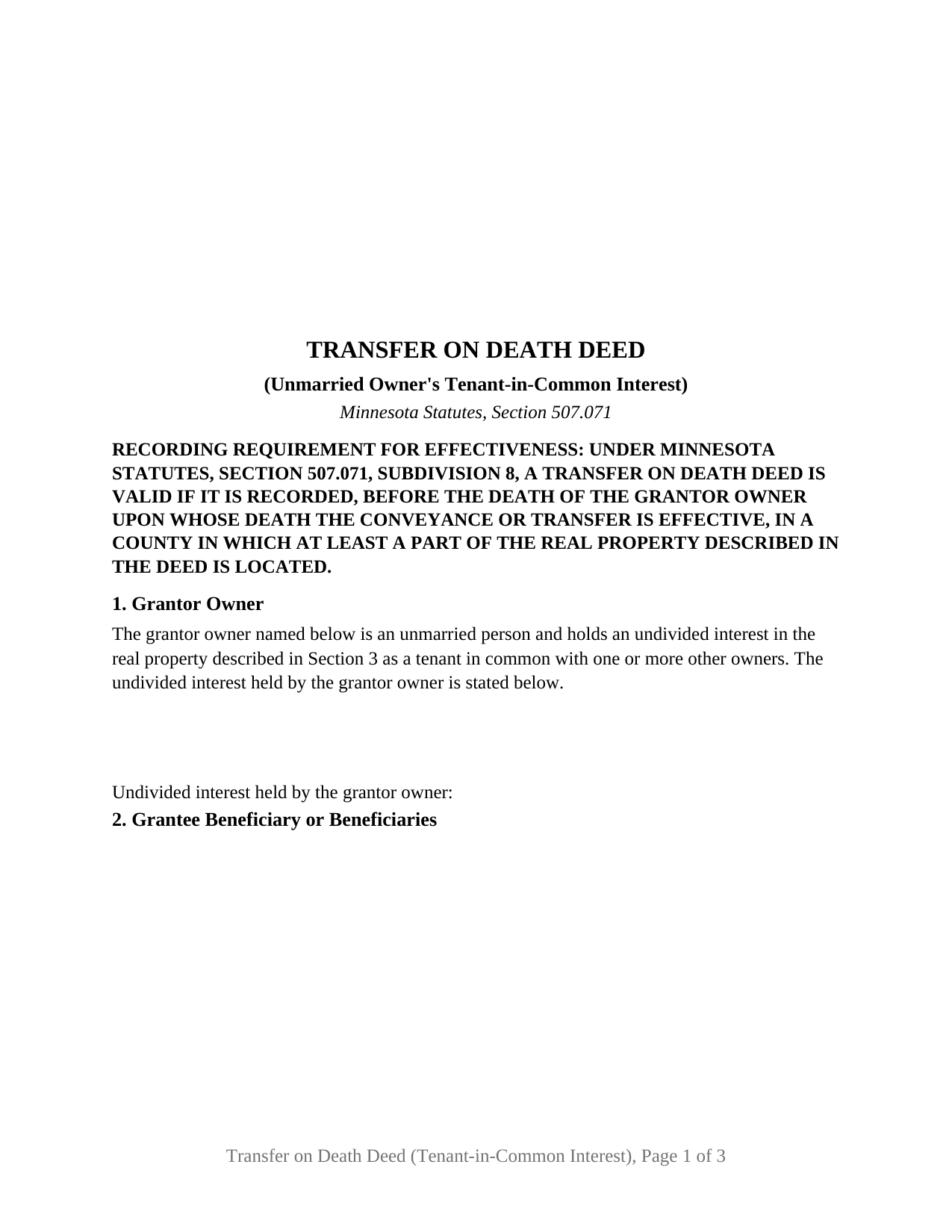
A tenant in common owns an undivided share of the whole parcel, and a Minnesota transfer on death deed can carry that share, and only that share, to a named beneficiary at death. Built on Minnesota Statutes, section 507.071, this form is the deed of one unmarried grantor owner whose interest is an undivided tenant-in-common interest, so the designation never reaches the other co-owner's share.
A deed that conveys one undivided share
Section 507.071, subdivision 1, defines a grantor owner to include an owner who holds as a tenant in common, and section 500.19, subdivision 4, lets an owner of an interest in real estate convey all or part of it. Section 4 of this deed is written to that interest: the grantor owner conveys and quitclaims to the grantee beneficiary or beneficiaries, effective on the death of the grantor owner, all of the grantor owner's undivided interest as a tenant in common in the described real property, and the deed states, as subdivision 2 requires, that it is only effective on that death. Section 1 recites the undivided interest as fixed deed text and receives its fraction. Nothing in the deed severs, partitions, or binds the other tenant in common.
The box that decides whether a later-acquired share follows
A cotenancy changes shape over time: one co-owner buys out the other, or inherits the other's share, and ends up holding the whole. Subdivision 21 provides that a transfer on death deed does not reach an interest the grantor owner acquires after signing unless the deed says so by specific language, and the statutory form in subdivision 24 supplies that language as one optional statement with one box, which this deed prints word for word, unmarked on the blank. Marked, the deed reaches a share the grantor owner acquires later; unmarked, it carries the interest held at signing and still held at death, and under subdivision 14 it is void as to any part the grantor owner does not own at death. The guide describes both outcomes with their citations.
Unmarried status as deed text
Section 507.02 makes a conveyance of a married owner's homestead invalid without both spouses' signatures, and subdivision 2 of section 507.071 applies that rule to a transfer on death deed. Section 1 resolves the question on the deed's face by stating that the grantor owner is an unmarried person, so no spousal block is drawn: the execution is one GRANTOR OWNER signature block followed by one acknowledgment certificate in the individual short form of section 358.66.
What the configuration recites
The form recites exactly one grantor owner, a natural person who is unmarried, who holds an undivided interest as a tenant in common with one or more other owners, and who signs in an individual capacity, designating one or more grantee beneficiaries of any class subdivision 9 allows, with any tenancy designation subdivision 4 permits where more than one is named. Two siblings who inherited a parent's lake cabin in equal undivided shares, and a pair of friends who bought a duplex together under a deed that named no joint tenancy, present the ownership pattern this deed recites, where one co-owner is unmarried and designates who takes that co-owner's share. The form is not set up as a deed by joint tenants, whose deed subdivision 6 treats differently, by two or more grantor owners, by a married owner, or by a trustee, an entity, or an attorney-in-fact.
Recording before death, and the steps the counter skips
Under subdivision 8 the deed is valid only if it is recorded, before the grantor owner's death, in a county where at least part of the real property is located. At recording, no county auditor certification is made and no certificate of real estate value accompanies the deed. Section 5 prints the two insurance warnings section 507.072, subdivision 7, has required on deeds recorded since August 1, 2024. After the grantor owner's death, an affidavit of identity and survivorship and a county agency clearance certificate are recorded separately under subdivisions 20 and 23 and are not included in this package.
The package contains the fillable transfer on death deed, a completed example prepared on a Dakota County fact pattern in which an unmarried co-owner designates two beneficiaries to take his undivided half, and the guide that explains each numbered section, the acknowledgment, and the recording steps. The description and the guide describe the form and the statutes it rests on in general terms; they are not legal advice.
Important: County-Specific Forms
Our transfer on death deed (unmarried owners tenant-in-common interest) forms are specifically formatted for each of the 87 counties in Minnesota.
After selecting your county, you'll receive forms that meet all local recording requirements, ensuring your documents will be accepted without delays or rejection fees.