Minnesota Transfer on Death Deed (Entity Beneficiary)
County Specific Legal Forms Validated as recently as November 1, 2026 by our Forms Development Team
About the Minnesota Transfer on Death Deed (Entity Beneficiary)
How to Use This Form
- Select your county from the list
- Download the county-specific form
- Fill in the required information
- Have the document notarized if required
- Record with your county recorder's office
What Others Like You Are Saying
"easy to use, good experience"
"Easy to download this form. I will use it when the time comes to transfer title of my house."
"Thanks"
"Excellent same day service. Will use for future ones in several states!"
"I was very impressed with the speed at which information was retrieved on my very first search. Unfo…"
4.8/5 from 4,840 reviews. Read all
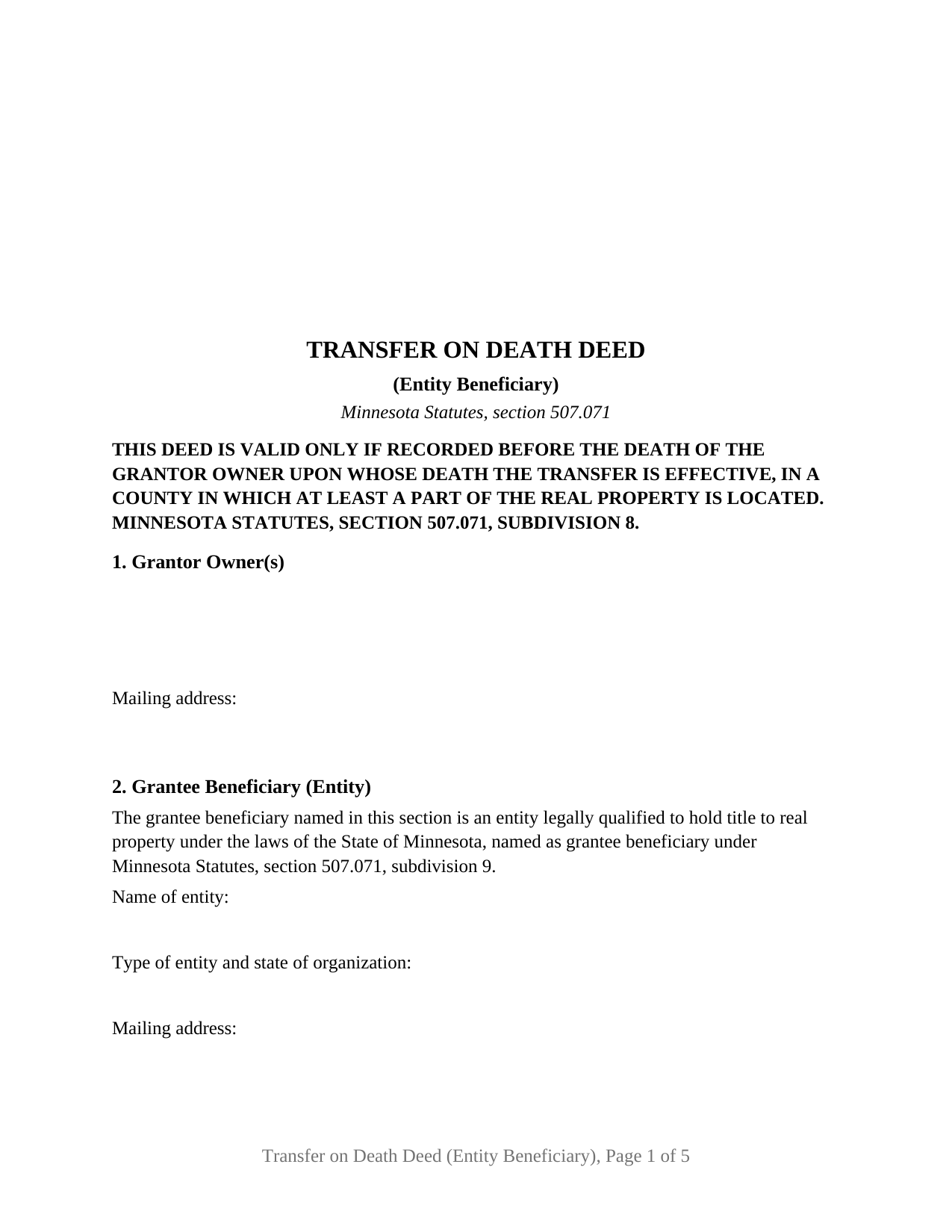
A corporation, a limited liability company, a nonprofit, or a church can be the one that takes Minnesota real property when its owner dies. This transfer on death deed is written for that designation: one or two grantor owners naming a single entity as grantee beneficiary under Minnesota Statutes, section 507.071, subdivision 9. The entity signs nothing and takes title at the operative death only if it still exists.
An entity as the beneficiary the statute names
Subdivision 9 permits a Minnesota TOD deed to name, beyond an individual, the trustee of a trust or any other entity legally qualified to hold title to real property under the laws of this state. This form takes the second branch. Section 2 opens with fixed text identifying the grantee beneficiary as such an entity and receives the entity's exact legal name as its organizational documents and the Secretary of State's records state it, its type and state of organization, and a mailing address. Nothing asks who its officers or members are; the entity itself is the beneficiary.
What happens if the entity is gone
Subdivision 12 states the lapse rule that belongs to this configuration: if the beneficiary is an entity no longer in existence at the grantor owner's death, no transfer occurs and the deed is void. A dissolved corporation or an organization merged away under another name presents that question when the deed would operate. The deed names no successor beneficiary; subdivision 5 permits one only where the deed states the condition on which the successor's interest vests, and the statute supplies no words for it.
Agricultural land and the question of qualification
The phrase legally qualified to hold title does real work in Minnesota. Section 500.24, subdivision 3, bars a corporation, limited liability company, pension or investment fund, trust, or limited partnership from owning or acquiring agricultural land outside the exceptions it defines, among them the family farm corporation and gifted land an educational, religious, or charitable nonprofit disposes of within ten years, and section 500.221 adds an 80 percent citizen or permanent resident ownership requirement. The guide describes both statutes; a city lot raises neither.
What the configuration recites
The grantor side is free form: Section 1 receives one or two natural persons with marital status designated, as the statutory form in subdivision 24 asks, however they hold. Two owner signature blocks, OWNER and SECOND OWNER (if applicable), follow, each with its own acknowledgment certificate. A third section and block, JOINING SPOUSE (if applicable), carries a fixed sentence under which a spouse who owns no interest signs solely to release marital interests under section 507.02 and is not a grantor owner. The operative sentence conveys and quitclaims to the named entity in the statutory form's words, effective at the single grantor owner's death or at the death of the last of two to die, with the form's one optional after-acquired statement and its single box beneath, unmarked on the blank. A sole owner leaving a home to a congregation, a parent naming the family's operating company, and two joint tenants naming a charitable foundation present the patterns this deed recites. It is not set up for an individual or trustee grantee beneficiary, for more than one beneficiary, for three or more owners, or for a trustee, entity, or attorney-in-fact signing as grantor.
Recording before death, and the two warnings
Subdivision 8 makes recording the condition of validity: the deed is valid if recorded, before the death on which it operates, in a county where at least part of the land lies, and it travels light, with no auditor certification, no certificate of real estate value, and, under section 287.22, no state deed tax. The deed carries the section 507.091 drafter statement and the two warnings section 507.072, subdivision 7, has placed on every Minnesota beneficiary deed recorded on or after August 1, 2024. Once the operative death occurs, an affidavit of identity and survivorship and a county agency clearance certificate complete the title record; each is prepared and recorded separately and neither is included in this package.
The purchase delivers the fillable transfer on death deed to an entity, a completed example on an Anoka County fact pattern in which a married brother and his unmarried sister, joint tenants, name a Minnesota nonprofit corporation with the brother's spouse joining, and the guide covering each section and recording. This description and the guide describe the form and the statutes behind it in general terms and are not legal advice.
Important: County-Specific Forms
Our transfer on death deed (entity beneficiary) forms are specifically formatted for each of the 87 counties in Minnesota.
After selecting your county, you'll receive forms that meet all local recording requirements, ensuring your documents will be accepted without delays or rejection fees.