Minnesota Transfer on Death Deed (Two Unmarried Joint Owners, Last Survivor)
County Specific Legal Forms Validated as recently as November 1, 2026 by our Forms Development Team
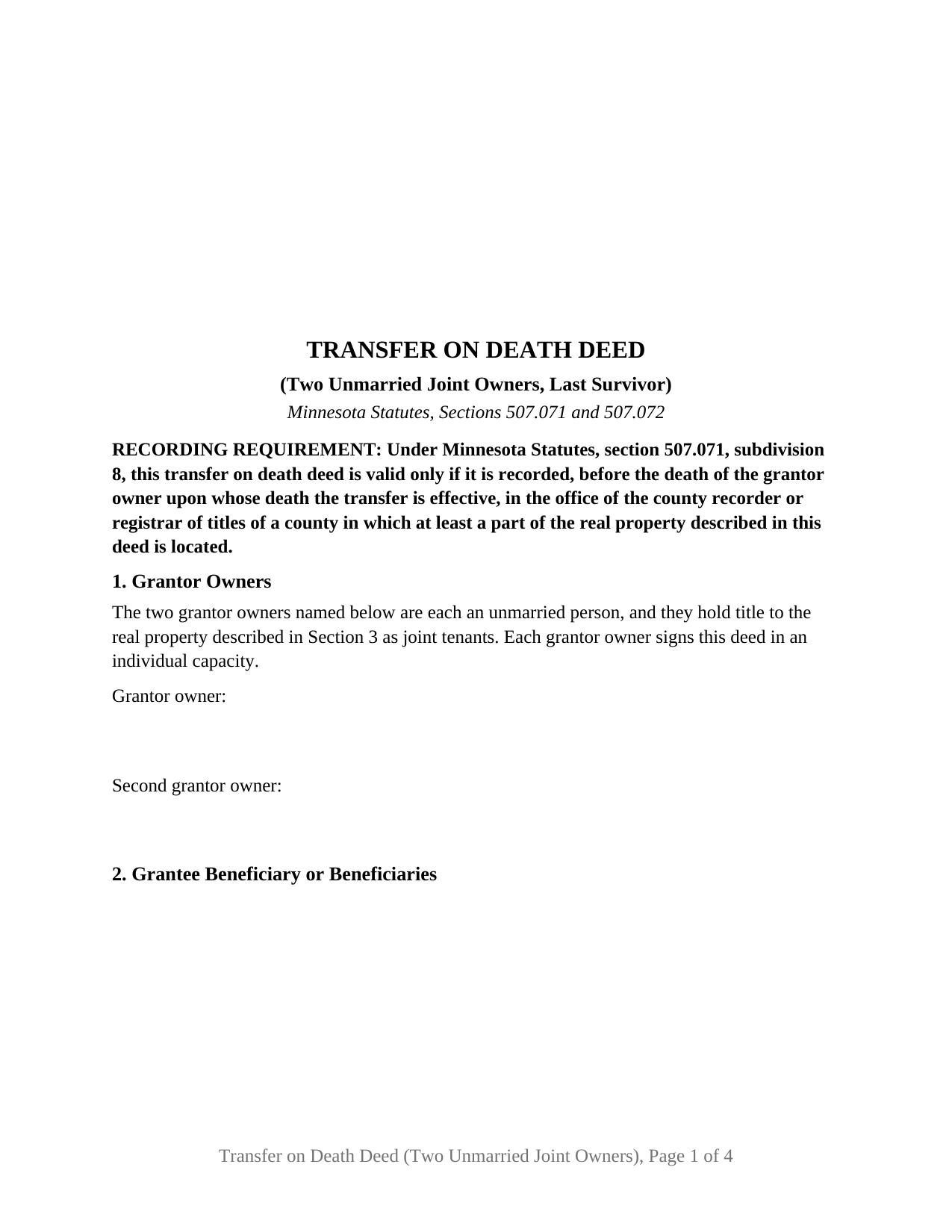
About the Minnesota Transfer on Death Deed (Two Unmarried Joint Owners, Last Survivor)
How to Use This Form
- Select your county from the list
- Download the county-specific form
- Fill in the required information
- Have the document notarized if required
- Record with your county recorder's office
What Others Like You Are Saying
"Very helpful and easy to use"
"For starters, enrolling was as easy as could be. Then, it only took minutes before my entry was form…"
"Excellent experience. Quickly responded and was able to get us exactly what we needed!"
"I guess I got what I paid for. The site said I would be able to download blank PDF forms that I coul…"
"Easy to process orders."
4.8/5 from 4,839 reviews. Read all
Two unmarried people who own Minnesota real estate as joint tenants can name, in one deed, who receives the property after both have died. This fillable form is built for that pattern under section 507.071 of the Minnesota Statutes: two grantor owners, each unmarried, holding as joint tenants, both signing, the transfer effective on the death of the last of the grantor owners to die.
One deed that waits for the second death
Section 507.071, subdivision 6 governs joint tenants: a transfer on death deed executed by all of the owners transfers the property to the grantee beneficiaries effective only after the death of the last surviving grantor owner. The deed states that trigger in the statutory form's words and adds that it does not sever the joint tenancy. At the first death the survivor holds the whole title, the deed stays revocable, and the beneficiaries take only at the second death. A deed the last surviving joint tenant did not execute is void, which is why both owners sign.
Why both owners are recited as unmarried
Section 507.02 provides that no conveyance of a married owner's homestead is valid without both spouses' signatures, and subdivision 2 of the TOD deed statute makes the deed subject to it. Section 1 of this deed settles the question as fixed text: the two grantor owners named below are each an unmarried person and hold title as joint tenants, and each signs in an individual capacity. The only entries there are names and mailing addresses, and the form carries no spousal block. Two unmarried partners who bought a house as joint tenants, two siblings who took title to an inherited lake cabin the same way, and a parent and adult child holding a home as joint tenants present the pattern this deed recites.
Who takes, and in what shares
Section 2 receives one or more grantee beneficiaries: a person, the trustee of a revocable or testamentary trust, or a qualified entity, under subdivisions 1 and 9. Where more than one is named, subdivision 4 permits the deed to say whether they take as joint tenants, as tenants in common, or in another valid form; the completed example names a niece and nephew as joint tenants. The guide covers the 120 hour survival rule of section 524.2-702 and the antilapse and lapse rules of subdivisions 11 and 12.
The single box, and the warnings
The statutory form in subdivision 24 prints one optional statement with one box, reproduced here word for word: when effective, the instrument conveys any interest in the property the grantor owners acquire before, on, or after its date. Subdivision 21 supplies the rule when the box stays unmarked, limiting the deed to interests held at signing. Below that box the deed carries the two insurance warnings section 507.072, subdivision 7 has required on every Minnesota TOD deed recorded since August 1, 2024: one to the grantor owners on notifying their insurer so temporary extended coverage can exist after death, and one to the beneficiaries on not presuming coverage continues.
Recording, and what is not in this package
Under subdivision 8 the deed is valid only if recorded, before the last surviving grantor owner dies, in a county where part of the land lies, with the county recorder or, for Torrens property, the registrar of titles. No auditor certification or certificate of real estate value is required, and section 287.22 exempts the deed from state deed tax. After the second death, an affidavit of identity and survivorship and a county agency clearance certificate are recorded separately and are not included here; a revocation, which either owner may record alone under subdivision 10, is likewise separate and not included here.
What this configuration recites
This beneficiary deed recites exactly two natural persons as grantor owners, each unmarried, holding as joint tenants and signing personally, with an acknowledgment certificate for each. It reaches the whole title the two hold, because the joint tenancy carries the first owner's share to the survivor and the deed carries the survivor's title to the beneficiaries. It is not set up as a deed by one owner, a married owner, tenants in common, three or more owners, or a trustee, entity, or attorney-in-fact.
The purchase includes the fillable deed, a completed example on a Washington County fact pattern, and the guide covering every numbered section, the acknowledgments, and recording. This description and the guide describe the form and the statutes in general terms and are not legal advice.
Important: County-Specific Forms
Our transfer on death deed (two unmarried joint owners, last survivor) forms are specifically formatted for each of the 87 counties in Minnesota.
After selecting your county, you'll receive forms that meet all local recording requirements, ensuring your documents will be accepted without delays or rejection fees.