Minnesota Transfer on Death Deed (Two Individual Beneficiaries as Joint Tenants)
County Specific Legal Forms Validated as recently as November 1, 2026 by our Forms Development Team
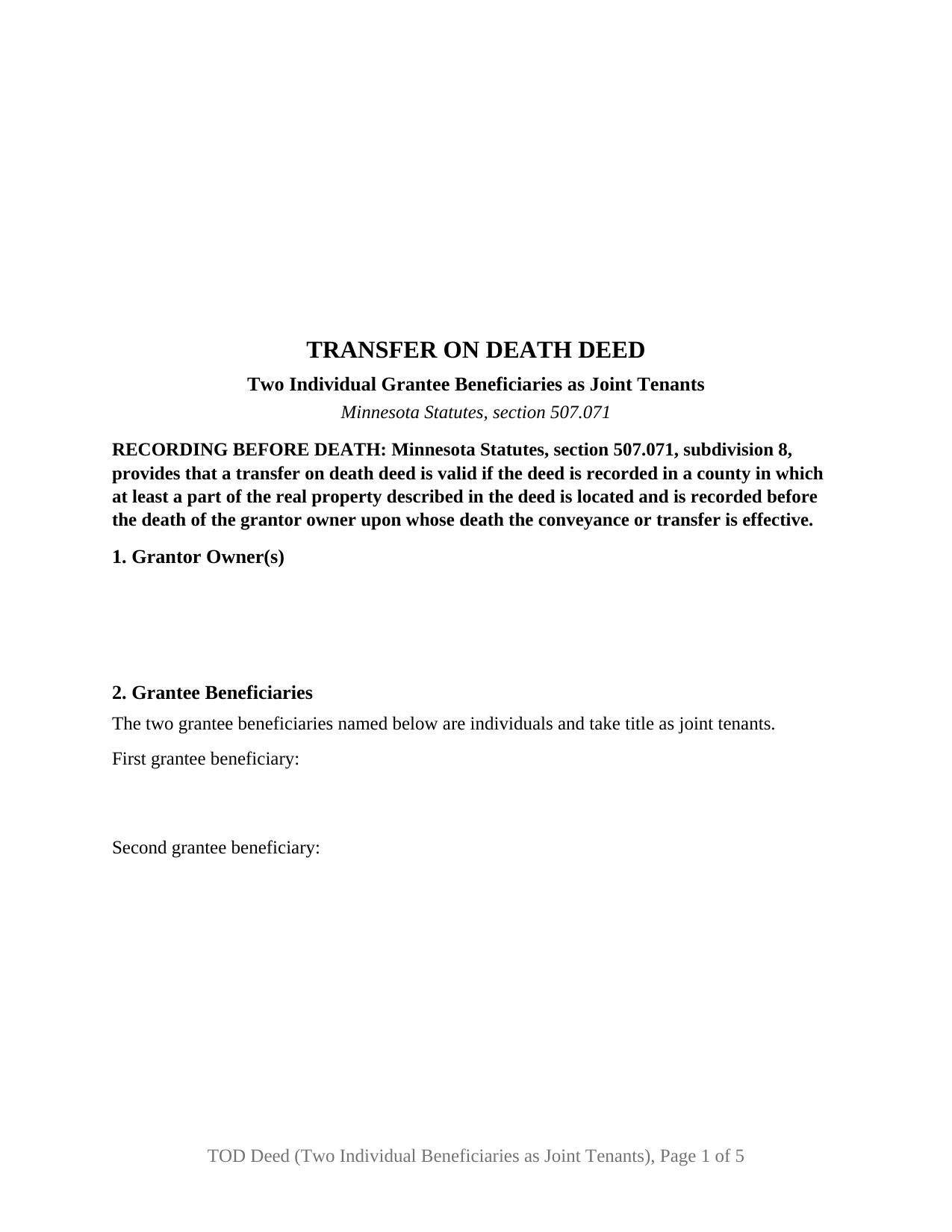
About the Minnesota Transfer on Death Deed (Two Individual Beneficiaries as Joint Tenants)
How to Use This Form
- Select your county from the list
- Download the county-specific form
- Fill in the required information
- Have the document notarized if required
- Record with your county recorder's office
What Others Like You Are Saying
"Great experience. Rapid service, no unexpected problems, and reasonable pricing. I will definitely u…"
"Great service! The example completed form and instructions provided by Deeds.com were extremely help…"
"A real boon to those of us who are not attorneys but wish to protect our assets and avoid probate co…"
"My mind is blown! For some reason, our veteran title companies wouldn't record our deed but luckily,…"
"Their customer service is impressive to say the least. I sent them an email and I received a respons…"
4.8/5 from 4,839 reviews. Read all
Two named people, one deed, and a survivorship between them that the statute itself supplies: this Minnesota transfer on death deed names exactly two individual grantee beneficiaries who take title as joint tenants when the grantor owner dies. One or two grantor owners sign it, Minnesota Statutes, section 507.071, governs it, and the joint tenancy is printed as fixed deed text.
Why the deed says joint tenants in so many words
Section 500.19, subdivision 2, reads a grant of land to two or more persons as a tenancy in common unless it expressly declares a joint tenancy. Section 507.071, subdivision 4, carries the same choice into the TOD deed by permitting multiple grantee beneficiaries to take as joint tenants, as tenants in common, or in any other form valid in the state. This deed makes the express declaration in the beneficiary section and again inside the operative sentence, so the two beneficiaries take the property with the right of survivorship between them, and when one later dies the other holds the whole without probate.
A beneficiary who dies first
The second sentence of subdivision 4 provides that if a grantee joint tenant dies before the grantor owner and the deed designates no successor beneficiary for that grantee, the surviving joint tenants are the successors and no interest lapses. This deed designates no successor beneficiary, so that sentence governs when one of the two predeceases. Section 524.2-702 measures survival at 120 hours, and subdivision 11, the antilapse rule for a beneficiary descended from the grantor owner's grandparent, remains in the chapter; the guide describes both as the statute states them.
What the configuration recites
The beneficiary section opens with a fixed sentence that the two grantee beneficiaries named below are individuals and take title as joint tenants, followed by two labeled entries, one for each person's name and mailing address. The operative sentence conveys and quitclaims to those two beneficiaries, as joint tenants, effective on the death of the grantor owner or, where two grantor owners are named, on the death of the last of them to die, in the words of the statutory form in subdivision 24. The grantor side is a free-form entry for one or two natural persons with their marital status, two owner signature blocks, and a labeled joining-spouse section for a non-owner spouse whose signature section 507.02 calls for on a homestead. Two children who are to hold the family home together after their parents, with the survivor taking the whole, and two unmarried partners whom an owner names together, present the pattern this deed recites. The form is not set up for one beneficiary or three or more, for tenants in common, for a trust or entity beneficiary, or for a grantor signing as trustee or attorney-in-fact.
Nothing moves until death, and only if the deed is on record
Section 507.071, subdivision 8, makes recording the condition of validity: the deed is valid if recorded in a county where at least part of the property lies, before the death of the grantor owner on whose death the transfer depends. Until then the deed has no effect on title, and the beneficiaries' interest cannot be assigned, encumbered, or reached by creditors under subdivision 22. Subdivision 8 also spares the deed the auditor's transfer certification and the certificate of real estate value, and section 287.22 exempts it from deed tax. The form carries the drafter statement of section 507.091, the two insurance warnings section 507.072 has placed on every beneficiary deed recorded since August 1, 2024, and, with its single box, the after-acquired property statement of subdivision 21.
Each signer, one certificate
Each of the three signature blocks is followed by its own acknowledgment certificate in the short form of section 358.66. Where two owners hold as joint tenants, subdivision 6 makes the deed operate only after the last surviving owner's death and voids it if that survivor did not sign. After the grantor owner's death the beneficiaries record an affidavit of identity and survivorship and a county agency clearance certificate, each prepared and recorded separately and not part of this package.
The package contains the fillable transfer on death deed, a completed example on a Dakota County fact pattern in which two parents name their two children as joint tenants, and the guide that explains every numbered section, the survivorship rules, and the recording steps. This description and the guide describe the form and the statutes behind it in general terms and are not legal advice.
Important: County-Specific Forms
Our transfer on death deed (two individual beneficiaries as joint tenants) forms are specifically formatted for each of the 87 counties in Minnesota.
After selecting your county, you'll receive forms that meet all local recording requirements, ensuring your documents will be accepted without delays or rejection fees.