Minnesota Transfer on Death Deed (Trust Beneficiary)
County Specific Legal Forms Validated as recently as November 1, 2026 by our Forms Development Team
About the Minnesota Transfer on Death Deed (Trust Beneficiary)
How to Use This Form
- Select your county from the list
- Download the county-specific form
- Fill in the required information
- Have the document notarized if required
- Record with your county recorder's office
What Others Like You Are Saying
"Excellent website. I found exactly what I was looking for!"
"you made this so easy,user friendly"
"Did not need power to "serve" contractor. All work done well, paid for, nothing more. Wort…"
"THE PROCESS WENT VERY SMOOTH AND EASY"
"Thought I knew what I was doing but it turns out I was in way over my head. Thankfully customer serv…"
4.8/5 from 4,839 reviews. Read all
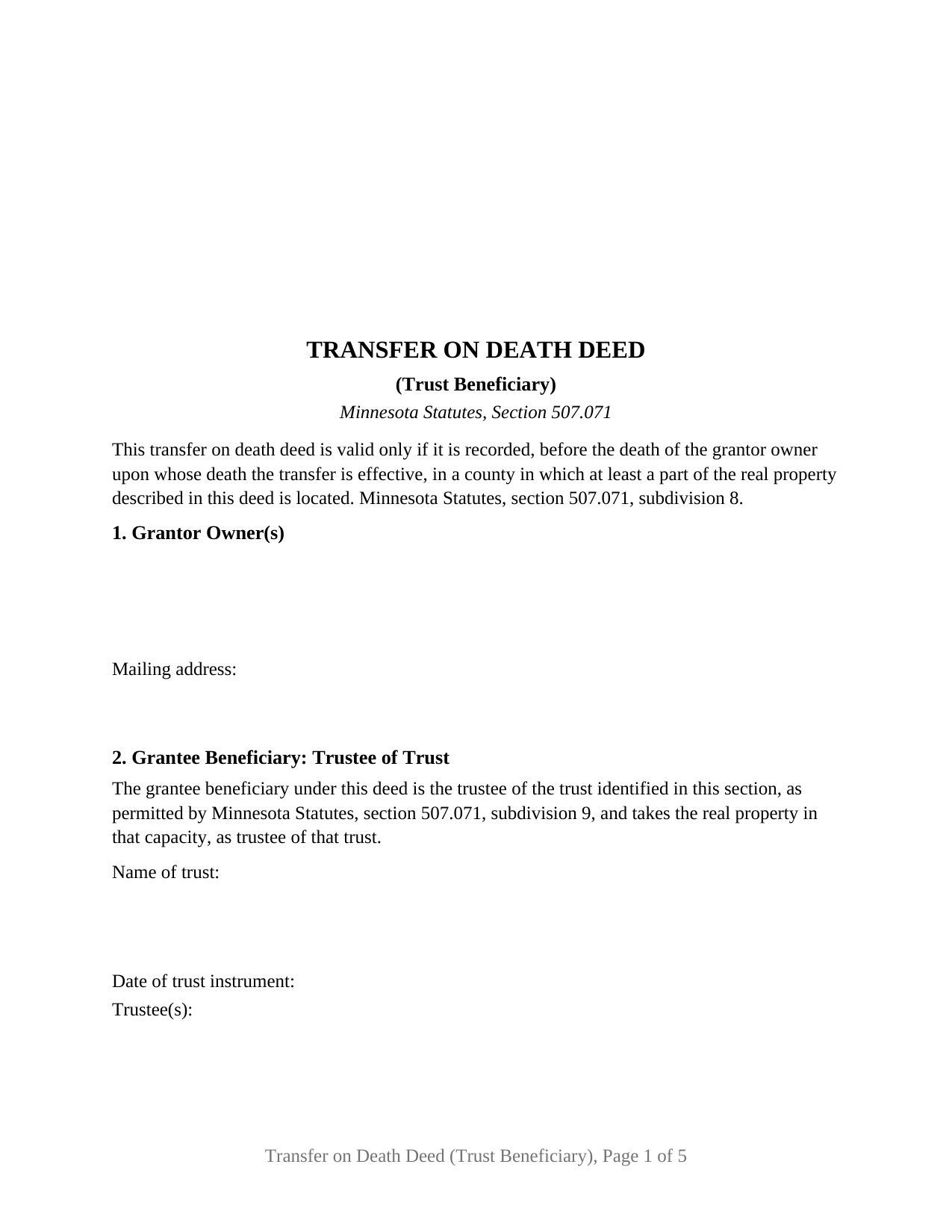
This Minnesota transfer on death deed names the trustee of a trust as the grantee beneficiary, so the real property joins the trust at the owner's death and not before. Minnesota Statutes, section 507.071, governs it; one or two grantor owners holding title in their own names sign it, and the beneficiary side is fixed as the trustee of one identified trust.
A trust that receives the property at death, not before
Subdivision 9 of section 507.071 permits a transfer on death deed to convey real property to the trustee of an inter vivos trust, even a revocable one, or to the trustee of a testamentary trust. An owner who has signed a revocable living trust but kept the home in the owner's own name records no lifetime deed to the trust, and under subdivision 2 the recorded TOD deed has no effect on title until death. At that death the trustee holds the property as part of the trust.
The deed names an office, and a separate certificate proves it
Section 2 opens with fixed text identifying the grantee beneficiary as the trustee of the trust named there and receives the trust's name, the date of the trust instrument, the trustee or trustees now serving, and a mailing address. Because the deed describes the beneficiary by office, the trust instrument and the Minnesota Trust Code, chapter 501C, decide who occupies it when the deed takes effect. Section 507.35 provides that a grant to a person as trustee may be disregarded, where the trustee's powers and the trust's beneficiary are not set out in the instrument or by reference to a recorded one, until an instrument defining those powers is recorded; the certificate of trust under section 501C.1013, which a settlor or trustee may execute and record, is the instrument that statute supplies for real property transactions, prepared apart from this package.
A lapse rule written for trusts
Under subdivision 12, if the beneficiary is a trust which has been revoked before the grantor owner's death, no transfer occurs and the deed is void. The 120-hour survival rule of section 524.2-702 still applies through subdivision 2, and subdivision 14 voids the deed as to any part of the property the owner no longer held at death.
What the configuration recites
The form carries a free-form grantor owner block for one or two natural persons and two owner signature blocks, OWNER and SECOND OWNER (if applicable), each followed by its own acknowledgment certificate. A third block and certificate, JOINING SPOUSE (if applicable), receives the signature of a spouse who is not an owner, under a fixed sentence that the spouse joins only to release marital interests under section 507.02 and is not a grantor owner. The operative sentence is fixed text: the owner or owners convey and quitclaim to the trustee of the identified trust, effective at the single owner's death or, where two owners sign, at the death of the last of them to die. Settlors of a revocable living trust who still hold their home in their own names and name that trust's trustee, and a parent who names the trustee of a trust created for a child, present the patterns this deed recites. The form is not set up for an individual or entity grantee beneficiary, for a trustee or entity signing as grantor, for an attorney-in-fact, or for three or more owners.
The one box, the warnings, and the recorder's counter
The statutory form prints one optional statement with one box, the after-acquired property election of subdivision 21, and the deed prints it word for word, unmarked. The deed also prints the two insurance warnings of section 507.072, subdivision 7. Under subdivision 8 the deed is valid only if recorded before the operative death in a county where at least part of the land lies, with no auditor certification, no certificate of real estate value, and, under section 287.22, no state deed tax. After the death, an affidavit of identity and survivorship and a county agency clearance certificate complete the record; each is recorded separately and is not included in this package.
The purchase includes the fillable transfer on death deed to a trustee, a completed example on a Washington County fact pattern in which spouses name the co-trustees of their own revocable living trust, and the guide covering each section, signing, and recording. This description and the guide explain the form and the Minnesota statutes behind it in general terms and are not legal advice.
Important: County-Specific Forms
Our transfer on death deed (trust beneficiary) forms are specifically formatted for each of the 87 counties in Minnesota.
After selecting your county, you'll receive forms that meet all local recording requirements, ensuring your documents will be accepted without delays or rejection fees.