Minnesota Transfer on Death Deed (Primary and Successor Beneficiary)
County Specific Legal Forms Validated as recently as November 1, 2026 by our Forms Development Team
About the Minnesota Transfer on Death Deed (Primary and Successor Beneficiary)
How to Use This Form
- Select your county from the list
- Download the county-specific form
- Fill in the required information
- Have the document notarized if required
- Record with your county recorder's office
What Others Like You Are Saying
"I'm stuck in Florida due to family business and needed to file documents in Virginia for other famil…"
"It very convenient and fast. Thank you Hilda Reyes"
"Very convenient and quick. I will definitely use it again."
"Loved it! Extremely easy to use. Quick and efficient. I was able to officially record my documents w…"
"Easy to use site with a good selection of documents"
4.8/5 from 4,839 reviews. Read all
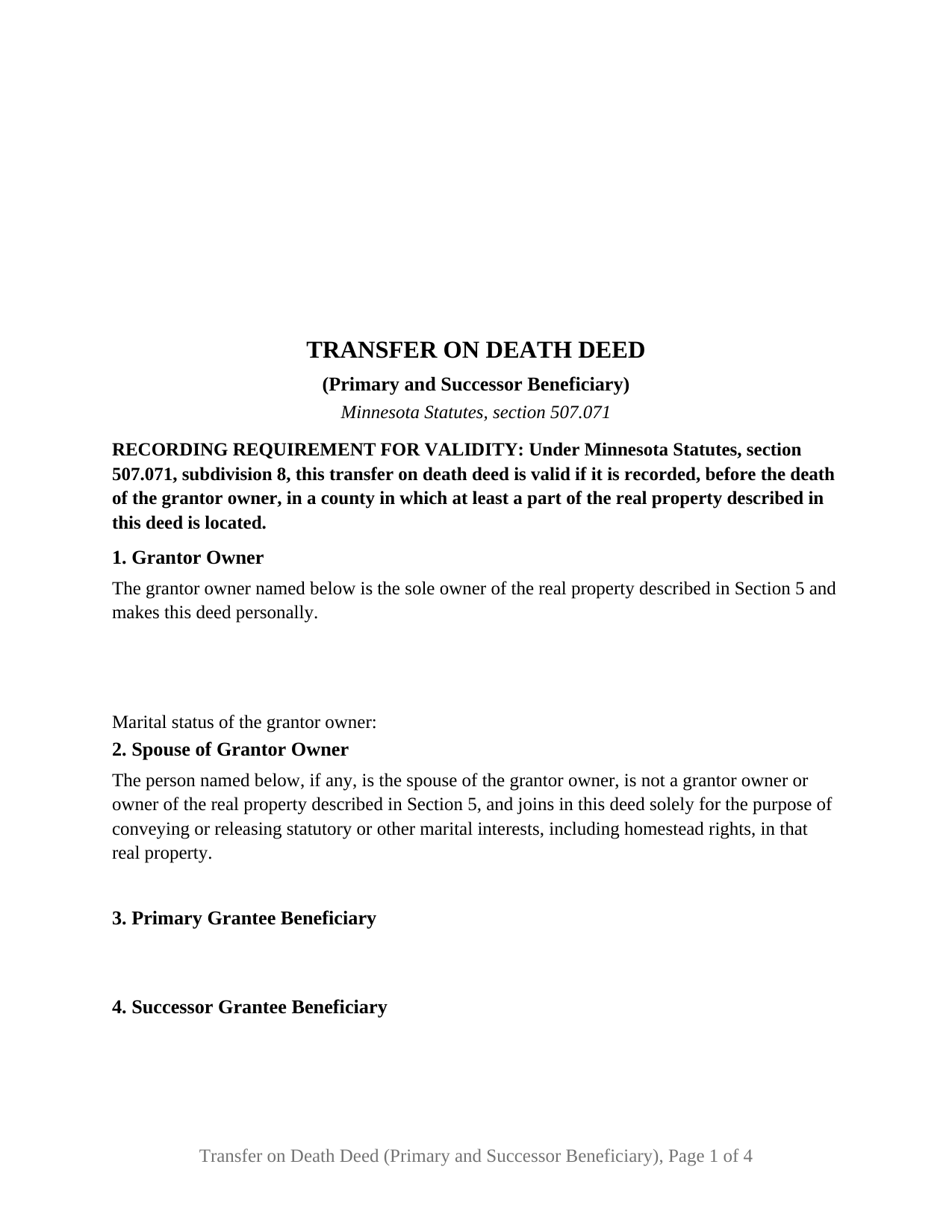
A named backup for the person meant to inherit: this Minnesota transfer on death deed lets one owner name a primary grantee beneficiary and a successor grantee beneficiary who takes the property if the primary does not survive the owner. Prepared under Minnesota Statutes, section 507.071, for a grantor owner who holds the real property alone, it states the one condition on which the successor's interest vests.
Why the deed has to state the successor's condition
Section 507.071, subdivision 5, permits a transfer on death deed to designate one or more successor grantee beneficiaries, and adds a requirement: a deed that designates a successor shall state the condition under which the successor's interest would vest. This deed answers in fixed text in Section 6. If the primary grantee beneficiary does not survive the grantor owner, the interest the primary would have taken vests instead in the successor named in Section 4, effective on the grantor owner's death, with survival measured as section 524.2-702 provides, which treats a beneficiary who fails to outlive the owner by 120 hours as having predeceased.
What a named successor changes about antilapse
Under the statute's own antilapse rule in subdivision 11, if a grantee beneficiary who is a grandparent or lineal descendant of a grandparent of the owner fails to survive, that beneficiary's surviving issue take in place of the beneficiary. The rule opens with an exception: it does not apply when a successor grantee beneficiary is designated in the deed for the beneficiary who did not survive. Naming a successor on this deed replaces the statutory substitution with the owner's own choice.
One sole owner, a factual marital status, and a joinder block
Section 1 recites, as fixed deed text, that the grantor owner is the sole owner of the real property and makes the deed personally; marital status is a factual line, because the statutory form in subdivision 24 asks for the grantor to be identified with marital status designated. The designation matters under section 507.02, which provides that no conveyance of a married owner's homestead is valid without both spouses' signatures, a rule subdivision 2 applies to this deed. Section 2 is therefore a joinder block for the spouse of the grantor owner, with a fixed sentence stating that the spouse is not a grantor owner and joins solely to convey or release statutory or other marital interests, tracking the subdivision 1 definition of grantor owner. The form carries a GRANTOR OWNER signature block and a SPOUSE OF GRANTOR OWNER block, each followed by its own acknowledgment certificate; an unmarried owner writes None in Section 2 and leaves the spouse's block and certificate blank.
What the configuration recites
This configuration recites one natural person as grantor owner, holding the whole interest alone and signing personally, with exactly one primary grantee beneficiary and exactly one successor grantee beneficiary, each a natural person named with a mailing address. A parent naming an adult child as primary beneficiary with a grandchild as successor, and an owner naming a sibling with a niece or nephew as successor, present the pattern this deed recites. The form is not set up for two or more grantor owners, for an owner who holds with a co-owner, for a trustee or entity as grantor or beneficiary, or for several concurrent beneficiaries taking in shares.
The statutory words the deed keeps
The conveyance uses the operative words of the subdivision 24 form, conveys and quitclaims, states that the deed is effective only on the death of the grantor owner, and prints the form's single optional statement with its one box, the after-acquired property election of subdivision 21, unmarked in the blank. It carries the two insurance warnings section 507.072, subdivision 7, has required since August 1, 2024. Recording before the owner's death in a county where the land lies is the condition of validity under subdivision 8. The post-death filings, the affidavit of identity and survivorship under subdivision 20 and the county agency clearance certificate under subdivision 23, are prepared and recorded separately and are not included in this package.
The package contains the fillable transfer on death deed, a completed example prepared on a Dakota County fact pattern with a married sole owner, a joining spouse, a son as primary, and a granddaughter as successor, and the guide covering each numbered section, acknowledgment, and recording. This description and the guide describe the form and the governing Minnesota statutes in general terms and are not legal advice.
Important: County-Specific Forms
Our transfer on death deed (primary and successor beneficiary) forms are specifically formatted for each of the 87 counties in Minnesota.
After selecting your county, you'll receive forms that meet all local recording requirements, ensuring your documents will be accepted without delays or rejection fees.