Mississippi Transfer on Death Deed (Married Joint Owners with Right of Survivorship, Last Survivor)
County Specific Legal Forms Validated as recently as November 8, 2026 by our Forms Development Team
About the Mississippi Transfer on Death Deed (Married Joint Owners with Right of Survivorship, Last Survivor)
How to Use This Form
- Select your county from the list
- Download the county-specific form
- Fill in the required information
- Have the document notarized if required
- Record with your county recorder's office
What Others Like You Are Saying
"Great service fast and easy."
"I recommend you add a box "Add another document or package." The way it is now confused me…"
"Best Way EVER to record a warranty deed! It was nice to not have to drive anywhere and find the faci…"
"Gift Deed is exactly what was required. Thank you!"
"Quick, Simple and a Ton of Time Saved..."
4.8/5 from 4,847 reviews. Read all
Two Mississippi spouses who hold their home as joint owners with right of survivorship already know what happens at the first death: the survivor owns the whole property. What the survivorship does not answer is who takes after the second death, and this fillable Mississippi transfer on death deed, drawn for exactly two married owners holding as joint tenants with right of survivorship or as tenants by the entirety with right of survivorship, supplies that answer in one recorded instrument under the Mississippi Real Property Transfer-on-Death Act, Miss. Code Ann. Sections 91-27-1 through 91-27-37.
A deed that waits for the second death
The Act defines a joint owner with right of survivorship to include a joint tenant and a tenant by the entirety, and Section 91-27-27(1) writes the timing for them: while an owner is survived by another joint owner, the property belongs to the survivor, and the transfer on death deed is effective when the last surviving joint owner dies. The form prints that rule in its operative section, directly after the statement, in the words Section 91-27-17(2) calls for, that at the death of the last surviving owner the owners transfer their interest in the described property to the designated beneficiaries. At the first death nothing moves under the deed; the surviving spouse holds the whole property, keeps every right an owner has, and keeps the recorded designation in place unless that spouse changes it. At the second death the designated beneficiaries take outside probate, subject to whatever mortgages and liens then affect the property under Section 91-27-29, and without covenant or warranty of title. The instrument Mississippi buyers also search for as a TOD deed or a beneficiary deed is, in this configuration, a deed with two signers and one operative death.
Both spouses sign, and both are needed to undo it
Each spouse is a transferor of that spouse's own interest under Section 91-27-9, so the form carries two signature blocks, FIRST OWNER and SECOND OWNER, and a separate acknowledgment certificate for each in the short form Section 89-3-7(2) prints, which lets the two owners acknowledge on different dates or before different notaries. Revocation is the mirror image. Under Section 91-27-21(e) a transfer on death deed made by joint owners with right of survivorship is revoked only if it is revoked by all of the living joint owners, and under Section 91-27-27(2) the last surviving owner may revoke it alone, by a recorded instrument of revocation or a later recorded transfer on death deed, each prepared and recorded separately and not included in this package. A will does not revoke the deed, and a divorce judgment revokes it only as to a former spouse who was named as a beneficiary.
Recorded while both are living
Section 91-27-17(3) makes recording before the transferor's death, in the official records of the chancery clerk of the county where the property is located, a condition of the deed's effectiveness, and the form prints that condition in capital letters above its transfer sentence. On a deed with two transferors the condition is written for each transferor's death, and a deed recorded while both spouses are living meets it as to both. Mississippi imposes no transfer tax on the deed; the chancery clerk's recording fee under Section 25-7-9 is $25.00 for the first five pages, $26.00 in the counties that add the $1.00 archive fee, and $1.00 for each page past five.
Laid out for the chancery clerk's first page
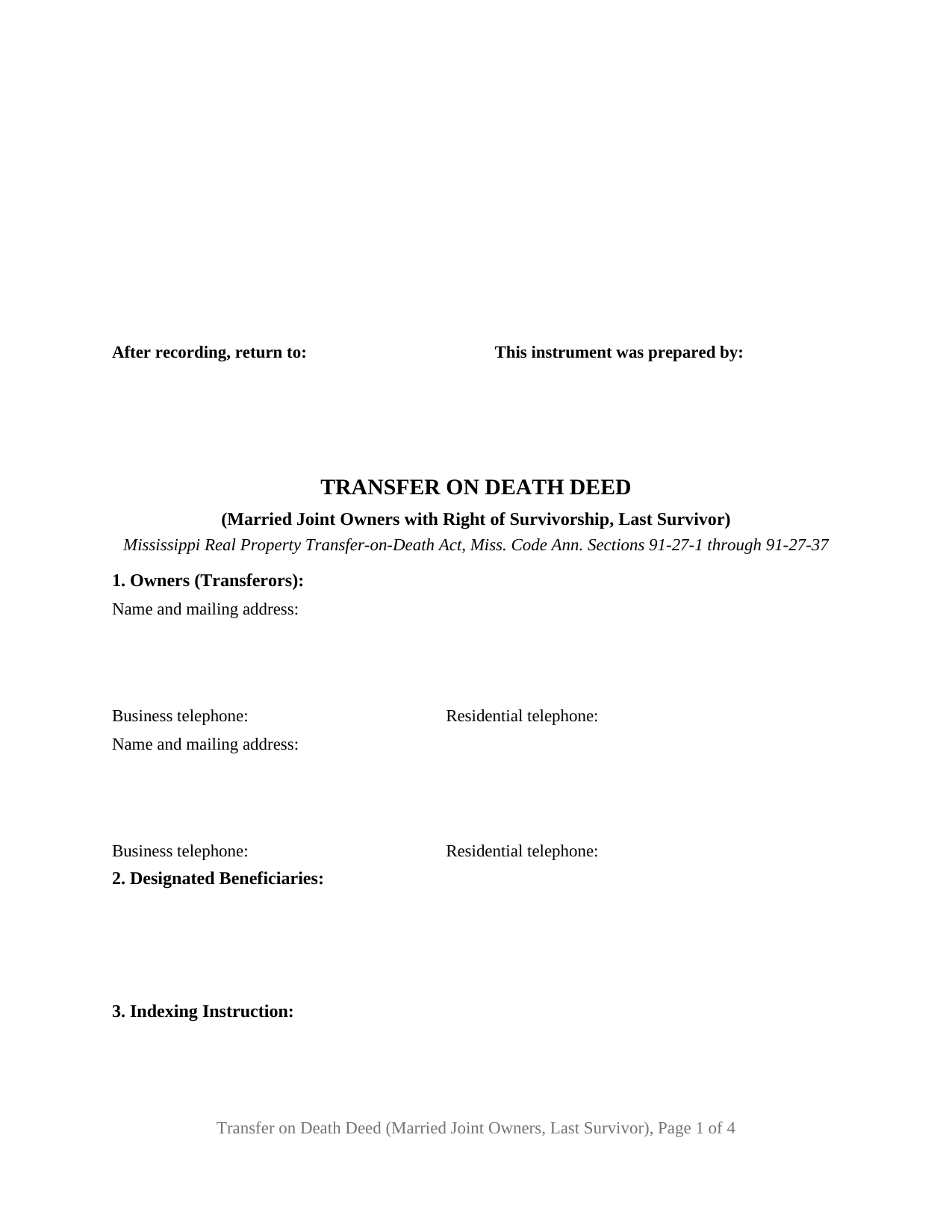
Section 89-5-24(2) puts the preparer's name, address, and telephone number, the name, mailing address, and telephone numbers of every party, the return address, the title, and the indexing instruction on the first page below the three-inch margin reserved for the clerk, and Section 27-3-51 lets the clerk refuse a deed that lacks each grantor's and grantee's mailing address and business and residential telephone numbers. This deed carries both owners with their telephone rows, the designated beneficiaries with theirs, and the sectional indexing instruction of Section 89-5-33(3) on recorded page one, and the legal description opens page two under the statute's own continuation rule.
The configuration this form recites
The form recites exactly two owners who are married to each other and hold title to the described property as joint owners with right of survivorship within the meaning of Section 91-27-3(c), whether as joint tenants with right of survivorship or as tenants by the entirety with right of survivorship, each signing personally and not through a power of attorney; a free-form beneficiary block for one or more designated beneficiaries of any class the chapter allows, who take in equal and undivided shares under Section 91-27-27(5); two signature blocks; and two acknowledgment certificates. Spouses naming the children of their marriage, a couple naming a trust for a child who cannot manage property, and a couple naming a church to take once both are gone present the pattern this deed recites. Section 89-1-7 makes a deed to spouses a tenancy in common unless survivorship manifestly appears from the instrument, so the couple's own vesting deed is what places them inside the chapter's definition. The form is not set up as a sole owner's deed, as a deed for two owners who are not married to each other or who hold as tenants in common, as an instrument for an entity or trustee owner, or as a deed signed through an agent, and it carries no alternate beneficiary block; where no designated beneficiary survives the last surviving owner, the deed transfers nothing and the property passes under that owner's will or by intestacy.
Three pieces make up the package: the fillable deed, a completed example filled in for two Madison County spouses designating their two children, and the guide, which walks through every numbered section, the two acknowledgments, the survivorship and homestead rules behind the form, and recording with the chancery clerk. The guide and this description state what the form carries and what the Mississippi statutes provide, in general terms, and neither is legal advice.
Important: County-Specific Forms
Our transfer on death deed (married joint owners with right of survivorship, last survivor) forms are specifically formatted for each of the 82 counties in Mississippi.
After selecting your county, you'll receive forms that meet all local recording requirements, ensuring your documents will be accepted without delays or rejection fees.