Mississippi Transfer on Death Deed (Sole Owner, One Individual Beneficiary)
County Specific Legal Forms Validated as recently as November 8, 2026 by our Forms Development Team
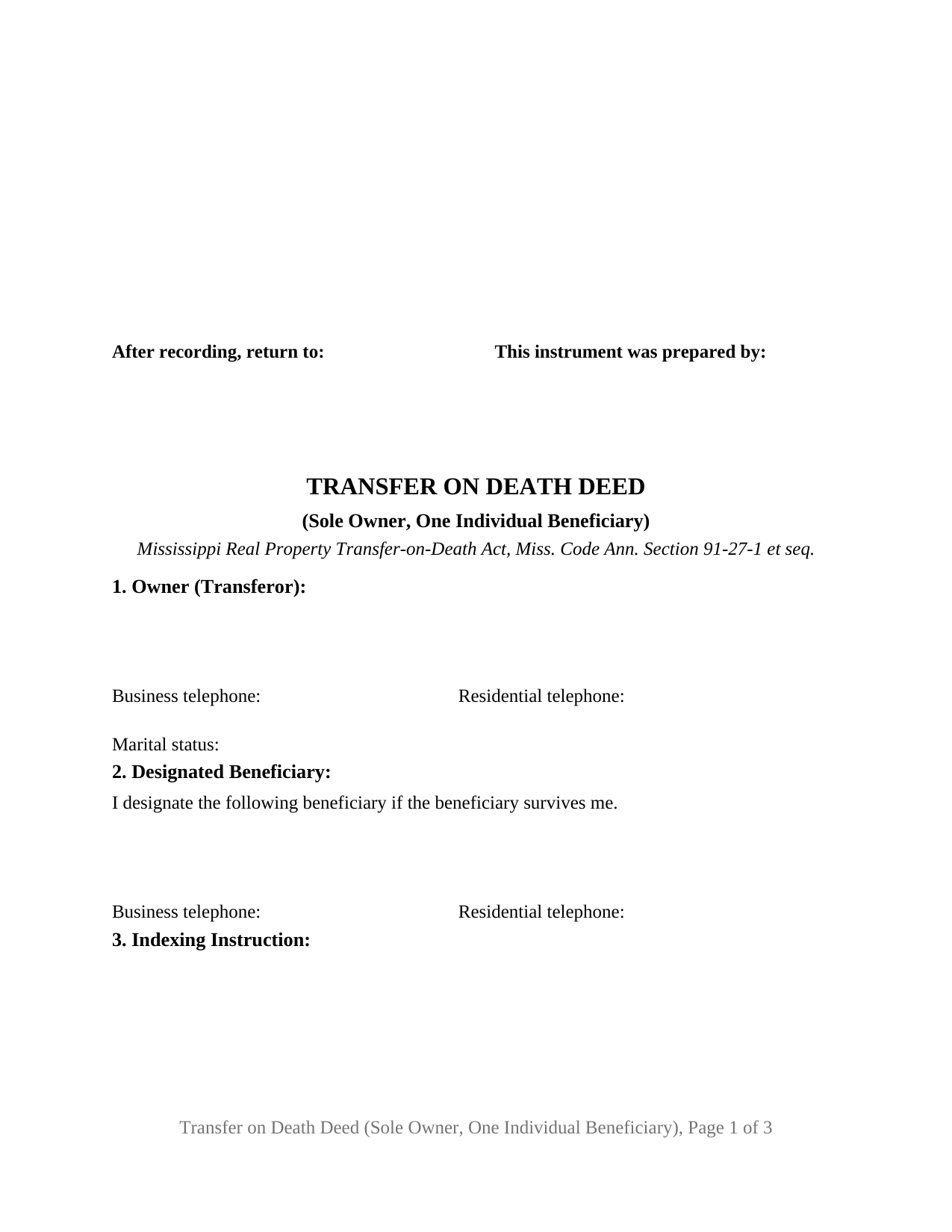
About the Mississippi Transfer on Death Deed (Sole Owner, One Individual Beneficiary)
How to Use This Form
- Select your county from the list
- Download the county-specific form
- Fill in the required information
- Have the document notarized if required
- Record with your county recorder's office
What Others Like You Are Saying
"It was a wonderful experience. Thank you for your help."
"Thorough, efficient, couldn't ask for better support. I refer everyone I know in real estate to use …"
"So far, this is working well. However, I don't see a form to change name due to marriage."
"Deeds.com was a great experience in helping me get some important documents recorded.I would recomme…"
"This is so amazing and I truly thank you for what I needed for my documents. This is a great company…"
4.8/5 from 4,847 reviews. Read all
One owner, one named person, and no second designation of any kind: that is the whole shape of this Mississippi transfer on death deed. The form is written for an owner who holds the property alone and designates a single individual to take it at the owner's death under Title 91, Chapter 27 of the Mississippi Code, the state's Real Property Transfer-on-Death Act, and it fixes both halves of that configuration as deed text.
One owner, one name, nothing left to resolve
Most beneficiary deed forms try to hold every situation at once: two owner lines, several beneficiary lines, an alternate, a box for shares. Each open line is a decision the signer has to make correctly, and each unused line is a question a title examiner later has to answer. This deed removes them. Section 1 identifies the one owner by name, mailing address, telephone numbers, and marital status. Section 2 opens with the optional statutory form's own sentence, I designate the following beneficiary if the beneficiary survives me, and takes the name and contact information of exactly one person. Section 7 then recites that the owner is the sole owner of the described property, makes the deed personally with the capacity Section 91-27-15 requires and not through an agent under a power of attorney, and that the designated beneficiary is one individual with no alternate beneficiary designated. Nothing on the recordable pages asks about a co-owner, a share, or a second taker, because the configuration has already decided each of those questions.
If the named person dies first
A deed with one beneficiary and no alternate has one consequence worth stating plainly, and the form states it in the guide rather than hiding it in a blank. Under Section 91-27-27(4) the designated beneficiary's interest is contingent on surviving the owner, and the interest of a beneficiary who does not survive lapses. The Mississippi chapter supplies no substitute taker for a lapsed designation, so if the one named individual dies before the owner, this deed transfers nothing and the property passes under the owner's will or by intestate succession, exactly as if no TOD deed had been recorded. The owner's remedies during life are the two Section 91-27-21 gives every transferor: a later transfer on death deed naming someone else, acknowledged after this one and recorded before death, revokes it by inconsistency, and an instrument of revocation, prepared and recorded separately and not included in this package, revokes it expressly. A will does neither. A change of mind is therefore a new recorded instrument, never a note in a file.
A spouse who is not on the deed
Sole ownership and marriage are different facts, and this form keeps them apart. The owner's marital status is a factual entry in Section 1, not a fixed recital, so a married owner who holds a parcel in that owner's name alone completes the same form as an unmarried one. Only the owner signs, and the form carries one signature block and one acknowledgment certificate. Two Mississippi statutes meet at that point. Section 89-1-29 makes a conveyance or encumbrance of a homestead by a married owner living with a spouse invalid without the spouse's signature, and Welborn v. Lowe, 504 So. 2d 205 (Miss. 1987), treats such a conveyance as void. Section 91-27-23 provides that during the owner's life a transfer on death deed affects no interest or right of the owner, including homestead rights, and creates no interest in the beneficiary; the transfer happens at death under Section 91-27-27. The guide describes both provisions and the surviving spouse's homestead occupancy protection under Section 91-1-23, and Section 91-27-27 applies its rules at death except as otherwise provided in Section 91-5-25, the spousal right to renounce a will.
Signed once, recorded once
Section 91-27-11 sends the deed's execution to Mississippi's acknowledgment statutes, so the owner signs before a notarial officer who completes the Section 89-3-7(2) short form certificate the deed carries, and no subscribing witness is required. Section 25-34-15 requires the owner to appear in person; Mississippi has enacted no remote online notarization statute. The deed is then recorded with the chancery clerk of the county where the property lies, before the owner's death, which Section 91-27-17(3) makes the condition of effectiveness. The owner and beneficiary blocks carry the business and residential telephone numbers Section 27-3-51 requires of every grantor and grantee, since the clerk may refuse a deed without them, and the recording fee under Section 25-7-9 is $25.00 for the first five pages before any county archive fee. The form runs three recordable pages, so one fee covers it.
What this deed fixes and what it leaves open
This is the sole-owner, one-individual-beneficiary configuration of the Mississippi transfer on death deed, also searched as a Mississippi beneficiary deed or TOD deed. The form fixes the owner count at one, fixes the recital that the owner is the sole owner, fixes the beneficiary at one natural person, and fixes the absence of an alternate; it leaves the owner's marital status, the parties' names and addresses, and the property identification as factual entries. An owner who holds a house alone naming a sibling, an unmarried owner naming a longtime partner, and a grandparent passing one lot to one grandchild all present the pattern this deed recites. The form is not set up for two owners on one instrument, for co-owners holding with a right of survivorship, for an entity or trustee owner, for a trust or entity beneficiary, for more than one beneficiary, or for an alternate beneficiary; each of those follows a different pattern. Nothing about how the owner holds title beyond sole ownership, and nothing about shares, is preprinted anywhere on the instrument.
The package contains three items: the fillable deed, a completed example prepared for an unmarried Lafayette County owner who designates her son, and a guide covering each numbered section, the acknowledgment certificate, the homestead and spousal statutes, and what the chancery clerk requires at recording. The description above and the guide explain the form and the statutes in general terms and are not legal advice.
Important: County-Specific Forms
Our transfer on death deed (sole owner, one individual beneficiary) forms are specifically formatted for each of the 82 counties in Mississippi.
After selecting your county, you'll receive forms that meet all local recording requirements, ensuring your documents will be accepted without delays or rejection fees.