Mississippi Transfer on Death Deed (Sole Owner, Trust Beneficiary)
County Specific Legal Forms Validated as recently as November 8, 2026 by our Forms Development Team
About the Mississippi Transfer on Death Deed (Sole Owner, Trust Beneficiary)
How to Use This Form
- Select your county from the list
- Download the county-specific form
- Fill in the required information
- Have the document notarized if required
- Record with your county recorder's office
What Others Like You Are Saying
"This process exceeded my expectations. A great customer experience!"
"Easy to navigate. The guide and sample helped a lot, including the availability of "Exhibit A". Know…"
"Extremely convenient for a moderate fee. Will definitely use Deeds.com for my recording needs going …"
"Haven't processed any deed documents so far. I do agree that Deed.com website browsing tool will be …"
"So quick. So easy. Worth every penny!"
4.8/5 from 4,847 reviews. Read all
This Mississippi transfer on death deed is built for one owner who holds the property alone and wants it to pass, at death, into a trust the owner has already created. The deed names the trust as the designated beneficiary, identifies its trustee, and provides in fixed text that the interest vests at the owner's death in the trustee of that trust then serving, including any successor trustee, to be held under the trust's terms. It is a transfer on death deed, also searched as a TOD deed or beneficiary deed, prepared under the Mississippi Real Property Transfer-On-Death Act, Miss. Code Ann. Sections 91-27-1 through 91-27-37, in the sole owner, trust beneficiary configuration.
The trustee then serving takes, whoever that turns out to be
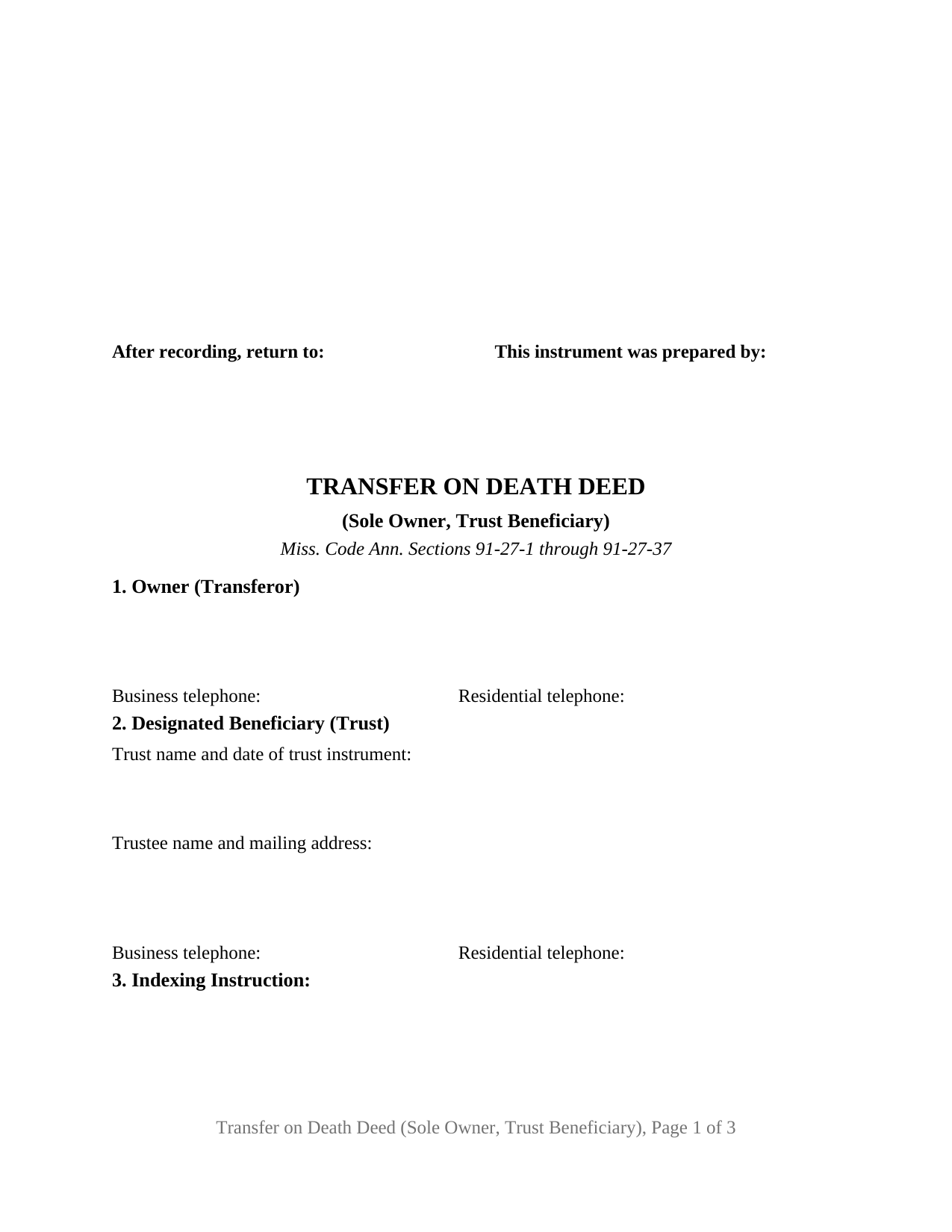
A trust does not die, but its trustee can resign, decline, or pass away between the day the deed is signed and the day the owner dies. A transfer on death deed that named the trustee by name alone would carry that risk forward for years. This form resolves it on the face of the deed: Section 2 identifies the trust by its name and the date of its trust instrument and identifies the trustee now in office with a mailing address and telephone numbers, and Section 7 then provides that at the owner's death the interest vests in the trustee of that trust then serving, including any successor trustee, to hold as trustee under the terms of the trust. A change of trustee during the owner's life therefore changes nothing on the recorded deed, and where the owner is the trustee of the owner's own revocable living trust, the deed carries the designation to the successor trustee the trust instrument names.
Why a Mississippi transfer on death deed can run to a trust
Section 91-27-3(b) defines a designated beneficiary as a person designated to receive real property in a transfer on death deed, and Section 91-27-3(d) defines a person to include a trust, alongside an individual, a corporation, a limited liability company, and the other entities the chapter lists. The Mississippi Uniform Trust Code supplies the title mechanics: Section 91-8-407(c)(3) provides that any estate in real property may be acquired in the trust name and that title so acquired can be conveyed in the trust name or by the trustees, as trustees of the trust, and Section 91-8-407(b)(1) requires a trust of or in real property to rest on a written instrument signed by the settlor. The deed itself does not create or fund the trust. The trust exists before the deed is signed, the deed designates it, and the property becomes trust property only at the owner's death and only if the deed is then of record.
One owner, one signature, one certificate
This is the sole owner configuration of the Mississippi transfer on death deed, and the deed recites it as fixed text: the person named in Section 1 is the sole owner of the described property. The form carries one owner signature block and one acknowledgment certificate in the Section 89-3-7(2) short form, and nobody else signs. The trustee does not sign, because Section 91-27-19 makes the deed effective without notice to, delivery to, or acceptance by the beneficiary during the owner's life. The owner signs personally; Section 91-27-15 sets the capacity at that required to make a contract and bars creating the deed through a power of attorney unless the power specifically authorizes it, and the deed says in its own words that it is made personally and not through an agent. An unmarried owner who built a revocable living trust around the home, and a widowed owner whose trust already holds the rest of the estate and whose house is the one asset left outside it, present the pattern this deed recites. The form is not set up as a deed for two owners, for a co-owner of property held with another person, for an entity or trustee as the owner, for an individual beneficiary, or for an alternate beneficiary; it carries no spouse signature line, and the guide describes the homestead statute a married owner of a Mississippi homestead would read beside this deed.
Effective only once it is of record
Nothing passes while the owner lives. Section 91-27-23 provides that the recorded deed does not affect the owner's right to transfer or encumber the property, leaves homestead rights and ad valorem tax exemptions in place, and creates no interest in favor of the trustee; the owner may revoke it under Section 91-27-21 by a later recorded instrument, and a will does not revoke it. Section 91-27-17(3) supplies the condition that makes the deed work: unless it has been recorded, before the owner dies, in the official records kept by the chancery clerk of the county where the land lies, it is not effective, and the form prints that condition in capital letters at the head of its operative section. Because Mississippi's recording statute, Section 89-5-24(2), places the preparer, the parties' names, addresses, and telephone numbers, the return address, the title, and the indexing instruction on the first page of a recorded deed below the clerk's three-inch margin, the first page of this deed is laid out to hold the owner's block, the trust and trustee block with the telephone numbers Section 27-3-51 asks of every grantor and grantee, and the Section 89-5-33(3) indexing instruction, with the legal description opening page two under the statute's own continuation sentence.
What the trust takes, and subject to what
At the owner's death the trustee takes whatever interest the owner then holds, in accordance with the deed, under Section 91-27-27(4). The transfer is made without covenant or warranty of title, which Section 91-27-27(3) attaches to every transfer on death deed, and under Section 91-27-29 the trustee takes subject to every mortgage, lien, encumbrance, contract, and other interest affecting the property at that moment. The chapter conditions a designated beneficiary's interest on surviving the owner and provides that an interest which fails to survive lapses; it states no separate rule for a beneficiary that is a trust, so a trust that has been revoked or terminated before the owner's death is a question the guide flags rather than answers. The deed carries no alternate beneficiary. A trustee who prefers not to take may disclaim under Section 91-27-31, by a separate instrument prepared and recorded apart from this deed and not included in this package. The memorandum of trust Section 91-8-407(b)(2) allows to be filed as constructive notice of the trust, and the certification of trust a trustee may furnish under Section 91-8-1013, are likewise separate documents outside this package.
The package includes the fillable Mississippi transfer on death deed for a sole owner designating a trust, a completed example filled in for an owner in Madison County designating her revocable living trust, and the guide that walks through each numbered section, the acknowledgment, the trust and homestead statutes that bear on the deed, and recording at the chancery clerk's office. This description, like the guide, describes the form and the Mississippi statutes behind it in general terms only; neither one is legal advice.
Important: County-Specific Forms
Our transfer on death deed (sole owner, trust beneficiary) forms are specifically formatted for each of the 82 counties in Mississippi.
After selecting your county, you'll receive forms that meet all local recording requirements, ensuring your documents will be accepted without delays or rejection fees.