Mississippi Transfer on Death Deed (Sole Owner, Multiple Beneficiaries (Equal Shares))
County Specific Legal Forms Validated as recently as November 8, 2026 by our Forms Development Team
About the Mississippi Transfer on Death Deed (Sole Owner, Multiple Beneficiaries (Equal Shares))
How to Use This Form
- Select your county from the list
- Download the county-specific form
- Fill in the required information
- Have the document notarized if required
- Record with your county recorder's office
What Others Like You Are Saying
"Haven't processed any deed documents so far. I do agree that Deed.com website browsing tool will be …"
"Easy to use."
"I'm still working on it. I'm surprised that it appears so much information has to be included about …"
"It was easy to use and clear directions."
"My 1st trip to your site. I give it a full 5-star rating! Thank you. I'll be back."
4.8/5 from 4,847 reviews. Read all
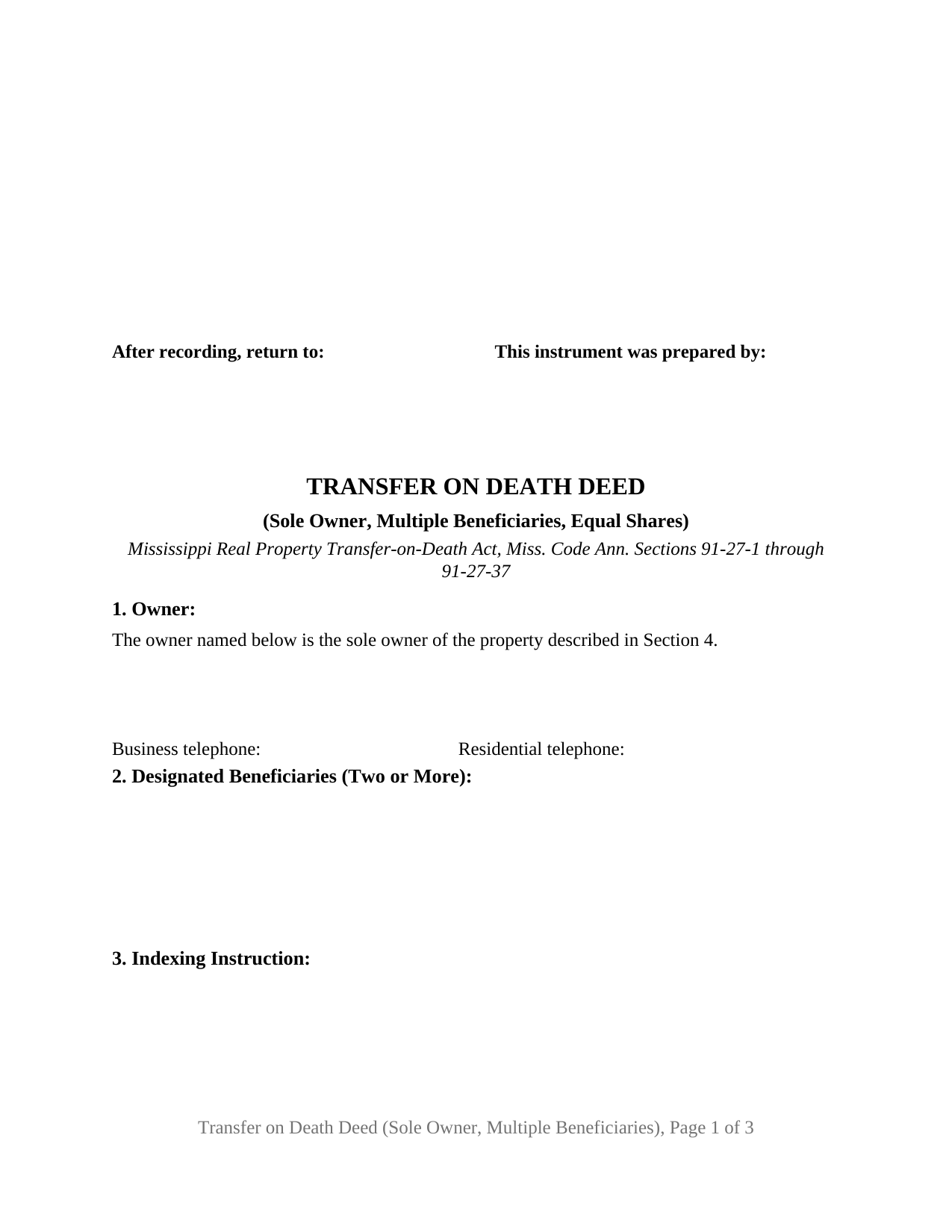
This Mississippi transfer on death deed is made by one owner, the sole owner of the property, and names two or more beneficiaries who take the property in equal and undivided shares when the owner dies. The form fixes those shares on its face under Miss. Code Ann. Section 91-27-27(5), so an owner with several children, or several intended takers of any kind, divides the property evenly in one recorded instrument, outside a will and outside probate.
Equal shares, fixed on the face of the deed
The Mississippi Real Property Transfer-on-Death Act supplies a default for concurrent beneficiaries: Section 91-27-27(5) transfers concurrent interests to the beneficiaries in equal and undivided shares with no right of survivorship among them. This deed does not leave that rule to the statute's silence. Section 7 of the deed states that the designated beneficiaries who survive the owner take in equal and undivided shares, so the chancery clerk, a title examiner, and the beneficiaries themselves read the division on the recorded page. Three beneficiaries each take an undivided one-third; four take undivided quarters. The deed carries no blank for a percentage and no provision for unequal shares, which is what makes the equal division a fixed term of this configuration rather than an entry the owner completes.
When one beneficiary does not survive the owner
The same subsection answers the question an owner naming several beneficiaries asks first. Under Section 91-27-27(4), each designated beneficiary's interest is contingent on surviving the owner, and the interest of a beneficiary who does not survive lapses. Under Section 91-27-27(5), when two or more beneficiaries are designated to take concurrently, the share of one that lapses or fails for any reason is transferred to the other beneficiaries in proportion to their interests in the rest of the property. The deed restates that rule in its operative section: a lapsed share passes to the surviving designated beneficiaries, not to the deceased beneficiary's heirs and not under the owner's will. The form names no alternate beneficiary; where every designated beneficiary fails to survive the owner, the deed transfers nothing and the property passes by will or by intestacy.
One owner, one signature, one certificate
The deed recites one owner, identified in Section 1 as the sole owner of the described property, signing in the owner's own right. It carries one signature block and one acknowledgment certificate in the short form Section 89-3-7(2) prints for an individual, This record was acknowledged before me on (date) by (name). The owner's marital status is not recited; a sole owner who is married or unmarried completes the same form, and the form carries no signature block for a spouse who is not an owner. Section 91-27-23 provides that during the owner's life the deed does not affect homestead rights in the property or the owner's right to transfer or encumber it, and the guide describes that section beside Mississippi's homestead joinder statute, Section 89-1-29. The deed also recites that it is made personally and not through an agent under a power of attorney, the capacity rule Section 91-27-15 attaches to every transfer on death deed.
Recorded before death, in the county where the land lies
Section 91-27-17(3) makes recording before the owner's death, in the official records of the chancery clerk of the county where the property is located, a condition of the deed's effect, and the deed prints that requirement in capital letters at the head of its operative section. Nothing else is needed to complete the deed: Section 91-27-19 provides that it is effective without notice to or acceptance by the beneficiaries and without consideration. The deed stays revocable for the owner's life under Section 91-27-21, by a later transfer on death deed or a recorded instrument of revocation prepared and recorded separately and not included in this package, and a will does not revoke it. A lifetime sale of the property voids the deed as to the interest sold once the sale deed is recorded, under Section 91-27-25.
Three beneficiaries on the first page
Mississippi's recording statute, Section 89-5-24(2), writes the first page of a recorded deed: below the three-inch space reserved for the chancery clerk, the page carries the preparer's name, address, and telephone number, the return address, the title, the name, mailing address, and telephone number of every party to the instrument, and the legal description or the indexing instruction. On a deed naming several beneficiaries the party inventory grows with each name, so this form gives the beneficiary section a six-line block on page one, room for three beneficiaries with the mailing address, business telephone, and residential telephone that Section 27-3-51 requires of each grantee on a recorded Mississippi deed, and sets the indexing instruction Section 89-5-33(3) calls for directly beneath it. The legal description opens page two under the statute's own continuation rule. Under Section 25-7-9 the chancery clerk's fee is $25.00 for the first five pages and $1.00 for each page after that, with a $1.00 archive fee in the counties that have adopted one, and Mississippi collects no transfer tax on a deed.
The configuration this deed recites
This is the sole-owner, multiple-beneficiary, equal-shares configuration of the Mississippi transfer on death deed, also searched as a TOD deed or beneficiary deed. The form recites exactly one owner who is the sole owner of the property, a beneficiary block built for two or more beneficiaries of any class Section 91-27-3(d) permits, an individual, a trust, a company, or a charity, and an operative section that fixes equal and undivided shares, survival as the condition of taking, and the reallocation of a lapsed share to the other beneficiaries. A widowed parent dividing a home evenly among three children, an unmarried owner naming two nieces in equal shares, and a sole owner naming a church and a grandchild to share a parcel equally present the pattern this deed recites. The form is not set up as a deed by two or more owners on one instrument, as a deed by a trustee, a company, or an agent under a power of attorney, as a deed naming a single beneficiary, as a deed dividing the property in unequal shares, or as a deed with an alternate beneficiary who takes if every primary beneficiary fails.
The package includes the fillable Mississippi transfer on death deed, a completed example filled in for a Madison County owner designating three children in equal shares, and the guide that walks through each numbered section, the signing and acknowledgment of the deed, the homestead and marital statutes, and recording with the chancery clerk of the county where the land lies. This description and the guide describe the form and the governing statutes in general terms and are not legal advice.
Important: County-Specific Forms
Our transfer on death deed (sole owner, multiple beneficiaries (equal shares)) forms are specifically formatted for each of the 82 counties in Mississippi.
After selecting your county, you'll receive forms that meet all local recording requirements, ensuring your documents will be accepted without delays or rejection fees.