Mississippi Transfer on Death Deed (Two Tenants in Common, Separate Interests)
County Specific Legal Forms Validated as recently as November 8, 2026 by our Forms Development Team
About the Mississippi Transfer on Death Deed (Two Tenants in Common, Separate Interests)
How to Use This Form
- Select your county from the list
- Download the county-specific form
- Fill in the required information
- Have the document notarized if required
- Record with your county recorder's office
What Others Like You Are Saying
"Thank You. Good Service. Questions were answered."
"well worth the money thank you"
"amazingly fast! Thank you!"
"Process was easy. The instructions for TOD and a sample completed form was very helpful. E-recording…"
"Great service, quick and easy!"
4.8/5 from 4,847 reviews. Read all
Two Mississippi co-owners who hold title as tenants in common own two separate undivided interests, and this transfer on death deed treats them that way: each owner names the beneficiary or beneficiaries of that owner's own interest, and each interest passes at the death of the owner who holds it, whether that owner dies first or second. The fillable form, built for Mississippi real property under the state's 2020 Real Property Transfer-on-Death Act, carries two owner sections, two beneficiary sections, two signature blocks, and two acknowledgment certificates, and it recites the tenancy in common as fixed deed text.
Two interests, two designations, two deaths
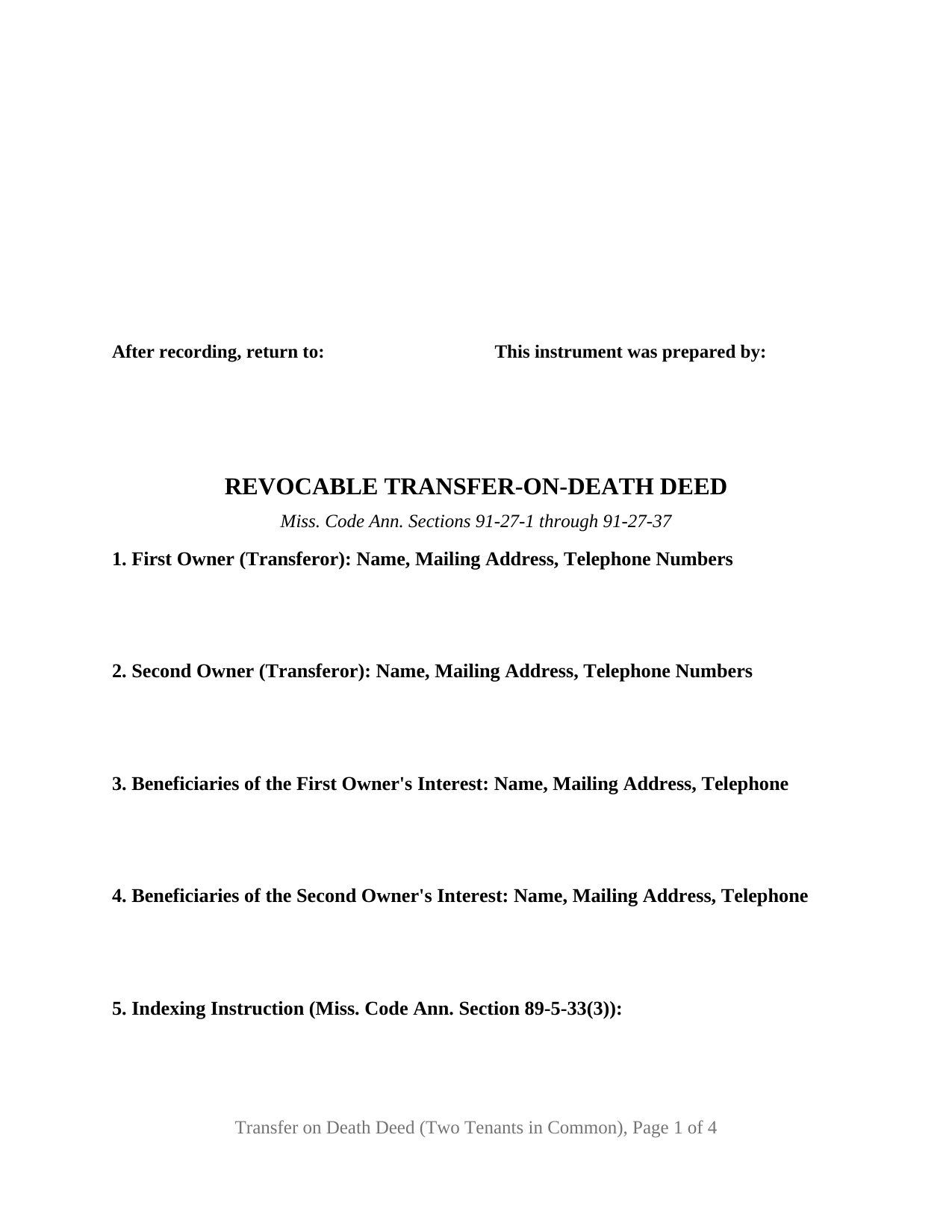
The form's defining feature is the pair of beneficiary sections. Section 3 names who receives the first owner's undivided interest, and Section 4 names who receives the second owner's undivided interest. The operative paragraph then makes each transfer in its own sentence: the first owner's interest transfers at the first owner's death to the Section 3 beneficiaries, and the second owner's interest transfers at the second owner's death to the Section 4 beneficiaries. The two sections may name the same people or different people, and either way each designation waits only for its own owner's death. Nothing on the form postpones one owner's transfer to the other owner's death, because nothing in the statute does: Miss. Code Ann. Section 91-27-3(c) defines a joint owner with right of survivorship to include a joint tenant and a tenant by the entirety and to exclude a tenant in common, so the last-surviving-owner rule of Section 91-27-27(1) never reaches a tenancy in common.
Why a tenancy in common gets its own deed
Mississippi makes tenancy in common the default. Under Miss. Code Ann. Section 89-1-7, a conveyance to two or more persons, including a husband and wife, creates a tenancy in common unless a joint tenancy or a tenancy by the entirety with right of survivorship manifestly appears from the instrument. Two names on a vesting deed with no survivorship words are therefore two separate fractional interests, each of which passes through its owner's estate at death unless a nonprobate instrument says otherwise. A transfer on death deed is that instrument, and Section 91-27-9 authorizes each individual to transfer the individual's own interest to one or more beneficiaries effective at that individual's death. One deed signed by both tenants in common is two such transfers on one recorded page set.
Revocation follows the same lines. Section 91-27-21(d) provides that where a transfer on death deed is made by more than one transferor, revocation by one transferor does not affect the deed as to the interest of another transferor who does not make the revocation. One owner may later record a revocation or a new TOD deed as to that owner's interest while the other owner's designation stays of record. The all-living-joint-owners rule of Section 91-27-21(e) belongs to survivorship co-owners and does not apply here.
Recorded before each owner's death
Section 91-27-17(3) makes the deed effective only if it is recorded before the transferor's death in the official records of the chancery clerk of the county where the property is located. On a deed by two transferors that requirement runs owner by owner, and the form states it that way in capital letters directly above the operative paragraph: the deed is effective as to an owner's interest only if it is recorded before that owner's death. Recording changes nothing during life; Section 91-27-23 keeps each owner free to sell, mortgage, or lease the owner's interest, leaves homestead rights and tax exemptions alone, and gives the beneficiary no interest until the owner dies. A beneficiary who survives takes the owner's undivided interest without covenant or warranty of title and subject to the mortgages, liens, and other interests of record at that death (Sections 91-27-27(3) and 91-27-29).
Laid out for the Mississippi first page
A two-owner, two-designation deed has more parties than most, and Mississippi's recording statute puts every one of them on page one. Miss. Code Ann. Section 89-5-24(2) places the preparer's name, address, and telephone number, the name, mailing address, and telephone number of every grantor and beneficiary, the return address, the title, and the indexing instruction on the first page below the three-inch recording margin. All of that lands on recorded page one: the return and preparer blocks, the title, both owner blocks, both beneficiary blocks, and the Section 89-5-33(3) indexing instruction, with the legal description opening the second page under the statute's own continuation rule. Each owner and beneficiary block holds the business and residential telephone numbers Section 27-3-51 asks of every grantor and grantee, the item a chancery clerk may refuse a deed for lacking. The recording fee is $25.00 for the first five pages under Section 25-7-9, and Mississippi charges no transfer tax.
The configuration this form recites
This is the two tenants in common configuration of the Mississippi transfer on death deed, also searched as a TOD deed or beneficiary deed: two natural-person owners signing in their own right, a fixed recital that they hold as tenants in common, each owning a separate undivided interest, a separate beneficiary section for each owner's interest, role headings FIRST OWNER and SECOND OWNER over two signature blocks, and two acknowledgment certificates in the Section 89-3-7(2) short form so the owners may sign on different days before different notaries. Two unmarried partners who bought a house together and each name a child of their own, a parent and an adult child on one deed who want different takers for their halves, and two spouses whose vesting deed carries no survivorship words and who each designate children of an earlier marriage present the pattern this form recites. Each owner's block carries that owner's marital status as a free-form entry, since the tenancy in common and not the marriage is what the form fixes. The form is not set up as a deed by joint tenants or tenants by the entirety with right of survivorship, as a sole owner's deed, as a deed for three or more owners, as an entity, trustee, or attorney-in-fact instrument, or as a single shared designation with unequal shares, and it carries no alternate beneficiary section; where every beneficiary named for one owner's interest fails to survive that owner, that interest lapses under Section 91-27-27(4) and passes under the owner's will or by intestacy.
The package includes the fillable Mississippi transfer on death deed for two tenants in common, a completed example filled in for two unmarried co-owners of a Madison County home who each designate a child of their own, and a guide that takes each numbered section in turn and then covers the two acknowledgments, the marital and homestead statutes that bear on signing, and recording at the chancery clerk's office. The description here and the guide describe the form and the Mississippi statutes that govern it in general terms, and neither is legal advice.
Important: County-Specific Forms
Our transfer on death deed (two tenants in common, separate interests) forms are specifically formatted for each of the 82 counties in Mississippi.
After selecting your county, you'll receive forms that meet all local recording requirements, ensuring your documents will be accepted without delays or rejection fees.