Mississippi Transfer on Death Deed (Sole Owner, Primary and Alternate Beneficiary)
County Specific Legal Forms Validated as recently as November 8, 2026 by our Forms Development Team
About the Mississippi Transfer on Death Deed (Sole Owner, Primary and Alternate Beneficiary)
How to Use This Form
- Select your county from the list
- Download the county-specific form
- Fill in the required information
- Have the document notarized if required
- Record with your county recorder's office
What Others Like You Are Saying
"I purchased a Deed on Death for Washington State. Very user friendly site. Thank you 5star"
"The recording service has been very easy to use. It is efficient and no hassle."
"very happy so far. Haven't gone to record deeds yet so am in good hopes everything will be in good o…"
"No problem with Recorders Office using your document. It is now completed and recorded."
"Easy to use and comprehensive in content. Would recommend to anyone that is looking for a cheaper al…"
4.8/5 from 4,847 reviews. Read all
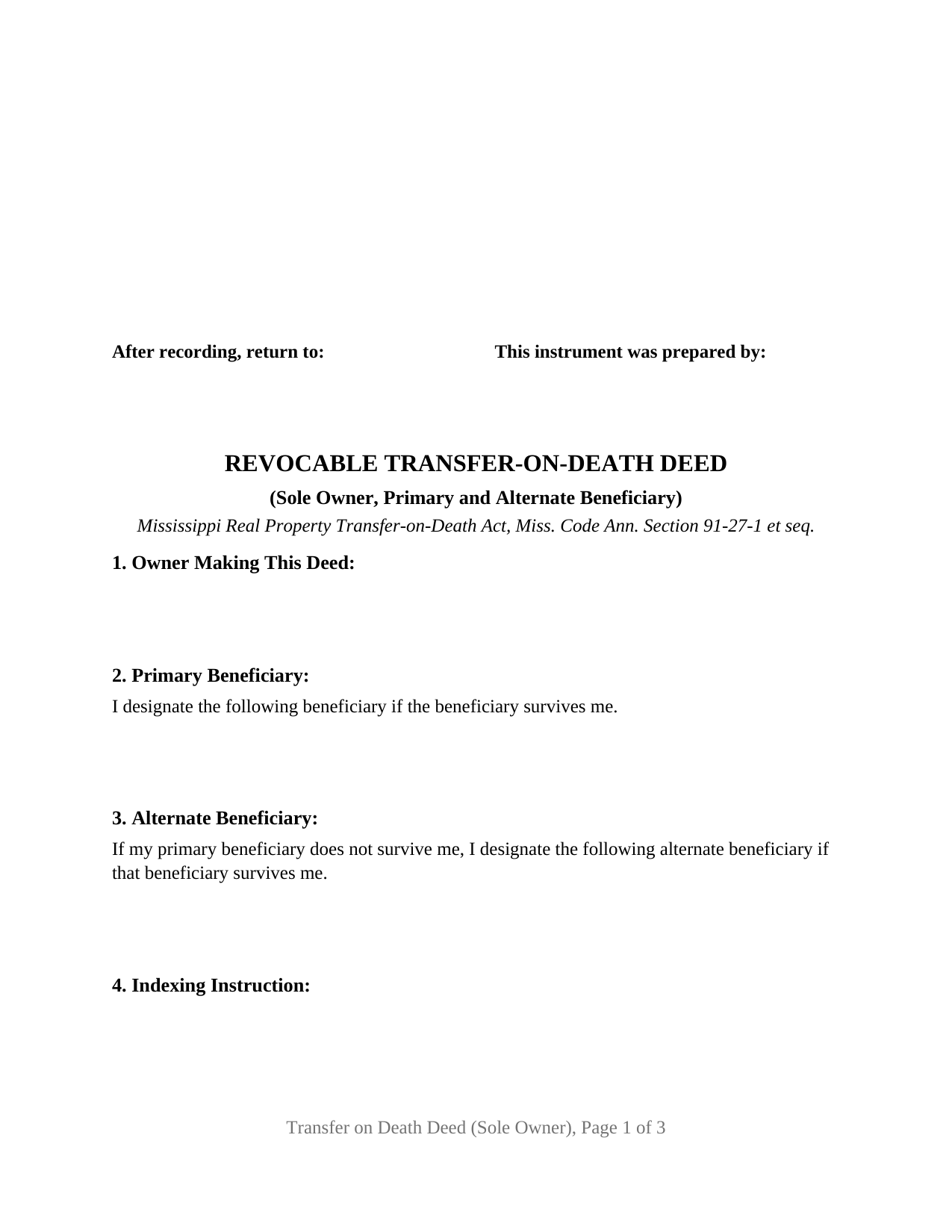
A Mississippi transfer on death deed with an alternate beneficiary answers the question an ordinary beneficiary designation leaves open: who takes the property if the person named first dies before the owner. This fillable form prepares that deed for one owner who holds Mississippi real property alone, designating one primary beneficiary and one alternate beneficiary, in the two-tier pattern printed in the optional statutory form at Miss. Code Ann. Section 91-27-33.
A second name, in case the first does not survive
Under Section 91-27-27(4) of the Mississippi Real Property Transfer-on-Death Act, the interest of a designated beneficiary is contingent on that beneficiary surviving the owner, and the interest of a beneficiary who does not survive lapses. A deed naming only one person therefore transfers nothing if that person dies first, and the property passes through the owner's estate as though the deed had never been recorded. The alternate beneficiary is the chapter's answer. The statutory form prints two sentences, one for each tier, and this deed carries both in the statute's own words: I designate the following beneficiary if the beneficiary survives me, and, under its own heading, If my primary beneficiary does not survive me, I designate the following alternate beneficiary if that beneficiary survives me. The alternate takes nothing while the primary beneficiary is living and takes everything the deed covers once the primary beneficiary has died first. Where neither survives the owner, both designations lapse and the deed transfers nothing.
Because each tier is written for one person, the form sets out one block for the primary beneficiary and one for the alternate, each with room for a name, a relationship label such as my daughter or my grandson, a mailing address, and the telephone numbers Mississippi puts on a recorded deed. The chapter's definition of a person who may be designated reaches an individual, a trust, a corporation, a limited liability company, and the other entities listed in Section 91-27-3(d), so either tier may name a trust by its name and trustee or an organization by its legal name.
One owner, one signature, one certificate
The deed recites that the person signing is the sole owner of the described property: one natural person holding the whole interest, with no co-owner of any kind. Section 91-27-9 lets an individual transfer the individual's own interest, and on this configuration that interest is the entire title, so the operative sentence of the statutory form, At my death, I transfer my interest in the described property to the beneficiaries as designated above, reaches the whole parcel. The form carries one signature block, labeled OWNER, and one acknowledgment certificate in the short form of Section 89-3-7(2), the certificate every acknowledged Mississippi deed uses; Section 91-27-11 provides that the deed is executed as an acknowledged deed and not with the formalities of a will, and no witness signs. The owner's marital status is not fixed by the form. The owner line takes the status recital the owner's deed of record uses, and the guide describes how the homestead joinder statute, Section 89-1-29, and the chapter's lifetime-effect section, Section 91-27-23, bear on a married owner's homestead. The owner signs personally; Section 91-27-15 permits creation through a power of attorney only where the power specifically authorizes a transfer on death deed, and this form is not set up for an agent's signature.
Revocable until death, and revoked by divorce as to a spouse
The deed is revocable for the owner's whole life. Section 91-27-21 provides that a later transfer on death deed or a recorded instrument of revocation, acknowledged after this deed and recorded in the same county before the owner's death, revokes it; a will does not, and the optional revocation form the chapter prints at Section 91-27-35 is prepared and recorded separately and is not included in this package. One rule in that section speaks directly to a two-tier designation: where the owner's marriage to a designated beneficiary ends by a final judgment of divorce after the deed is recorded, the judgment revokes the deed as to that beneficiary, so a deed naming a spouse as primary beneficiary and a child as alternate operates, after such a judgment, as a designation of the child.
Laid out for the chancery clerk's first page
Mississippi's recording statute, Section 89-5-24(2), names what the first page of a recorded instrument carries below the three inch band reserved for the clerk, and a beneficiary deed with two designated persons has more of it than most deeds: the return address, the preparer, the owner, the primary beneficiary, the alternate beneficiary, the title, and the indexing instruction Section 89-5-33(3) requires for the sectional index. This form holds all of it on recorded page one at twelve point type by giving the owner and each beneficiary a three-line block, one line each for the name, the mailing address, and the two telephone numbers Section 27-3-51 asks of every grantor and grantee, and by opening the legal description on page two under the statute's own continuation rule. Under Section 91-27-17(3) the deed takes effect only if the chancery clerk of the county where the property lies has recorded it in the official records before the owner dies, and the form prints that requirement in bold directly above the operative sentence. The recording fee under Section 25-7-9 is twenty-five dollars for the first five pages, and no transfer tax applies.
The configuration this form recites
This is the sole-owner, primary-and-alternate configuration of the Mississippi transfer on death deed, also searched as a TOD deed or beneficiary deed: one owner block, two beneficiary blocks under the statutory form's two designation sentences, a sole-ownership statement inside the operative paragraph, one OWNER signature block, and one acknowledgment certificate. A widowed parent naming an adult child with a grandchild as alternate, an owner naming a partner with a sibling as alternate, and an owner naming a church with a niece as alternate present the two-tier pattern this deed recites. The form is not set up as a deed by two owners, as a deed by a trustee, personal representative, or attorney-in-fact, as a designation of two or more concurrent primary beneficiaries, or as a designation with more than one alternate; each of those follows a different pattern. It states no shares, carries no special provisions, and leaves the chapter's survival and lapse rules to operate as written.
The package includes the fillable Mississippi transfer on death deed, a completed example filled in for a sole owner in Lafayette County designating a daughter with a grandson as alternate, and the guide, which explains each numbered section, the acknowledgment certificate, the homestead and marital rules, and the chancery clerk's recording requirements. The description and the guide describe the form and the governing statutes in general terms and are not legal advice.
Important: County-Specific Forms
Our transfer on death deed (sole owner, primary and alternate beneficiary) forms are specifically formatted for each of the 82 counties in Mississippi.
After selecting your county, you'll receive forms that meet all local recording requirements, ensuring your documents will be accepted without delays or rejection fees.