Mississippi Transfer on Death Deed (Tenant in Common, Undivided Ownership Interest)
County Specific Legal Forms Validated as recently as November 8, 2026 by our Forms Development Team
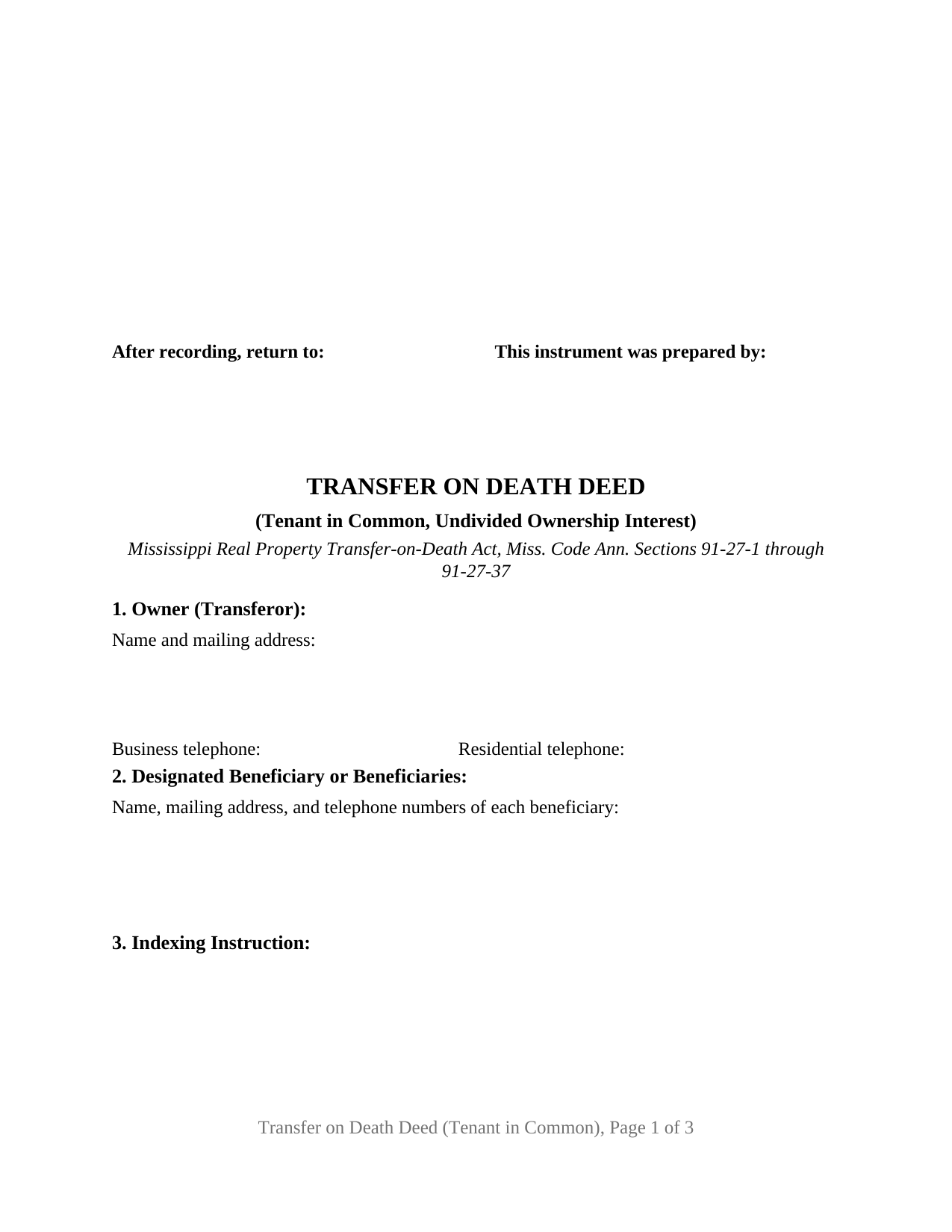
About the Mississippi Transfer on Death Deed (Tenant in Common, Undivided Ownership Interest)
How to Use This Form
- Select your county from the list
- Download the county-specific form
- Fill in the required information
- Have the document notarized if required
- Record with your county recorder's office
What Others Like You Are Saying
"Good after I figured out the form process. Hopefully I won't be charged for two as I redid the reque…"
"loads of forms and instructions....for a good buy...it would help to know where to send the forms af…"
"Very easy to use."
"I got what I needed and you provided great templates."
"Your site is simple, easy to use, and an outstanding service."
4.8/5 from 4,850 reviews. Read all
A tenant in common owns a share of Mississippi real estate, not the whole of it, and a transfer on death deed signed by that owner reaches exactly that share. This fillable Mississippi transfer on death deed is built for one owner who holds an undivided interest as a tenant in common and wants that interest, and nothing belonging to any co-owner, to pass to named beneficiaries at death without probate.
An undivided interest with no survivorship behind it
Miss. Code Ann. Section 89-1-7 makes tenancy in common the default whenever a Mississippi deed or will passes property to two or more people, married or not, without words that manifestly create a joint tenancy or a tenancy by the entirety with right of survivorship. Heirs who received a parcel together, co-owners who bought in under a plain deed, and partners who hold under a deed that says nothing about survivorship are, in most cases, tenants in common. Each holds an undivided fractional interest, and when one of them dies that fraction does not go to the other co-owners. It passes through the deceased owner's estate, by will or by intestacy, unless a recorded nonprobate instrument sends it somewhere else first. The Mississippi Real Property Transfer-on-Death Act, Sections 91-27-1 through 91-27-37, supplies that instrument. Under Section 91-27-9 an individual may transfer the individual's interest in real property to one or more beneficiaries effective at the transferor's death, and an undivided interest as a tenant in common is an interest that section reaches.
The deed operates at this owner's death, not the last co-owner's
The chapter draws a line that matters here. Section 91-27-3(c) defines a joint owner with right of survivorship as an individual who owns concurrently with others with a right of survivorship, a term that includes a joint tenant and a tenant by the entirety and expressly does not include a tenant in common. Section 91-27-27(1), the rule that makes a joint owner's deed wait until the last surviving joint owner has died, therefore never applies to a tenant in common. A transfer on death deed made by a tenant in common takes effect at that owner's own death, whether or not any co-owner is still living, and the joint owner revocation rule of Section 91-27-21(e), which requires every living joint owner to join in a revocation, does not apply either: the owner who made this deed revokes it alone, by a later recorded deed or a recorded instrument of revocation acknowledged after the deed it revokes. The co-owner never signs this deed and designates nothing by it. Under Section 91-27-23 the recorded deed does not affect an interest or right of the transferor or any other owner during the transferor's life, so possession, partition, and the right to sell or mortgage continue for everyone exactly as before.
What the fixed recital says
Section 7 of this deed carries, as fixed text, the recital that the owner named in Section 1 holds an undivided interest in the described property as a tenant in common with one or more other persons, followed by the statutory form's own operative sentence from Section 91-27-33, and then the sentence that limits the transfer to the owner's undivided interest and no interest of any other co-owner. The limiting sentence is the point of this configuration: a beneficiary, a title examiner, and the chancery clerk read on the face of the recorded deed that the instrument never purported to pass the whole parcel. The deed also states that a designated beneficiary takes only by surviving the owner, the condition Section 91-27-27(4) attaches, and where two or more beneficiaries are named they take the undivided interest in equal shares under Section 91-27-27(5), with a lapsed share passing to the others. Those beneficiaries then hold the owner's former fraction among themselves as tenants in common with the parcel's other co-owners, who are unaffected.
Recorded before death, with the clerk's first page in mind
Section 91-27-17(3) makes recording before the owner's death, in the official records of the chancery clerk of the county where the property lies, a condition of the deed having any effect, and the form prints that condition in capital letters directly above the operative paragraph. Mississippi's recording statute, Section 89-5-24(2), then dictates what the clerk expects on page one below the three inch recording margin: the preparer, the return address, the title, the name, mailing address, and telephone numbers of the owner and of each beneficiary, and the indexing instruction. This deed places all of it on the first page, with the legal description of the whole parcel opening page two under the statute's continuation rule, and the owner block carries the business and residential telephone entries Section 27-3-51 requires of every grantor. The recording fee is $25.00 for the first five pages under Section 25-7-9, and the deed is three pages.
The configuration this form recites
The form recites exactly one owner, a natural person holding an undivided interest as a tenant in common, who signs alone; it carries one OWNER signature block and one acknowledgment certificate in the Section 89-3-7(2) short form, a two line owner block with its telephone entries, a four line beneficiary block for one or more designated beneficiaries of any class Section 91-27-3(d) allows, and the fixed tenancy in common recital described above. An heir who holds an inherited fractional interest alongside other heirs and designates that interest to the heir's own children, a co-owner who bought into a parcel with a relative or a business associate under a deed naming no survivorship, and unmarried partners holding as tenants in common who each sign a separate deed for their own shares present the pattern this deed recites. The form is not set up as a deed signed by two co-owners on one instrument, as a deed for co-owners who hold with a right of survivorship, as an entity or trustee owner's deed, or as a deed signed through a power of attorney, and it carries no alternate beneficiary block and no spouse signature line. A married owner whose undivided interest forms part of the family homestead has a Section 89-1-29 question the guide describes rather than answers.
Three pieces make up the package: the fillable deed for a Mississippi tenant in common, a completed example prepared for an unmarried owner of an undivided one half interest in a platted Lafayette County lot who names two beneficiaries, and the guide, which takes each numbered section in turn and then covers the acknowledgment, the co-ownership and homestead rules, and the chancery clerk's recording requirements. Neither this description nor the guide applies the law to a particular owner or parcel, and neither is legal advice.
Important: County-Specific Forms
Our transfer on death deed (tenant in common, undivided ownership interest) forms are specifically formatted for each of the 82 counties in Mississippi.
After selecting your county, you'll receive forms that meet all local recording requirements, ensuring your documents will be accepted without delays or rejection fees.