New York Quitclaim Deed (Divorce)
County Specific Legal Forms Validated as recently as October 8, 2026 by our Forms Development Team
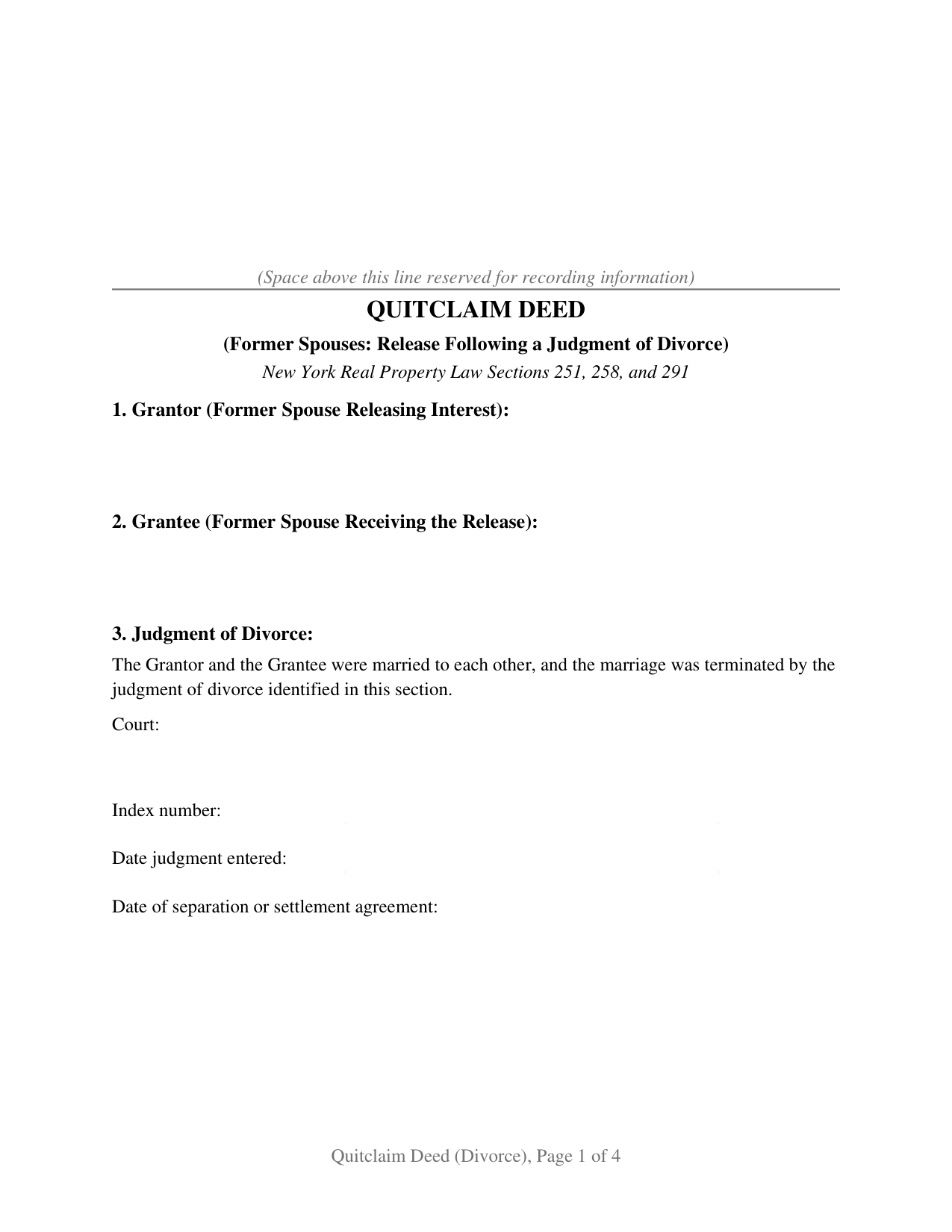
About the New York Quitclaim Deed (Divorce)
How to Use This Form
- Select your county from the list
- Download the county-specific form
- Fill in the required information
- Have the document notarized if required
- Record with your county recorder's office
What Others Like You Are Saying
"KVH really went above and beyond to help me try to find what I needed."
"I was so happy I found a way to register my deed electronically! The county I live in only does e-fi…"
"So far so good. Prompt and responsive. Thank you."
"Appreciate your diligent assistance."
"Easy to use website. customer service messages you back super quickly. They also double check your w…"
4.8/5 from 4,818 reviews. Read all
A judgment of divorce reaches New York real property before any deed does. When the marriage ends, a tenancy by the entirety is severed and the two former spouses hold as tenants in common, and this New York quitclaim deed, often typed as a quit claim deed, is the instrument that moves one of those undivided shares into the other party's name. The form recites one individual Grantor, a former spouse signing personally, and one Grantee, the other former spouse.
What the divorce already did to the title
Estates, Powers and Trusts Law Section 6-2.2(b) gives a married couple a tenancy by the entirety by default, and the Court of Appeals held in Stelz v. Shreck that an absolute divorce ends the unity of person as completely as death, severing that estate into proportionate shares held in common without survivorship. Kahn v. Kahn restates it: the parties become tenants in common. Section 5-1.4 of the same law severs a survivorship joint tenancy between divorced individuals. What the Grantor releases here is an ordinary undivided share, not an interest hedged by survivorship.
A numbered section that looks back at the courthouse
Section 3 is the section an ordinary release has no use for. It recites the terminated marriage, then takes the court, the index number, the date the judgment was entered, and the date of any settlement agreement the judgment incorporates. The judgment travels a separate road: Domestic Relations Law Section 234 lets the matrimonial court determine any question of title between the parties and directs that a certified copy be recorded where the land lies, and Real Property Law Section 297-b records that copy in the same manner as a conveyance. The certified copy comes from the court clerk, separately from this deed.
The former spouse configuration
The form recites exactly one Grantor and one Grantee, each named as the former spouse of the other, with one signature block and one acknowledgment certificate in the substance of the Real Property Law Section 309-a uniform form. Conveyances presenting this configuration appear in the record where two former spouses hold as tenants in common and one releases that undivided share, where a stipulation incorporated in a judgment provides for the marital residence to pass into one name, and where a release is recorded long after the judgment because the land records still carry both names. The form is not arranged for a couple still married, for two record owners conveying together, for an agent's signature, or for a fiduciary capacity.
A release that names the marital claim and promises nothing
Nothing about the title is promised here. The conveyance rides on the Section 258 verbs remise, release and quitclaim, and Real Property Law Section 251 keeps a New York deed clear of any covenant it does not spell out. Section 9 reaches past the Grantor's record share, releasing any right, title, interest, claim, or demand that arises by reason of the former marriage, the question a title examiner opens this deed to answer. The Lien Law Section 13 trust fund covenant is printed alongside it, as customary New York deed forms carry it.
The line item on the state's own return
New York's transfer tax return names this transaction outright: Schedule A of Form TP-584 lists the conditions of conveyance, and item r is a conveyance pursuant to divorce or separation. Naming it is not exempting it. Tax Law Section 1404 presumes every conveyance taxable and puts the burden of proving otherwise on the person liable, Section 1401(d) counts an encumbrance as consideration whether or not the debt is assumed, and no paragraph of the Section 1405(b) exemption list mentions divorce. Inside the five boroughs, City rules treat a transfer between spouses under a divorce decree as subject to the Real Property Transfer Tax and presume the consideration, marital rights included, to equal fair market value. The RP-5217 report rides along on legal size paper, and the deed goes to the county clerk where the land lies, or through ACRIS in four boroughs.
The download holds three items: the blank divorce quitclaim deed as a fillable PDF, a completed example prepared for an Orange County release following a Supreme Court judgment, and a plain language guide covering all eleven numbered sections, the certificate, and the returns filed alongside it. The materials are informational and are not legal advice. What a particular judgment directs, and what one former spouse's release reaches on a given title, are questions for a New York attorney.
Important: County-Specific Forms
Our quitclaim deed (divorce) forms are specifically formatted for each of the 62 counties in New York.
After selecting your county, you'll receive forms that meet all local recording requirements, ensuring your documents will be accepted without delays or rejection fees.