New York Quitclaim Deed (Reserving Life Estate)
County Specific Legal Forms Validated as recently as September 11, 2026 by our Forms Development Team
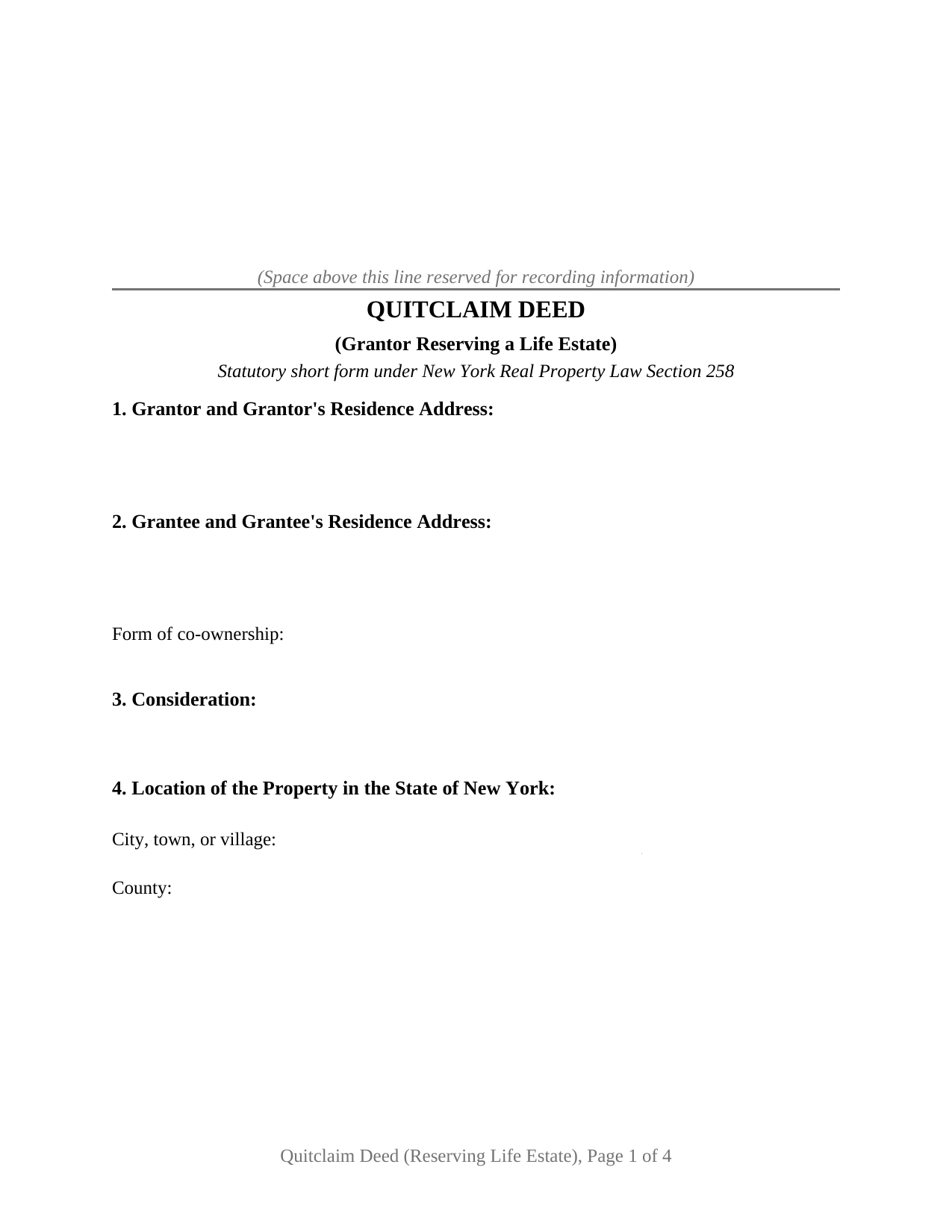
About the New York Quitclaim Deed (Reserving Life Estate)
How to Use This Form
- Select your county from the list
- Download the county-specific form
- Fill in the required information
- Have the document notarized if required
- Record with your county recorder's office
What Others Like You Are Saying
"Obtaining a quick claim deed from this website was easy and friendly I must say. Thank you so much."
"This was a good experience. I easily found the document I needed and easily downloaded it and its co…"
"I was overwhelmed with information about what forms I needed to complete the probate process, and th…"
"My client needed to provide a statutory Oklahoma Memorandum of Trust. I was able to provide her with…"
"Very prompt response to my questions."
4.8/5 from 4,818 reviews. Read all
One signature, two estates. On this New York quitclaim deed the owner releases the property to a named grantee and, in the same operative sentence, keeps a life estate: the right to occupy the property, rent it, and take what it produces, for life. What the grantee receives is a remainder, owned from the day the deed is delivered and possessory only when the life estate ends. This form prepares that instrument, also typed as a quit claim deed, for New York real property.
A reservation that runs to the person signing
New York is strict about whom a reservation can benefit. The Court of Appeals held in Matter of Estate of Thomson v. Wade that a deed reserving or excepting an interest in favor of a third party, a stranger to the deed, creates no valid interest in that party, and the Appellate Division carried the rule into a life estate in Sganga v. Grund, where a deed reserving life use in the grantor and in another man left that man with nothing. The reservation printed in Section 10 runs to the grantor alone, the person executing the deed.
What the remainder is before anyone dies
Estates, Powers and Trusts Law Section 6-4.3 defines a remainder as a future estate created in favor of someone other than its creator, and Section 6-5.1 settles the practical question: future estates are descendible, devisable and alienable, in the same manner as estates in possession. The grantee holds present property rather than an expectancy, which is why a later deed signed by the life tenant alone reaches the life estate and nothing beyond it. Duties run between the two estates by statute as well: an action for waste lies against a tenant for life under Real Property Actions and Proceedings Law Section 801, and Section 831 lets a person seized of an estate in remainder sue for an injury done to the inheritance.
The reserved life estate configuration
The form recites exactly one grantor, an individual signing personally and reserving the life estate, with one signature block and one certificate in the substance of the Real Property Law Section 309-a uniform form. Section 2 holds the grantee or grantees taking the remainder, with a co-ownership blank for the form in which two or more of them hold it; no one on the receiving side signs, since a New York deed is executed by the grantor. Conveyances presenting this configuration appear in the record where a sole owner passes a house to adult children and keeps the right to live there, and where a parent moves a family parcel to one child while retaining the rents. A release of the whole interest, an execution by two record owners, and a signer acting in an entity or fiduciary capacity each recite a different first section.
Nothing promised, two clauses printed
The words of conveyance are the Section 258 statutory short form words, and Section 251 leaves them unaccompanied, so the instrument vouches for nothing about the title it passes. Printed beside them are the Lien Law Section 13 trust fund covenant and a listing of recorded matters carrying a line that it creates no covenant.
Assessment roll, tax return, county clerk
Splitting one ownership into two estates has consequences that surface quickly. Real Property Tax Law Section 425 treats the owner of a present interest under a life estate who has been granted the STAR exemption as the owner of the parcel for that section and for Section 502, with duplicate tax statements going to the remainderman on request, so the roll keeps naming the life tenant. On the return side, the Department of Taxation and Finance instructs that Schedule D of the TP-584 is not completed where the interest transferred is anything other than a fee simple interest, and a remainder is not one. The deed itself goes to the clerk of the county where the land lies, or through ACRIS in four boroughs, with the RP-5217 transfer report on legal paper.
The download holds three items: the blank deed as a fillable PDF, a completed example prepared for a Schenectady County conveyance in which a mother keeps a life estate and two children take the remainder as tenants in common, and a plain language guide covering the twelve numbered sections, the certificate, and the companion filings. These materials are informational and are not legal advice. What a reserved life estate does to a particular title is a question for a New York attorney.
Important: County-Specific Forms
Our quitclaim deed (reserving life estate) forms are specifically formatted for each of the 62 counties in New York.
After selecting your county, you'll receive forms that meet all local recording requirements, ensuring your documents will be accepted without delays or rejection fees.